
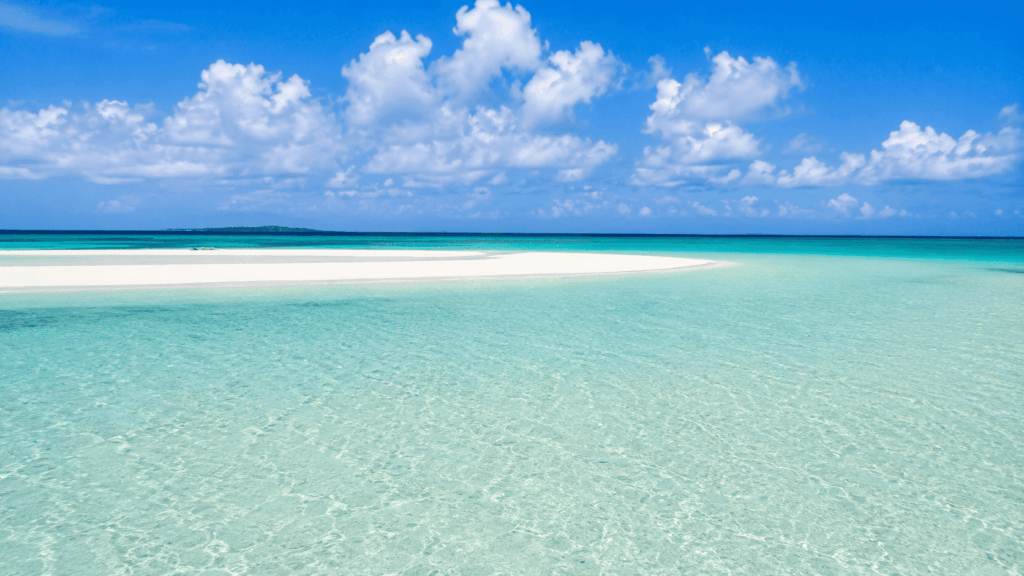
Taketomi Island sits just 10–15 minutes by high-speed ferry from Ishigaki, but it feels a world away: no traffic lights, no tall buildings, and streets of white coral sand lined with red-tiled roofs and shisa guardians. For most first-time visitors, the question isn’t whether to go — it’s how to fit the island’s highlights into one day without missing the ferry home.
Here’s the short version: on a first visit, plan around the water buffalo cart ride, a cycle or walk through the traditional village to Nishi Pier, and a tide-aware stop at Kondoi Beach. You can do the highlights in about three hours, but give yourself four to six hours if you want to include the beach, a slow lunch, and photos. What matters most is not the number of stops — it’s locking down your ferry, your buffalo cart, and your island transport before you leave Ishigaki.
If you want Taketomi to be part of a fuller Yaeyama day rather than a standalone half-day, one option pairs a guided Phantom Island snorkeling trip with round-trip ferry tickets to Taketomi. Check live availability, start times, and recent traveler reviews for the Phantom Island snorkeling + Taketomi sightseeing tour before deciding how much of the day you want to commit.
What to Do on Taketomi Island: My Recommended First-Time Route
In my experience guiding first-time visitors around the Yaeyama Islands, the people who enjoy Taketomi most treat it as one relaxed loop rather than a checklist. They also make the key decisions — ferry time, buffalo cart, and whether they have a bicycle — before stepping onto the boat. Show up without a plan and the island still works, but you’ll spend a surprising amount of your day waiting and walking.
| What to Do | Where to Look | Why It’s Worth It | Time Needed | Best For |
|---|---|---|---|---|
| Water buffalo cart ride | Taketomi Tourist Center (free shuttle from Taketomi Port) | The island’s signature experience — a slow, musical tour of the traditional village streets | About 25–30 minutes, plus possible waiting at busy times | First-timers, families, anyone who wants the village explained without walking in the heat |
| Village walk or cycle | Between Taketomi Port and the village center | Red-tiled roofs, coral stone walls, and white sand lanes in a national preservation district | 1–1.5 hours | Photographers, slow travelers |
| Nishi Pier | West side, about 10 minutes on foot from the village | An old wooden pier over turquoise water — one of Okinawa’s classic sunset spots | 30–45 minutes | Sunset watchers, photographers |
| Kondoi Beach | West side, about 15 minutes by bicycle from the port | The island’s main swimming beach, with a sandbar that appears at low tide | 1–2 hours | Swimmers (at your own risk — no lifeguards), families, low-tide sandbar walkers |
| Kaiji Beach | Next to Kondoi Beach | “Star sand” beach with striking views — but currents make swimming inadvisable | 30–60 minutes | Photo stops, star-sand seekers, not for swimming |
Start with a Water Buffalo Cart Ride
The water buffalo cart is Taketomi’s signature experience, and I’d put it first on any first-time itinerary. The carts leave from the Taketomi Tourist Center, which runs a free shuttle from the port for cart passengers — no reservation needed for the shuttle itself. The ride lasts roughly 25–30 minutes and winds through the village lanes while a local guide plays the sanshin (a three-stringed Okinawan instrument) and points out the island’s history. It’s unhurried by design; the buffalo sets the pace, and that’s rather the point.
Set your expectations on language: the commentary is in Japanese, as is the case with the standard tour packages sold by Yaeyama Kanko Ferry. You won’t follow every story, but the atmosphere — the music, the shade under the canopy, the pace of the village — carries the experience. If you want every detail explained in English, book a guided day tour from Ishigaki rather than the walk-up option.
Fares are around ¥3,300 for adults in the regular season and ¥3,900 during the busy months of March, July, and August (children and infants are cheaper). The center is cashless-only — credit cards and IC cards are accepted, cash is not. Walk-up rides are usually possible, but tour-company reservations get priority, and on busy days the 10:00–14:00 window can mean a long wait. Booking your cart together with the ferry removes most of that uncertainty, which is why most first-timers are better off doing exactly that.
Cycle Through the Traditional Village and Stop at Nishi Pier
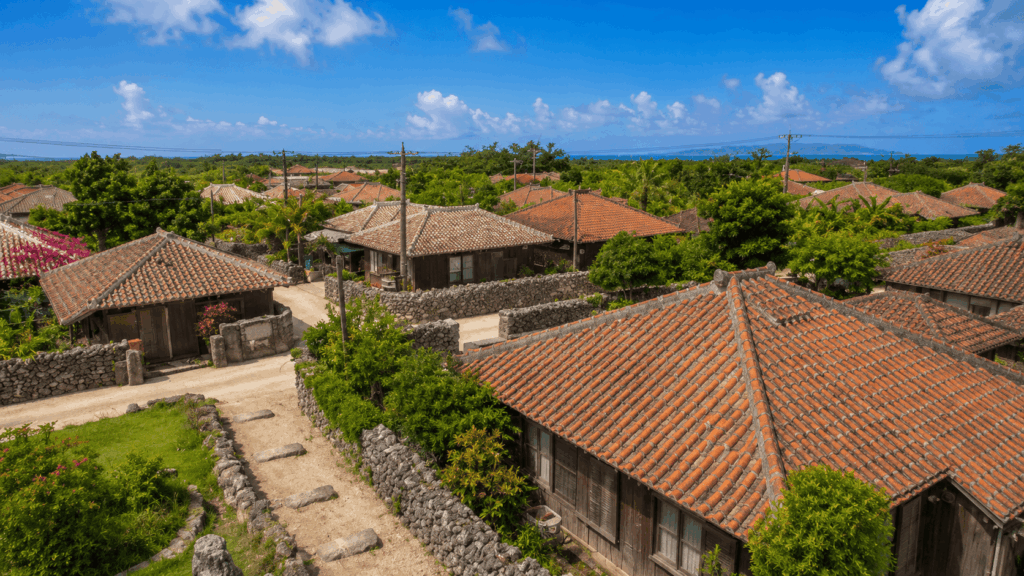
After the cart, the village deserves time on your own feet — or wheels. The settlement was designated a national Important Preservation District for Groups of Traditional Buildings in 1987, and it looks the part: red-tiled roofs, coral stone walls, white sand lanes, and shisa guardians watching from the rooflines. A bicycle is the most comfortable way to cover it, and the flat terrain makes it easy going. The island’s old lookout tower, Nagomi-no-To, stands at the center of the village — it’s currently closed for climbing, but the lanes around it are the most atmospheric part of the walk.
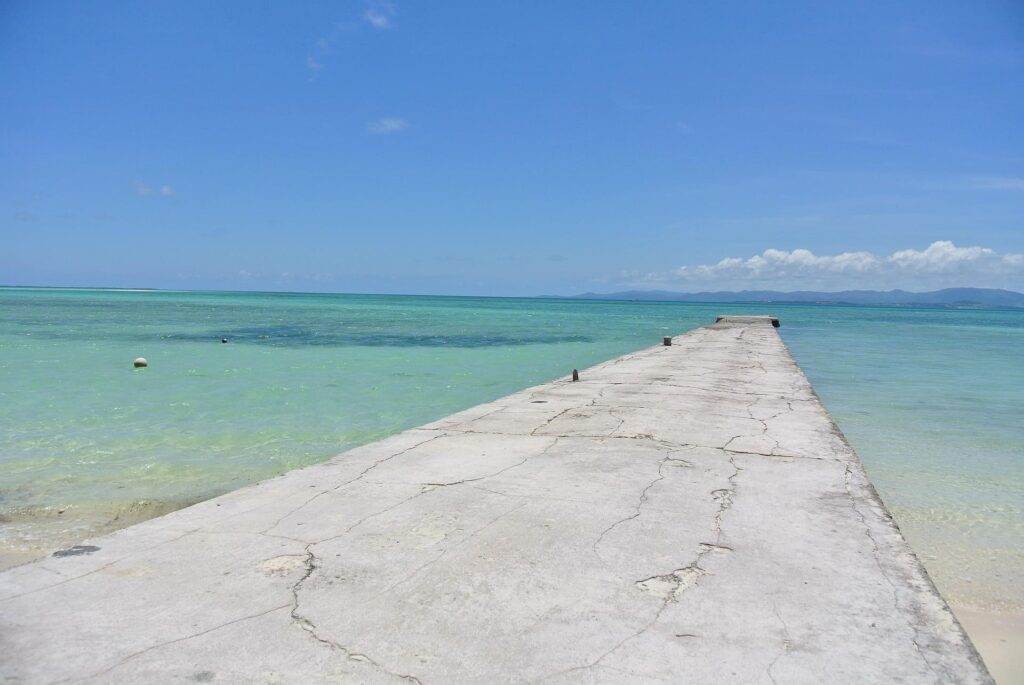
From the village, it’s a short ride to Nishi Pier (Nishi Sanbashi), a long wooden pier built in the early 1900s and now a registered cultural property. It juts out into impossibly clear water and is famous as a sunset viewpoint (see our Ishigaki sunset guide for other spots and timing tips). One practical note: the tip of the pier is off-limits — the local government closed it after a series of slip-and-fall accidents on the algae-slicked planks. You can still walk most of the way out and photograph the end from the side; just don’t climb over the barrier.
What catches people out here is the heat, not the distance. The village lanes have almost no shade, and in summer the combination of white sand, red tiles, and midday sun is intense. Treat the village like a beach: hat, water bottle, and sunscreen, and don’t plan the long walk between 11:00 and 14:00 if you can help it.
Make Kondoi Beach Your Main Beach Stop
Kondoi Beach is Taketomi’s main swimming beach and, for me, the most rewarding stop if you time it right. The water is shallow and clear, the sand is fine and white, and at low tide a sandbar emerges offshore that you can wade out to — one of those experiences that photographs well but feels even better in person. There are showers, changing rooms, and toilets at the beach, which makes it easy to slot into a day trip.
Two things to know before you go. First, there are no lifeguards — swimming is at your own risk, and the local government asks you not to swim alone. Second, the beach changes dramatically with the tide, so check the day’s tide table before you build your schedule around it. More on that in the tide section below.
Add Kaiji Beach Only If You Have Time
Kaiji Beach, right next to Kondoi, is the famous “star sand” beach — look closely at the sand and you’ll see tiny star-shaped foraminifera shells. It’s a beautiful photo stop, but the currents are strong and swimming is not advised here. Also note that taking star sand home is prohibited. If you’re on a tight schedule, Kondoi gives you more; treat Kaiji as a bonus five-minute detour on the way back.
Taketomi Island Map: The Stops That Matter
Taketomi is small — about 9.2 km around — and nearly everything you’ll visit sits on the western half of the island. Think of it as a simple line, not a web:
- Taketomi Port (east side) — where the ferry drops you and where the Tourist Center shuttle picks you up.
- Traditional village and Taketomi Tourist Center — about 15 minutes on foot from the port (1.2 km), or a short shuttle ride.
- Nishi Pier — about 10 minutes on foot from the village (700 m), on the west coast.
- Kondoi Beach — about 20 minutes on foot from the Tourist Center (1.3 km), or 15 minutes by bicycle from the port.
- Kaiji Beach — immediately next to Kondoi, another few minutes along the coast.
There are no traffic lights on the island and almost no cars — the only real choices are walking, cycling, the infrequent route bus, or a taxi. That layout is exactly why the bicycle question matters, which I’ll get to in the getting-around section below.
How to Get to Taketomi Island from Ishigaki
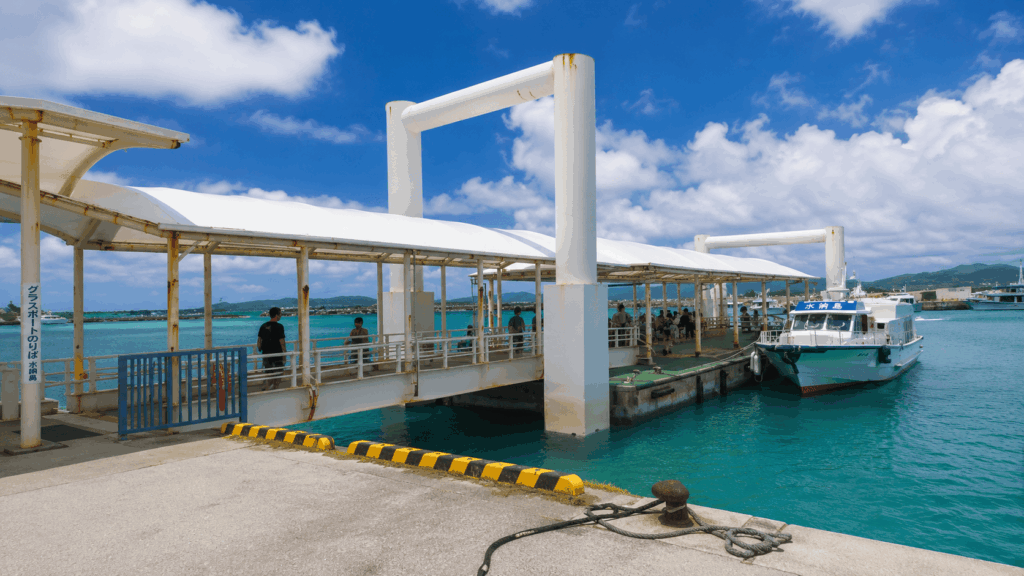
Ferries to Taketomi leave from the Euglena Ishigaki Port Remote Island Terminal (the “remote island terminal” on the east side of Ishigaki Port). Two companies run the route: Yaeyama Kanko Ferry and Anei Kanko. Both take roughly 10–15 minutes and land at Taketomi Port, a short walk from the village.
Fares were around ¥970 one-way and ¥1,880 round-trip for adults as of August 2026, with children roughly half price — but fares and schedules do change, so confirm the current price and the day’s timetable on the operator’s site before you travel. Seats are non-reserved on the regular ferries; just buy a ticket at the terminal and board. In typhoon season or rough weather, check the day’s sailing status the night before and again in the morning — cancellations happen, and they ripple through every plan you’ve made on the island.
One practical tip: the terminal has coin lockers, and there are also lockers at Taketomi Port’s waiting area (Karyushikan). If you’re carrying a big bag, store it rather than dragging it onto the island — the buffalo carts don’t take luggage on board.
How to Get Around Taketomi Island: Bike, Bus, Walk, or Taxi?
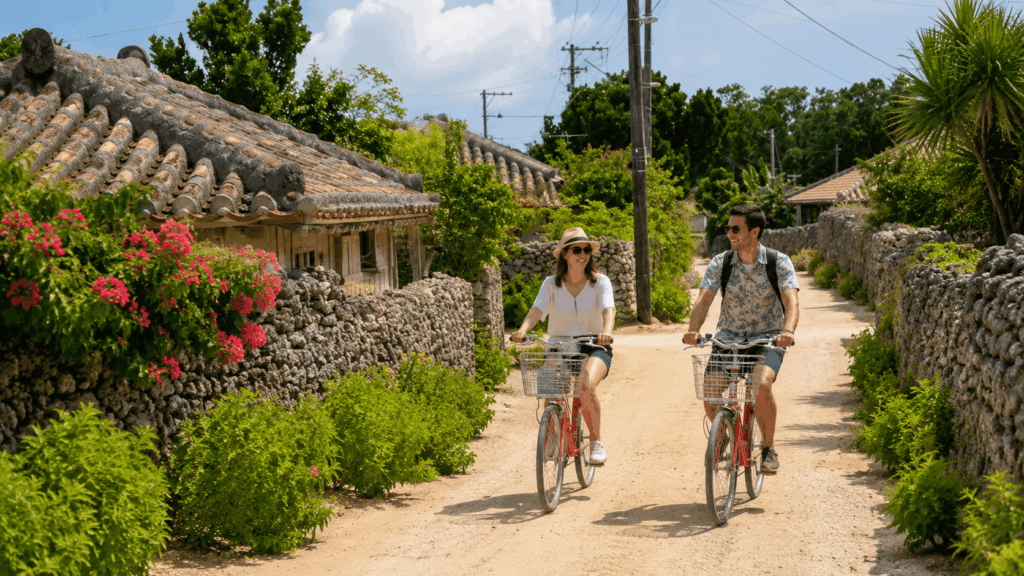
The island is flat and compact, so walking is genuinely possible — the port is about 15 minutes from the village, and Kondoi Beach is about 40 minutes on foot. But the sights worth seeing sit across the western half of the island, and in summer the combination of white sand and open sky makes long walks punishing. The honest trade-off: for a day trip that includes the beach, a bicycle is the difference between a relaxed loop and a lot of walking.
Here’s the part that has changed recently. Since 18 July 2026, the Taketomi Tourist Center rents bicycles only to water buffalo cart passengers — there’s no direct advance reservation, the bikes are limited, they must be returned to the center (no drop-off at the port), and overnight rental isn’t offered. Independent rental operators on the island — Nitta Kanko and Tomori Kanko are the best known — still rent bicycles separately for roughly ¥1,000–2,000 per day, but their fleets are small and hours and closed days vary, so it’s worth checking availability before you travel.
Kai’s tip: The mistake I see most often is assuming you can rent a bicycle when you arrive. I’ve been on the island more than once when every rental was already out — and since the 2026 rule change, the Tourist Center’s bikes are reserved for cart passengers anyway. If a bicycle matters to your plan, secure it before you leave Ishigaki: book a package that includes one, or check availability with the rental operators ahead of your visit. Walking works, but on a hot day it changes the kind of trip you can have. We cover the current rental rules and options in more depth in our separate Taketomi bike rental guide.
If you’d rather not cycle, the route bus (run by Taketomi Island Transportation) costs ¥300 per ride and links the port, the village, and the beaches. Departures from the port are timed to ferry arrivals and need no reservation; boarding at any other stop requires a phone call at least 15 minutes before departure (0980-85-2154). The catch is frequency — the bus makes only a few runs a day, so plan your stops around the timetable rather than the other way around.
Taxis exist, but there’s no cruising: the fleet is small, and you’ll need to arrange one by phone — ask at the Tourist Center or your Ishigaki accommodation for the number.
| Option | Cost | Best for | Watch out for |
|---|---|---|---|
| Bicycle (rental or package) | Around ¥1,000–2,000 per day at independent shops; included in some ferry + cart packages | Most first-time visitors; couples; families with children who can ride | Limited stock; Tourist Center bikes are for cart passengers only since July 2026; package bikes must be back by 16:00 |
| Route bus | ¥300 per ride | Travelers who prefer not to cycle; quick beach-only trips | Only a few runs a day; reserve by phone 15 minutes ahead from stops other than the port |
| Walking | Free | Short visits; cooler months; fit travelers | Heat and little shade; port to Kondoi is about 40 minutes |
| Taxi | Metered; small fleet | Groups with luggage; very tight schedules | No cruising; arrange by phone in advance |
Kondoi Beach Changes With the Tide
Kondoi’s shallow, clear water makes it the island’s main swimming beach — but the tide decides what kind of beach it is on the day you visit. At low tide, the water pulls back to expose a wide sandbar offshore, and you can wade out across it in ankle-to-knee-deep water. At higher tide, that sandbar is submerged, the swimming area deepens, and the beach behaves like a normal — very pretty — swimming spot. Neither version is “wrong”; they’re just different experiences, and which one you get depends on the clock.
Practicalities: the beach has showers, changing rooms, and toilets, but no lifeguards — swim at your own risk, and the local government advises against swimming alone. Check the tide table for Taketomi before you set your schedule; a standard tide app works, and the Taketomi Town Tourism Association also posts low-tide beach information. We go into tide timing at Kondoi in more depth in a separate guide to the beach.
Kai’s tip: Kondoi is genuinely two different beaches depending on the tide. At low tide I’ve walked out across the sandbar until the water barely reached my knees — it feels like standing in the middle of the sea, and it photographs beautifully. An hour or two later, that same spot is open water. If the sandbar walk is your goal, aim for the hour around low tide; if you want to swim, higher tide gives you deeper water. Bring sandals you don’t mind getting wet and a towel — the return walk is through warm, ankle-deep water.
How Long Do You Need on Taketomi Island?
You can see the essentials in about three hours on the island: ferry, buffalo cart, a loop through the village, Nishi Pier, and back. But if the beach, a slow lunch, and unhurried photos matter to you, plan for four to six hours. When planning your broader Ishigaki itinerary, remember that the real constraint isn’t the sightseeing — it’s the return ferry and, for package bicycles, the 16:00 return time.
| Approach | What fits | Best for | Watch out for |
|---|---|---|---|
| Half-day (about 3–4 hours on the island) | Ferry, buffalo cart, village, Nishi Pier; the beach only if you skip a sit-down lunch | Tight schedules; travelers here mainly for the cart and village | Feels rushed; little time for Kondoi or photos |
| Relaxed day (about 5–6 hours) | Everything above, plus Kondoi Beach, optional Kaiji, and a slow lunch | First-timers; families; swimmers; photographers | Confirm the last return ferry and any bike return deadline (16:00 on package bikes) |
If you want a guided marine experience as well as time on Taketomi — rather than spending the whole day arranging a Taketomi-only loop — the Phantom Island combination is the higher-value option worth comparing.
Why I’d book this one
- Recent travelers consistently mention friendly, capable guides, including positive feedback on English communication during the guided marine portion.
- The snorkeling portion bundles the guided activity, equipment, and photo support before you continue to Taketomi with round-trip ferry tickets.
- It reduces the number of separate bookings for travelers who want both a Yaeyama marine experience and Taketomi in the same day.
Taketomi itself is self-guided on this tour, and the water buffalo cart and bicycle are not included, so check how much island time the schedule leaves before choosing it. See live availability, start times, cancellation terms, and recent traveler reviews for the Phantom Island Snorkeling and Taketomi Sightseeing tour.
A Simple First-Time Taketomi Itinerary
- The evening before — check the next day’s ferry schedule and weather; aim to arrive on the island by mid-morning.
- At the port — take the free Tourist Center shuttle and ride the water buffalo cart early, before the 10:00–14:00 rush builds.
- Then the village — pick up your bicycle (or set out on foot), loop through the lanes, and ride out to Nishi Pier.
- Lunch early — before 13:00 if possible, or carry food; more on this below.
- Kondoi Beach — aim for the low-tide window if the sandbar is your goal; otherwise swim at higher tide.
- Kaiji Beach — a short photo detour on the way back if time allows.
- Return — give the bike back by its deadline and be at the port with a comfortable buffer before the last ferry; confirm that departure time when you arrive on the island.
Food on Taketomi Island: Don’t Let Lunch Make You Miss the Ferry
Taketomi’s food scene is small on purpose: a handful of restaurants and cafés around the village serving Okinawan home cooking, soba, and island sweets. Seats are limited, and the kitchens run on island time — food arrives when it arrives. On a day trip that’s part of the charm, until it isn’t: the return ferry doesn’t wait for anyone.
Kai’s tip: The mistake I’ve made myself — and watched travelers make — is treating lunch as flexible. More than once I’ve had to hurry back to the port after a slow meal, and the margin gets tight fast. Treat the return ferry as the one fixed point of the day: check the last departure when you arrive, work backwards from it, and if you’re not confident a sit-down meal will turn around in time, eat a bigger breakfast and buy an onigiri or sandwich at the Ishigaki terminal before you cross. A picnic on the Kondoi sandbar is no sacrifice.
A few practical notes: many island restaurants close one or two days a week, so check what’s open on your date rather than assuming. Water is the bigger issue — there are few shops on the island, so carry a bottle. If you have dietary restrictions, the options are limited; eating in Ishigaki or bringing your own food is the most reliable route.
What to Book Before You Go to Taketomi Island
For a first visit, the two things worth locking in before you leave Ishigaki are the ferry and the water buffalo cart. Booking them together removes the two biggest on-the-day unknowns — a sold-out cart window and a long walk-up wait — which is why most first-timers are better off with a combined ticket.
| Option | What’s included | Best for | Watch out for |
|---|---|---|---|
| Klook — ferry + water buffalo package | Round-trip ferry and water buffalo cart; flexible return sailing | Travelers who want one simple booking and don’t need a bicycle | No bicycle included; book ahead, typically by the day before |
| Yaeyama Kanko Ferry direct — cart tour, with or without bike | Ferry + cart (around ¥5,000) or ferry + cart + bicycle (around ¥6,900) per adult, as of August 2026 | Travelers who want the bicycle locked in from the start | Commentary in Japanese; bicycle return by 16:00; reserve by the previous day |
| DIY — book it yourself | Ferry ticket at the terminal; walk-up cart (regular ¥3,300, busy season ¥3,900); bicycle on the day | Flexible travelers visiting outside peak season | Cart waits in the 10:00–14:00 window; bicycle sellouts; the cart center is cashless-only |
Whichever route you choose, read the inclusions before you pay — especially whether a bicycle is part of the deal and what time it must be returned. Prices and terms shift with the season, so treat the figures above as of August 2026 and confirm them at booking.
If you’d rather keep the day focused entirely on Taketomi, the Klook round-trip ferry + water buffalo cart package matches the first-time route above more closely. Check the current departure options and inclusions before finalising your date.
FAQ
Is Taketomi Island worth a day trip from Ishigaki?
For most first-time visitors to the Yaeyama Islands, yes — it’s the easiest complete taste of a traditional Okinawan island from Ishigaki: a 10–15 minute ferry ride, no cars or traffic lights, and a water buffalo cart ride and village unlike anything on the main island. It’s a weaker pick if your schedule is very tight and you’d rather focus on what to do in Ishigaki itself, or if you prefer faster-paced sightseeing with more infrastructure.
Is the water buffalo cart too touristy?
It is the island’s flagship, tourist-oriented experience — run through the Taketomi Tourist Center, with free shuttles and packaged ferry deals — but it’s also genuinely charming: a slow, musical ride through the village with local storytelling. Think of it as the island’s equivalent of a gondola ride. If you’d rather skip it, you can cover the same streets on foot or by bicycle; the cart adds the history, the music, and the unhurried pace.
Can I visit Taketomi Island without a bicycle?
Yes. Walking works for a short visit — the port to village is about 15 minutes — and the route bus (¥300 per ride) links the port, village, and beaches, though it runs only a few times a day. What changes with a bicycle is how much you can comfortably cover in the heat: port to Kondoi Beach is about 40 minutes on foot versus roughly 15 by bike. Since July 2026, the Tourist Center rents bikes only to water buffalo passengers, so independent rentals or a package that includes a bicycle are the alternatives.
Do I need to book the ferry, cart, or bicycle in advance?
The regular ferry needs no reservation — buy a ticket at the terminal. The water buffalo cart and any bicycle are the things worth securing: the cart can mean a long walk-up wait at busy times, and bicycle stock is limited. A combined ferry + cart booking, with a bicycle added if you want one, is the most reliable way to lock everything in before you cross.
Is Kondoi Beach worth visiting if I don’t swim?
Yes — at low tide. The shallow water pulls back to expose a sandbar you can wade across, which is the beach’s signature experience and needs no swimming at all. If you arrive at higher tide and don’t swim, Kondoi is still a pretty beach but a less distinctive one; in that case the village and Nishi Pier may matter more to you.
Do people speak English on Taketomi Island?
Basic English works at the port and the Tourist Center, but don’t expect detailed English guidance — the water buffalo commentary is in Japanese, and menus and signs are mostly Japanese. The island is simple to navigate (one village, two beaches, a port), so language is rarely a real obstacle; a translation app helps with restaurant menus and the phone call to book the bus.
How do I avoid missing the last ferry back?
Check the return timetable when you arrive on the island — it varies by season — and work backwards from the last departure, leaving a comfortable buffer on the island side (around 45–60 minutes) for lunch, bike returns, and the walk back to the port. If you’ve booked a package bicycle, note that its 16:00 return time may be earlier than the last ferry — confirm both before you plan the afternoon.
Final Verdict
Choose Taketomi Island if you want the most accessible taste of a traditional Okinawan island: the water buffalo cart, the red-tiled village, and a low-tide walk across the Kondoi sandbar are all achievable in a relaxed half-day to full day from Ishigaki, as long as you book the ferry and cart ahead.
Consider skipping it if you’re not drawn to slow, low-key sightseeing, your Ishigaki schedule is already full, or you want beaches with lifeguards and full infrastructure — Kondoi has neither.
For first-time visitors: book a ferry + water buffalo package, ride the cart early, then do the village, Nishi Pier, and Kondoi at low tide. That sequence is the whole island in its best form, and it’s the route I’d give a friend visiting for the first time.
For families: the cart ride suits children, the village is flat and safe, and Kondoi’s shallow water is easy for kids — but watch the heat, pack water and snacks, and remember the cart commentary is in Japanese, so set expectations for younger listeners.
For travelers on a tight schedule: a half-day works if you skip the beach and the sit-down lunch; arrive mid-morning, do the cart and village, and keep the last ferry in sight. Booking the cart ahead takes the 10:00–14:00 wait out of the equation.
For repeat visitors: skip the cart if you’ve done it, spend your time on the beaches and the quieter back lanes, and check the tide before you commit to Kondoi — the sandbar is the reward, and it only shows up at low tide.

Hi, I’m Kai. I’m a Tokyo-based travel writer, tourism industry insider, and the author of a published guidebook for international visitors to Japan. With over 10 years of professional experience at a leading Japanese tourism company, my mission is to help you skip the tourist traps and navigate Japan’s best destinations like a local. I believe the perfect day trip is like a traditional kaiseki meal: a beautiful balance of precise planning and unforgettable seasonal discovery. When I’m not out conducting field research, you’ll usually find me drafting new itineraries with one of my favorite fountain pens!