
Planning Arashiyama as more than a quick viewpoint stop? If you already know you want the Bamboo Grove, Okochi Sanso, Tenryu-ji, and the riverside context in one smooth route, check current availability, start times, and recent traveler reviews for this private Arashiyama day trip before you lock in your day.
What Exactly Is the “Gorge Observation Deck”? (The Confusion, Resolved)
If you’re planning your Arashiyama itinerary and spotted a pin on Google Maps labelled “Okochi Sanso Gorge Observation Deck,” you’re probably wondering two things: Is this a free public viewpoint? and Can I just pop in for the view without paying?
The short answer is no — but not for the reason you might think. Here’s what the map pin doesn’t tell you.
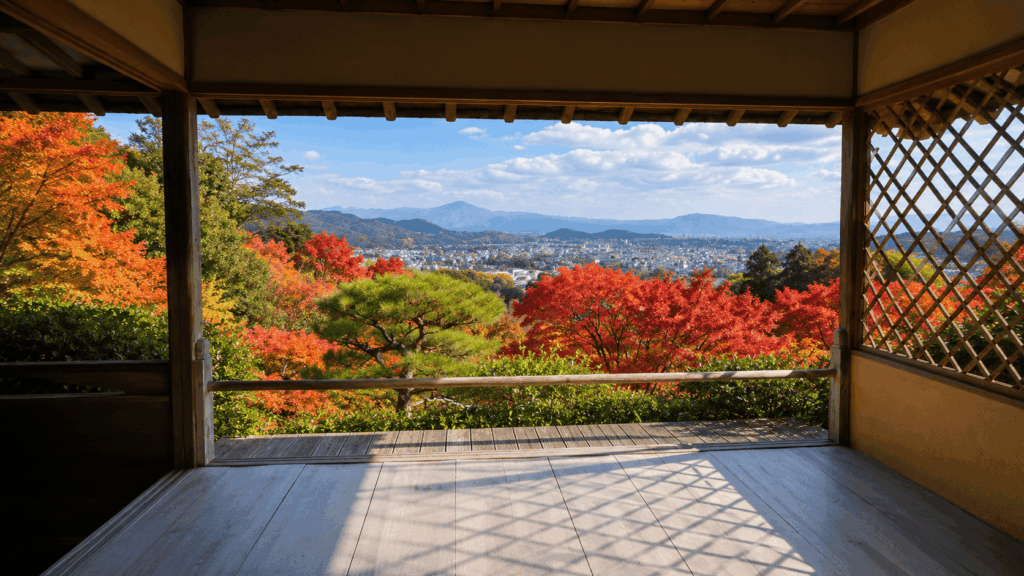
The “Gorge Observation Deck” is not a standalone attraction. It’s the Rankei Observation Deck (嵐峡展望台), one of two lookout points inside Ōkōchi Sansō (大河内山荘) — a sprawling hillside villa and garden that belonged to Denjirō Ōkōchi, a legendary samurai-film star of the Showa era. You cannot access the observation deck separately; it’s included in the garden’s ¥1,000 admission fee.
In fact, there are two viewpoints inside the grounds:
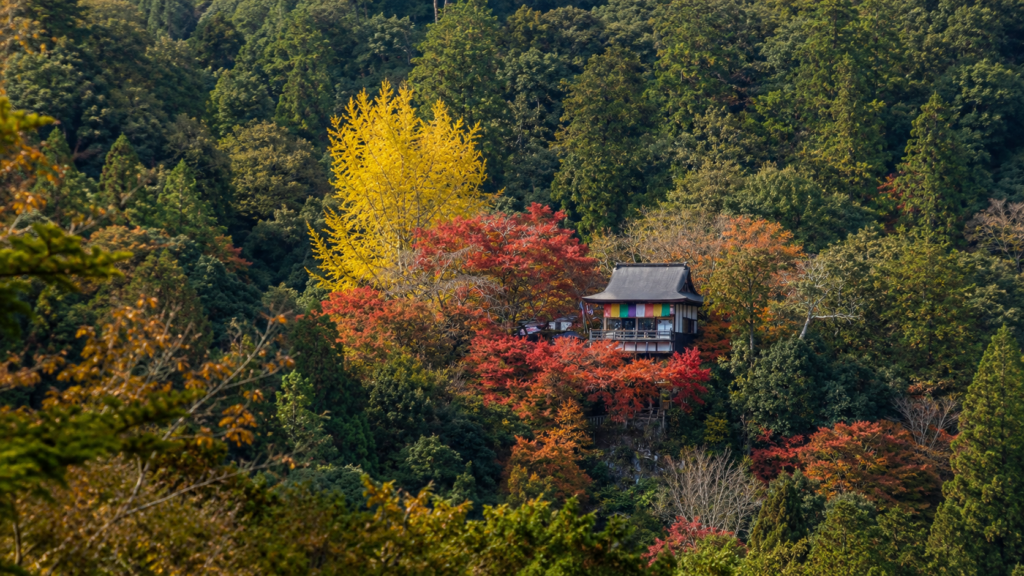
- Rankei Observation Deck — overlooking the Hozu Gorge (保津峡), Arashiyama’s mountain ridges, Mount Hiei, and the temple Daihikaku Senkoji perched on the opposite slope. This is the “gorge view” people search for.
- City Viewpoint (Gekko / 月香) — the highest point in the garden, marked with a plaque reading “Gekko” (moon-viewing). From here, the view opens across Kyoto city toward the eastern hills.
Both are accessible only with a garden ticket. There is no free shortcut, no separate entrance, and no way to see the Rankei deck without paying the ¥1,000.
If that makes you hesitate, keep reading. For some travelers, this garden is the best ¥1,000 they’ll spend in Kyoto. For others, a free alternative nearby does the job better. This guide helps you decide which one you are — and exactly how to visit either way.
Quick Verdict: Should You Pay ¥1,000 for Okochi Sanso?
Let’s cut to the chase. Here’s who the garden is for — and who should skip it.
| Visit Okochi Sanso if… | Skip it if… |
|---|---|
| You want a quiet escape from the Bamboo Grove crowds | Your only goal is a Hozugawa river gorge photo |
| You enjoy traditional Japanese villa architecture (Daijōkaku’s blend of shoin-zukuri and sukiya-zukuri is outstanding) | You’re on a tight budget after Tenryu-ji (¥800) and lunch |
| You’d value a proper matcha experience with a view | You have limited time and can’t spare 40–60 minutes |
| You appreciate moss gardens, tea houses, and curated strolls | You’re visiting with children under 15 who won’t enjoy a slow garden walk (note: Myōkō-an hall is off-limits to under-15s) |
| You want to understand the why behind Arashiyama — the story of the actor who built this place over 30 years with his film earnings | You only want a view and are fine skipping the architecture and history |
Kai’s tip: The ¥1,000 ticket feels expensive until you notice what it does to the crowd level. While the Bamboo Grove just outside the gate is shoulder-to-shoulder with selfie sticks well into the afternoon, the ticket counter acts as an accidental filter. Step through the gate, and the noise drops by 80%. In a district where crowds are the biggest complaint, paying ¥1,000 is actually a surprisingly effective way to buy yourself some quiet.
What Your ¥1,000 Covers (It’s More Than Just a View)
Before you decide, here’s the full breakdown of what you’re paying for. The value makes more sense when you see it itemised.
The Garden Stroll (20,000 m² of Borrowed Scenery)
The garden spreads across the southwestern slope of Mount Ogura (小倉山), using the mountain’s natural contours to create a winding, one-directional route. You’ll pass through several distinct zones:
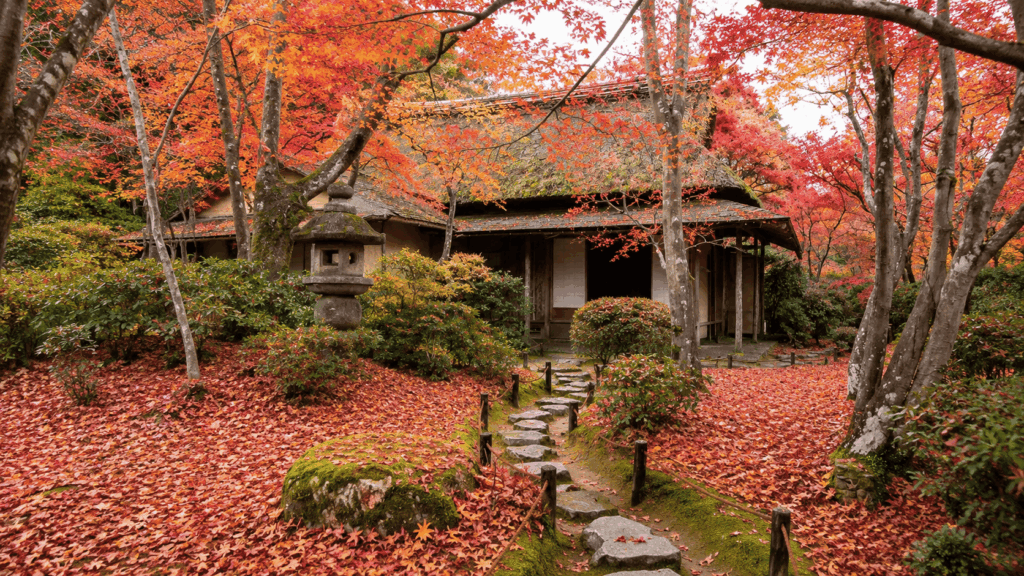
- Daijōkaku (大乗閣) — the main building, a masterwork that blends shinden-zukuri, shoin-zukuri, and sukiya-zukuri architectural styles. Listed as a Registered Tangible Cultural Property of Japan. From its veranda, the garden frames views of Arashiyama and Mount Hiei as “borrowed scenery.”
- Jibutsu-dō (持仏堂) — a Meiji-era Buddhist hall that Ōkōchi had relocated here. He would meditate here between film shoots. The white sand and pine trees around it create a minimalist Zen composition.
- Tekisui-an (滴水庵) — a tea house gifted to Ōkōchi by a Zen master. This is where the garden path starts to climb toward the viewpoints.
- Myōkō-an (妙香庵) — a quieter meditation hall off the main path where visitors can copy sutras (materials provided). Note: children under 15 are not permitted, and the hall may be closed on unscheduled days.
Matcha + Sweet + Postcard (Included in the Ticket)
Your admission fee includes a bowl of matcha green tea, a traditional Japanese sweet (typically a rakugan-style pressed confection or monaka), and a commemorative postcard. The tea is served at a dedicated tea house near the exit — not at the entrance — which we’ll come back to in the tips section below.
Ōkōchi Denjirō Memorial Hall
Near the exit, an open-air corridor displays film posters, production stills, and panels about Ōkōchi’s life and career. He was one of Japan’s biggest pre-war and post-war stars, famous for his tate (realistic sword-fighting) roles in films like Tange Sazen. The exhibition is compact and the commentary is predominantly in Japanese, so history buffs may want to read up beforehand or join a guided tour for context.
Important Practical Note: Cash Only
The ticket counter does not accept credit cards — bring ¥1,000 in cash per adult (¥500 per child). There are no ATMs immediately nearby; the nearest convenience store is a few minutes’ walk back toward the main Arashiyama street.
The Two Viewpoints Inside the Garden
One of the most confusing things about Okochi Sanso is that there isn’t just one viewpoint — there are two, and they show you completely different sides of Kyoto. Most visitors only hear about the “gorge” view and miss the city panorama entirely.
Rankei Observation Deck — The “Gorge View”
This is the lookout that matches the search term “Gorge Observation Deck” — and it’s the first one you’ll reach as you follow the garden path uphill from Tekisui-an tea house.
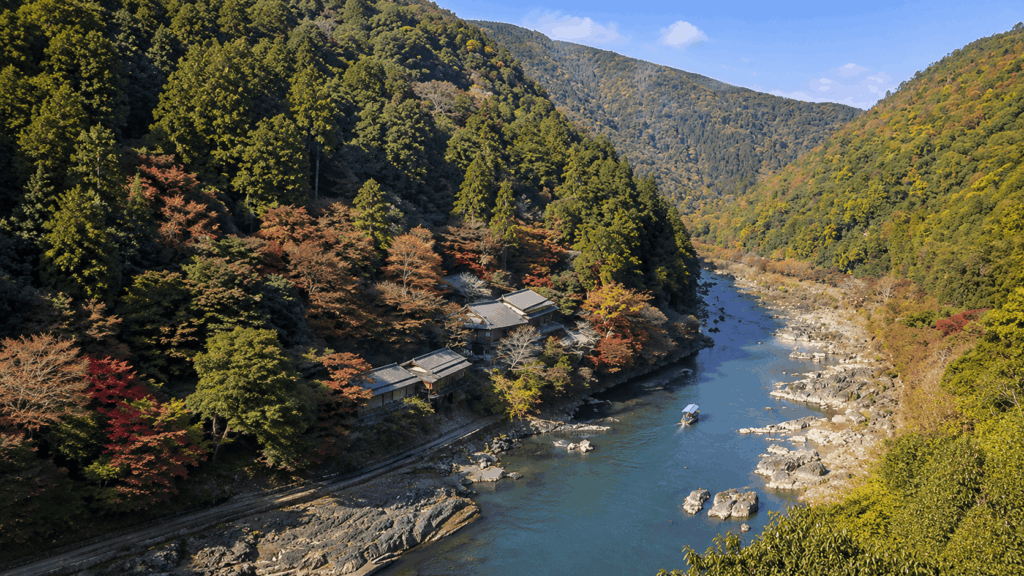
- Direction: Southwest-facing, looking across the Hozu River valley
- What you see: The deep green slope of Mount Arashiyama, the vermilion roof of Daihikaku Senkō-ji Temple perched on the opposite ridge, the winding Hozu Gorge below, and Mount Hiei on the distant northern skyline
- Best time: Mid-to-late afternoon when the sun illuminates the gorge from the west
- Vibe: Peaceful and contemplative — the deck is wide enough that you won’t feel rushed, but it’s the more popular of the two viewpoints
City Viewpoint (Gekko / 月香) — The Kyoto Panorama
Keep climbing after the Rankei deck. The path narrows and climbs to the garden’s highest point, where a stone plaque engraved with the characters for Gekko (月香) — “moon fragrance” — marks the second lookout.
- Direction: East-facing, overlooking Kyoto city
- What you see: The sprawl of Kyoto city below, the Kyoto Tower silhouette in the central distance, the eastern hills (Higashiyama) that run from Ginkaku-ji to Fushimi Inari, and Mount Hiei off to the northeast
- Best time: Morning for clear city views (before haze builds up) or late afternoon for the golden light
- Vibe: Quieter than Rankei — fewer visitors make the full climb. On clear days, the contrast between the moss garden foreground and the modern skyline is striking
Kai’s tip: If you only visit one viewpoint, make it Rankei for the gorge itself — but if you have the energy for the extra 50 metres of uphill path, the City Viewpoint gives you something the Rankei deck doesn’t: a sense of how the old garden literally overlooks the modern city. It’s also far less crowded, which matters during peak foliage season when the Rankei deck can have a wait.
Paid vs. Free: Okochi Sanso vs. Kameyama Park Observation Deck
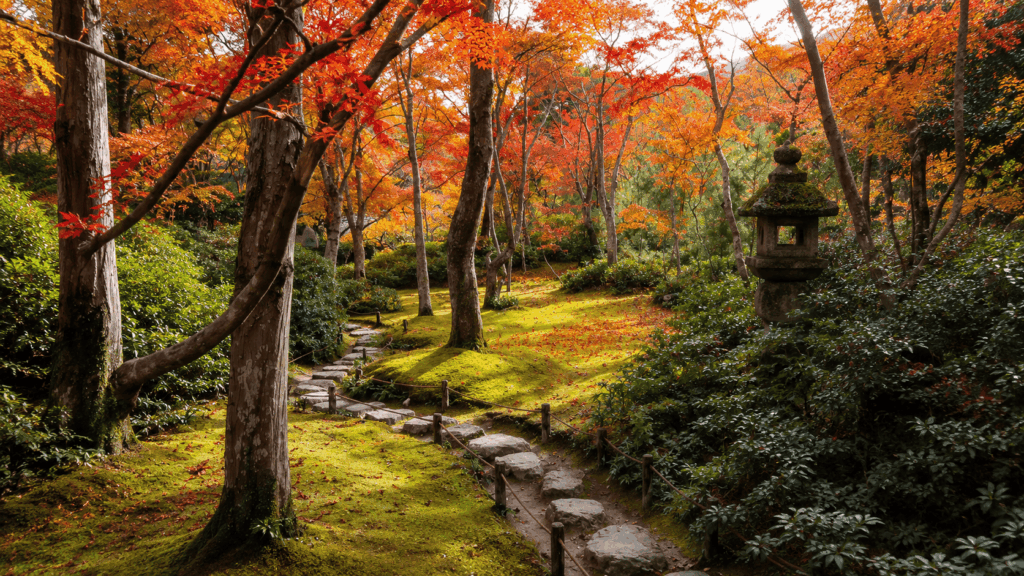
If your main goal is a view of the Hozu Gorge, you have two options. One costs ¥1,000. The other is free, 24-hour accessible, and sits just next door. Here’s the honest comparison.
| Factor | Okochi Sanso (Rankei + City Viewpoints) | Kameyama Park (亀山公園) Observation Deck |
|---|---|---|
| Cost | ¥1,000 adult / ¥500 child | Free — no ticket required |
| What you see | Gorge + mountains (Rankei); city + Higashiyama (City Viewpoint) | Hozu Gorge + Togetsu-kyo Bridge + the river bend — the gorge view is actually wider and more open here |
| Crowds | Sparse on most days; moderate during autumn foliage season (narrow paths) | Can be busy during peak hours, but the deck is large |
| Added value | Japanese villa architecture, moss garden, tea house stroll, matcha + sweet + postcard, film exhibition | None — this is purely a lookout |
| Accessibility | Some uphill sections; not suitable for wheelchairs or strollers in parts | Gentle slope from the park entrance; more accessible overall |
| Opening hours | 9:00–17:00 (last entry 16:30) | 24 hours — great for sunrise or sunset |
| Best for | Travelers who want the full experience: garden + architecture + tea + views | Travelers who only want the gorge photo and want to spend ¥0 |
Kai’s tip: Here’s the honest truth that most guides won’t tell you: for the pure Hozu Gorge view — the river cutting between the mountains — Kameyama Park’s observation deck actually gives you a better angle. It sits slightly lower but faces the gorge more directly, and you can see the Togetsu-kyo Bridge frame the composition. Okochi Sanso’s Rankei deck shows you more of the mountain ridges and the temple on the opposite slope. So if your camera roll just needs that one gorge photo, save your ¥1,000. But if you want to be inside the scenery — walking through a moss garden built by a samurai actor, drinking tea in a 90-year-old villa — Okochi Sanso is the only option.
How to Get to Okochi Sanso (Accurate Directions)
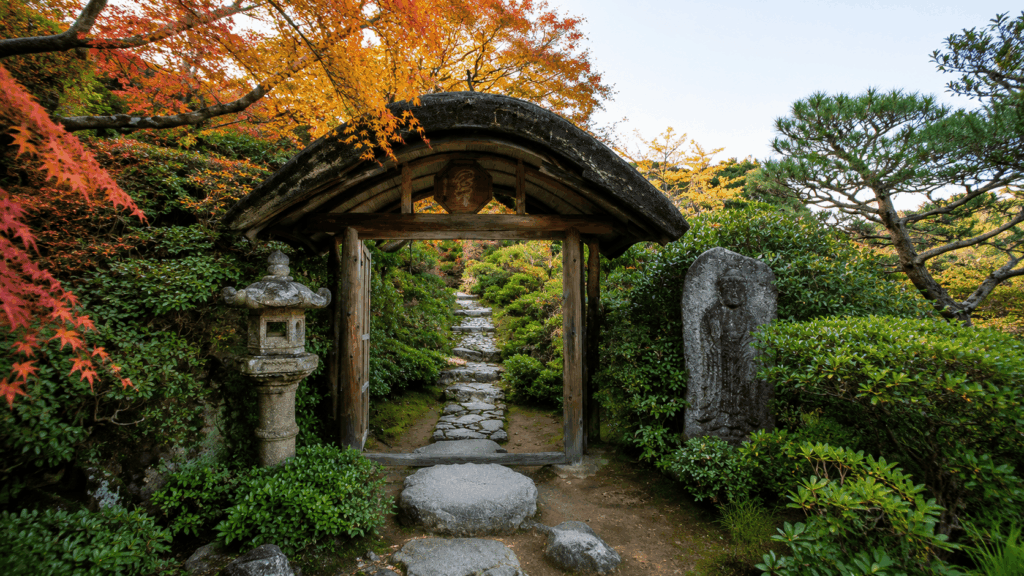
Several online guides direct you to “Settsu Station” or “Bus 28” — these are incorrect. Here are the real routes.
From the Bamboo Grove (Most Common Route)
Walk the full length of the Bamboo Grove path (竹林の小径) heading north. Instead of turning right toward the temple, continue straight until you reach a T-junction at the end of the bamboo path. The entrance gate of Okochi Sanso is directly in front of you — you cannot miss it. Total walk from the bamboo entrance: approximately 7 minutes.
From Tenryu-ji Temple
Exit Tenryu-ji through its north gate (北門) — this gate puts you directly onto the Bamboo Grove path. Walk through the bamboo tunnel to the end, then continue straight as above. Total walk from Tenryu-ji’s main hall: approximately 10–15 minutes (including time to pass through the temple garden).
From Saga-Arashiyama Station (JR)
Exit the station, walk toward the Bamboo Grove entrance (5 minutes), then follow the bamboo route north. Total: approximately 15–20 minutes.
From Randen (Keifuku) Arashiyama Station
Walk north through the shopping street, past Tenryu-ji’s main gate, and enter the Bamboo Grove. Follow it to the end. Total: approximately 15–18 minutes.
From Torokko Arashiyama Station (Sagano Romantic Train)
This is the closest station. Exit and walk straight — the Okochi Sanso entrance is less than 1 minute on foot. If you’re arriving by the romantic train from Kameoka, this is by far your most convenient access point.
Important Route Notes
- The garden path is one-directional — you enter at the main gate and exit at a separate point downhill. You cannot backtrack easily.
- There are uphill sections and steps, particularly between the Tekisui-an tea house and the two viewpoints. Wear comfortable walking shoes.
- The path narrows significantly in some sections. During autumn foliage season (mid-November to early December), these bottlenecks can create short waits even inside the garden.
Kai’s tip: Here’s a small but effective time-saver. Your matcha ticket is handed to you at the entrance with a small tear-off coupon. Most people use it at the first tea house they see, near the entrance. Don’t. The tea house near the exit has the better view — large windows that look out over the bamboo and the garden slope from above. Save your tea for the end of the stroll. You’ll finish the walk, sit down with your matcha and sweet, and the crowds from the Bamboo Grove will feel like a distant memory. It’s the reward lap the garden was designed for.
When to Visit for the Quietest Experience
Okochi Sanso is significantly less crowded than the Bamboo Grove, but “quiet” is relative. If you’re looking to avoid crowds in Kyoto, here’s how to time your visit right.
Best Windows for Solitude
- Opening time (9:00–10:00): The garden opens at 9:00, and most bamboo-bound visitors don’t trickle in until 10:30. You’ll often have the viewpoints to yourself during this hour.
- Late afternoon (15:00–16:30): The last entry is 16:30, and the garden clears out noticeably after 15:00. The afternoon light on the gorge is beautiful at this time.
When It Gets Busy
- 10:30–13:00: Peak arrival window for day-trippers from central Kyoto. The garden path will have people, though never at bamboo-grove density.
- Autumn foliage season (mid-November to early December): The quiet reputation breaks down here. The narrow one-directional path between Tekisui-an and the viewpoints becomes a slow-moving queue. If you’re visiting for the autumn colours, arrive at 9:00 sharp or skip it altogether.
- Rainy days: Surprisingly good — the garden empties out, and the moss takes on a vivid green. The veranda of Daijōkaku becomes a perfect spot to sit and watch the rain. Bring an umbrella.
Compared to the Bamboo Grove — which feels crowded even at 8:00 — Okochi Sanso offers a genuinely different experience. The ticket price filters out the large tour groups and casual passers-by, which is precisely why it works for travelers who are tired of shoulder-to-shoulder sightseeing.
Frequently Asked Questions
Is the “Gorge Observation Deck” actually free?
No — it’s a common misunderstanding created by the way Google Maps labels the pin. The “Okochi Sanso Gorge Observation Deck” is not a separate, free viewpoint. It’s the Rankei Observation Deck, which sits inside the paid garden of Ōkōchi Sansō. You need a ¥1,000 garden ticket to access it. There is no separate entrance or free shortcut to the view.
How long does it take to walk through Okochi Sanso?
Most visitors spend between 40 and 60 minutes from entrance to exit. This includes a slow stroll through the garden, stopping at both viewpoints, and sitting for 10–15 minutes at the tea house. If you add the sutra-copying experience at Myōkō-an, budget closer to 75 minutes. The path is one-directional and mostly uphill in the middle section before descending toward the exit.
Is matcha always included with the ticket?
Yes — the ¥1,000 admission usually includes a bowl of matcha, a traditional Japanese sweet, and a commemorative postcard. However, the tea house has occasionally been closed on unscheduled days, so don’t make matcha the sole reason for your visit. If it’s important to you, check at the ticket counter before entering.
Can I visit with children?
Yes — children’s tickets are ¥500 (roughly half price). The garden path is manageable for most children who can handle some uphill walking, though strollers will struggle on the steps and narrow sections near the viewpoints (for easier routes, see our stroller-friendly guide to Kyoto). Note that Myōkō-an (妙香庵), the meditation hall where visitors can copy sutras, does not permit children under 15.
Do I need cash?
Yes — the ticket counter is cash only. There are no ATMs inside the garden or immediately nearby. The nearest convenient cash point is at the 7-Eleven on the main street near the Tenryu-ji entrance, about 5 minutes’ walk back. Bring ¥1,000 per adult and ¥500 per child in cash.
Is there an audio guide or English information?
The Ōkōchi Denjirō Memorial Hall near the exit has a small exhibition of film posters and photographs with Japanese-language commentary panels. There is no audio guide available. The garden itself is designed to be experienced without a guide — the path is clearly marked and one-directional — but the architectural and historical context (the significance of Daijōkaku’s design, Ōkōchi’s film career, the Zen history of Tekisui-an) is left to the visitor to research independently. For travelers who want the full story, a guided walking tour of Arashiyama that includes this stop is a good option.
If you fall into that camp — you want Okochi Sanso to feel like part of Arashiyama’s story, not just a paid viewpoint — this is the one guided option to check first.
Why I’d book this one
- It solves the context problem. Recent travelers often value having a guide connect the Bamboo Grove, Tenryu-ji, Okochi Sanso, the riverside, and the district’s film-era history into one coherent route.
- It suits travelers who dislike rigid group sightseeing. The private, personalized format is useful if you want time for the garden and viewpoints without feeling rushed through Arashiyama’s busiest stops.
- It keeps the decision low-commitment. You can use the listing to compare current dates, start times, cancellation terms, and recent reviews before deciding whether the self-guided route is enough.
Final Verdict — Who Should Visit Okochi Sanso (and Who Shouldn’t)
Let me be direct about this, because the answer really depends on what kind of traveler you are.
Visit Okochi Sanso if:
- You’re tired of Arashiyama’s crowds. The ¥1,000 fee acts as a natural filter. Step through the gate and the district’s noise disappears. For travelers who’ve spent the morning shuffling through the Bamboo Grove and Tenryu-ji, this garden feels like a secret — even though it’s right there.
- You want the full package. Garden + samurai-era architecture (Daijōkaku is genuinely impressive) + moss + two very different viewpoints + matcha with a view. ¥1,000 for all of that is reasonable by Kyoto standards.
- You’re a first-time visitor to Arashiyama with a full day. The garden fits naturally after the Bamboo Grove and Tenryu-ji as a quiet “dessert” course. Add the tea at the end, and it becomes the calm conclusion your legs will thank you for.
- You’re visiting on a rainy day. The moss garden glows, the verandas are sheltered, and you’ll have the place nearly to yourself.
Skip it (or choose Kameyama Park instead) if:
- Your only goal is a photo of the Hozu Gorge. Kameyama Park’s free observation deck gives you a wider, more direct view of the river and Togetsu-kyo Bridge. Save your ¥1,000 for lunch.
- You’re on a tight schedule and budget. If you’ve already paid ¥800 for Tenryu-ji and you need to catch a train by 2:00 PM, adding 40–60 minutes and another ¥1,000 is hard to justify. The garden rewards a slow pace.
- You’re visiting with young children who won’t enjoy a quiet garden walk. The one-directional path, the uphill sections, and the lack of interactive elements mean this is more of an adult experience. Children under 15 are also excluded from Myōkō-an.
- You’re a repeat Kyoto visitor who’s already seen a few villa gardens. If you’ve done Shugaku-in Imperial Villa, Katsura Rikyu, or Nanzen-ji’s sub-temples, Okochi Sanso won’t surprise you architecturally. Its real value is the convenience of location and the crowd filter.
For travelers who want the story without the guesswork: If you wish someone would explain why Ōkōchi spent his entire acting fortune on this hillside, who the calligraphy on the tea house scrolls is by, and which temple across the gorge was used as a film location — the garden’s exhibition is in Japanese and doesn’t fill those gaps. A private Arashiyama walking tour with a knowledgeable guide can connect the dots in a way the self-guided route cannot. That said, the garden is perfectly enjoyable without a guide if you’re happy to simply experience the space and the quiet.
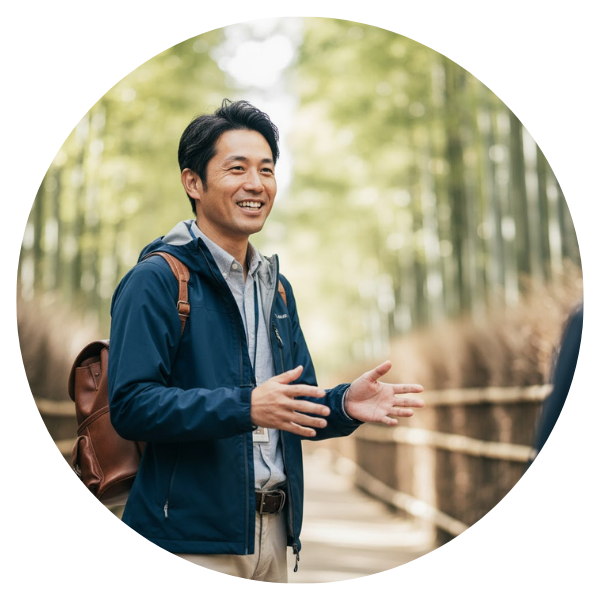
Hi, I’m Kai. I’m a Tokyo-based travel writer, tourism industry insider, and the author of a published guidebook for international visitors to Japan. With over 10 years of professional experience at a leading Japanese tourism company, my mission is to help you skip the tourist traps and navigate Japan’s best destinations like a local. I believe the perfect day trip is like a traditional kaiseki meal: a beautiful balance of precise planning and unforgettable seasonal discovery. When I’m not out conducting field research, you’ll usually find me drafting new itineraries with one of my favorite fountain pens!