
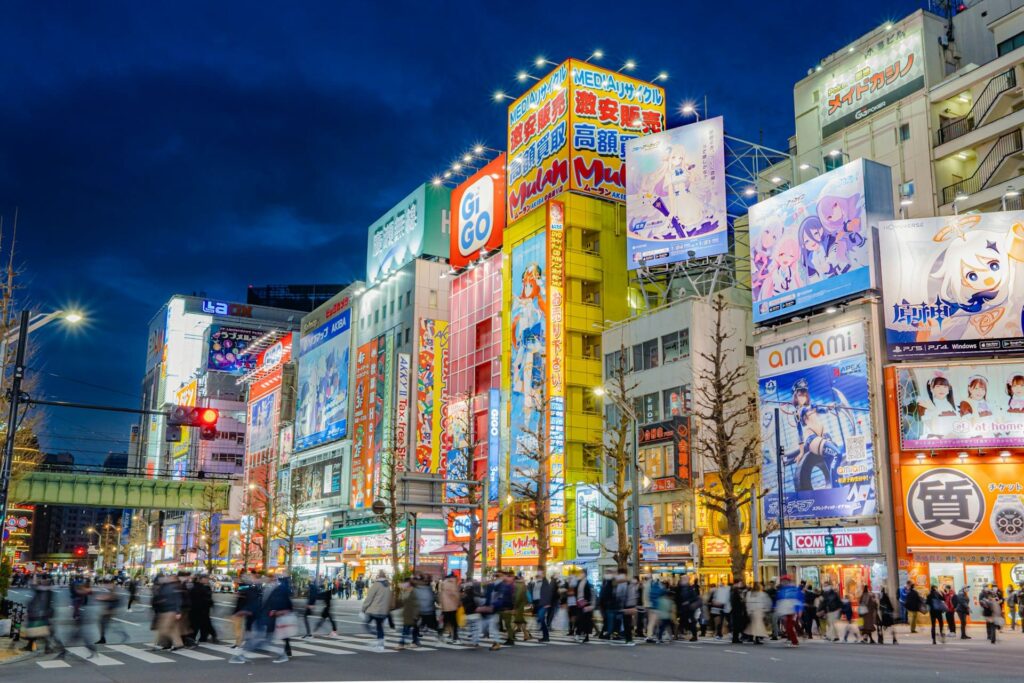
Planning a visit to Akihabara but not sure if it’s for you? You’re not alone. Every week I hear from travelers wondering whether Tokyo’s famous “Electric Town” lives up to the hype—especially if they’re not hardcore anime fans. The short answer is yes, but what you actually get out of it depends entirely on knowing which parts of Akihabara are for you and which you can comfortably skip.
This guide cuts through the “50 best spots” style lists you’ll find elsewhere. Instead, it gives you something more useful: a clear picture of what each experience category actually feels like, who it’s for, and how to fit it into the time you have. No fluff, no filler—just what you need to decide.
Planning your first Akihabara visit? If the maid cafe part, the multi-floor shop maze, or the scam-bar warnings make you hesitate, it is worth checking a small-group Akihabara pop-culture tour before you lock in your day. You can see live start times, availability, and recent traveler reviews for this Akihabara anime, games, and maid cafe tour.
Is Akihabara Worth Visiting? Quick Verdict by Traveler Type
Before we dive into the details, here’s an honest breakdown of who gets the most out of Akihabara and who might be better off spending their Tokyo time elsewhere.
Best for: Anime and manga fans (casual or die-hard), retro gaming enthusiasts, anyone curious about Japanese pop culture, and travelers who enjoy the energy of dense urban shopping districts. Even if you’re “just curious,” Akihabara offers a spectacle you won’t find anywhere else—flashing arcade façades, car-free Chuo-dori on Sunday afternoons, and multi-story hobby emporiums that feel like museums of Japanese creativity.
Not ideal for: Travelers looking for traditional Japanese culture (temples, gardens, tea ceremonies), families with very young children who can’t handle crowds or stairs, or anyone who dislikes aggressive pedestrian traffic. If you are following a tight realistic Tokyo 1-day itinerary and have zero interest in anime, gaming, or electronics, you’d get more value from Asakusa or Ueno.
If you’re on the fence: Allocate two to three hours. That’s enough time to walk Chuo-dori from end to end, pop into Radio Kaikan and Super Potato, grab a gachapon or two, and decide whether the scene resonates with you. If it clicks, you can easily stay all day.
What surprises most first-time visitors is how much of Akihabara exists above street level and underground. The ground-floor shops along the main street are the tourist-facing surface—the real depth is in the buildings where you have to take the elevator to find it. More on that later.
What to Do in Akihabara — Experience by Category
① Anime, Manga & Figure Shopping
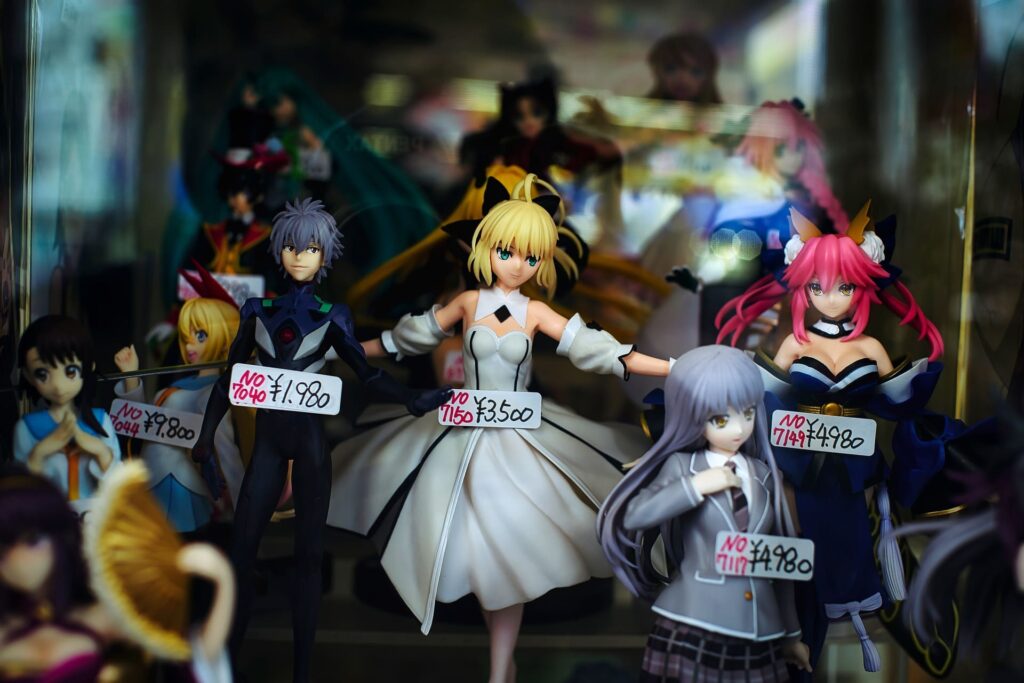
This is the main draw for most visitors, and the sheer density of anime merchandise in Akihabara is hard to overstate. The key is knowing which building to go to for what you’re looking for—not all anime shops are created equal.
Animate Akihabara is the flagship location of Japan’s largest anime retail chain, and it’s a reliable starting point. The store completed a major renewal in August 2026: Buildings 1 and 2 are open 10:00 to 21:00, with manga, audio/visual releases, character goods, and apparel still spread across the main buildings, while the ANNEX now includes dedicated capsule-toy floors, game-focused character goods, official shops, and event spaces. Gratte remains in the ANNEX, serving character-printed drinks and cookies; its hours are 12:00 to 20:00 on weekdays and 11:00 to 19:00 on weekends and holidays. Best for: current-season anime fans and first-timers who want a broad overview of what’s popular right now.
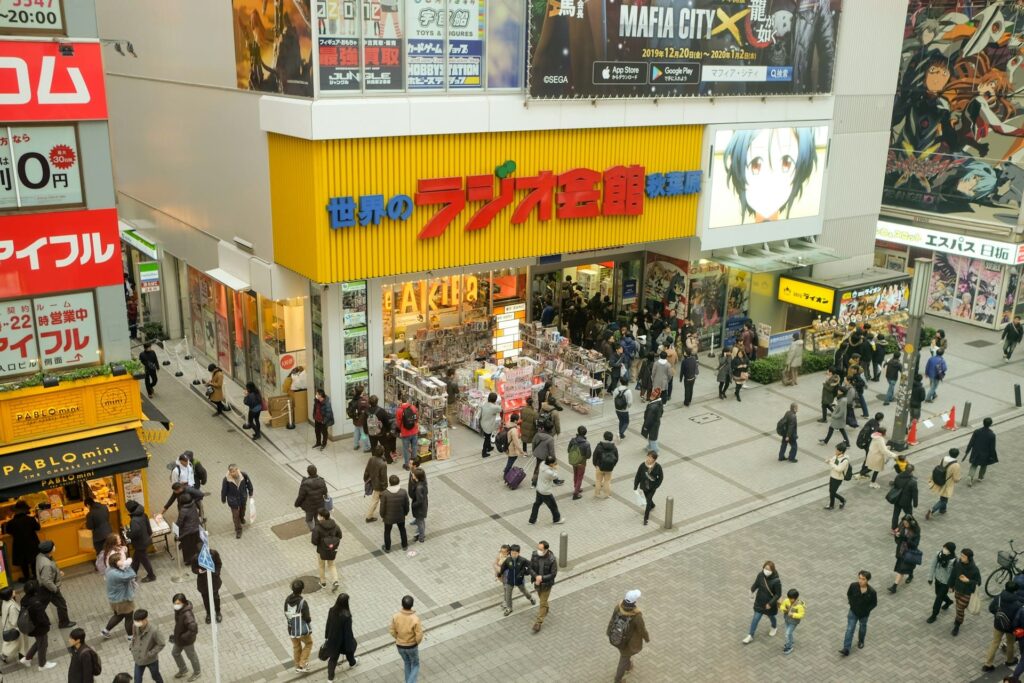
Akihabara Radio Kaikan is a multi-floor commercial building running from B1 to 10F that functions as a microcosm of everything Akihabara offers. Current tenants include K-Books on the 3rd floor, Kaiyodo on the 5th, and Volks on the 8th, alongside card, figure, hobby, and character-goods shops throughout the building. Each floor has a different specialty, so it rewards browsing rather than treating the ground floor as the whole experience. (If you are hunting for rare collectibles, check out our full breakdown of Nakano Broadway vs Akihabara). Best for: serious collectors and anyone who wants to browse a curated selection of shops under one roof.
Mandarake Complex (Sotokanda 3-11-12, open 12:00 to 20:00) is the Akihabara branch of Japan’s famous secondhand manga and figure chain. Eight floors of pre-owned anime goods, rare manga volumes, vintage cell art, and collectibles that range from affordable to museum-piece expensive. This is where you’ll find things that are out of print or hard to find elsewhere. Best for: bargain hunters and collectors looking for rare or older items.
Kotobukiya also has a dedicated standalone store in the area, best known for its high-quality PVC figures and model kits—particularly the Frame Arms and M.S.G lines. Best for: figure collectors who know what they’re looking for.
Where to look: Radio Kaikan is immediately beside the Electric Town side of Akihabara Station, making it one of the easiest first stops. Animate is farther north along the main Akihabara shopping area, while Mandarake Complex sits on a side street west of Chuo-dori—look for its distinctive black building and signage.
② Retro Games & Arcades
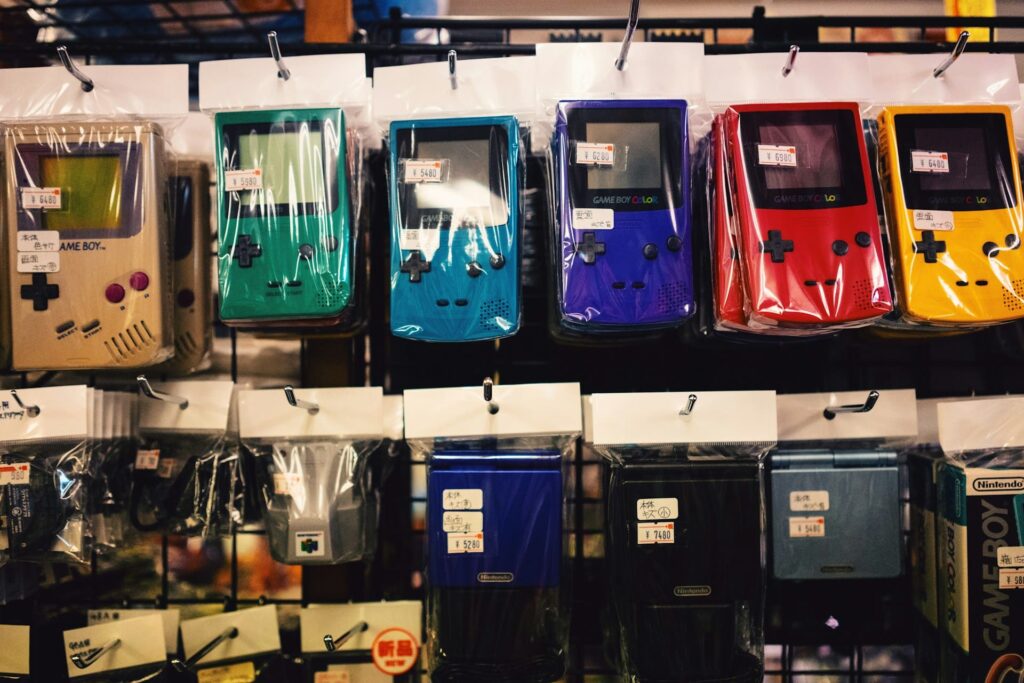
Akihabara is still the best place in Tokyo for retro gaming, though the landscape has shifted recently. Here’s what’s actually open and worth your time.
Super Potato (Kitabayashi Building, 3F–5F) is the flagship destination for retro game enthusiasts. Located about a 4-minute walk from the station, the store occupies three floors: the 3rd and 4th floors are packed with shelves of classic console games (Famicom, Super Famicom, Mega Drive, PlayStation 1, and import titles), while the 5th floor is a small retro arcade where you can play vintage cabinets for ¥100 per credit. The museum-like displays of boxed classics behind glass are worth a look even if you’re not buying. Open 11:00 to 20:00 daily. Best for: retro gamers, collectors, and anyone who wants to see gaming history in one place.
Taito Station remains one of Akihabara’s easiest modern arcades for first-time visitors. Open 10:00 to 23:45, it offers the full Japanese arcade experience: crane games with anime prizes, rhythm games (Dance Dance Revolution, Taiko no Tatsujin), fighting game cabinets, and photo booths. Multiple floors, bright lighting, and a mix of locals and tourists. Best for: arcade gamers and anyone who wants the classic Japanese game center experience.
What replaced GiGO Akihabara Building 1: The former SEGA/GiGO landmark closed in August 2025, but the building is no longer waiting for a new operator. Silk Hat Akihabara opened there on November 22, 2025 and now runs from B1 to 8F, with crane games, music games, video games, card games, and darts. It is open 10:00 to 24:00, so it is now a genuine late-night arcade alternative alongside Taito Station.
Where to look: Super Potato is on a side street off the main Chuo-dori strip—look for the yellow building with the distinctive retro signage. Taito Station has multiple locations around Akihabara, while Silk Hat Akihabara occupies the former GiGO Building 1 site near the Electric Town side of the station.
③ Gachapon (Capsule Toy Machines)
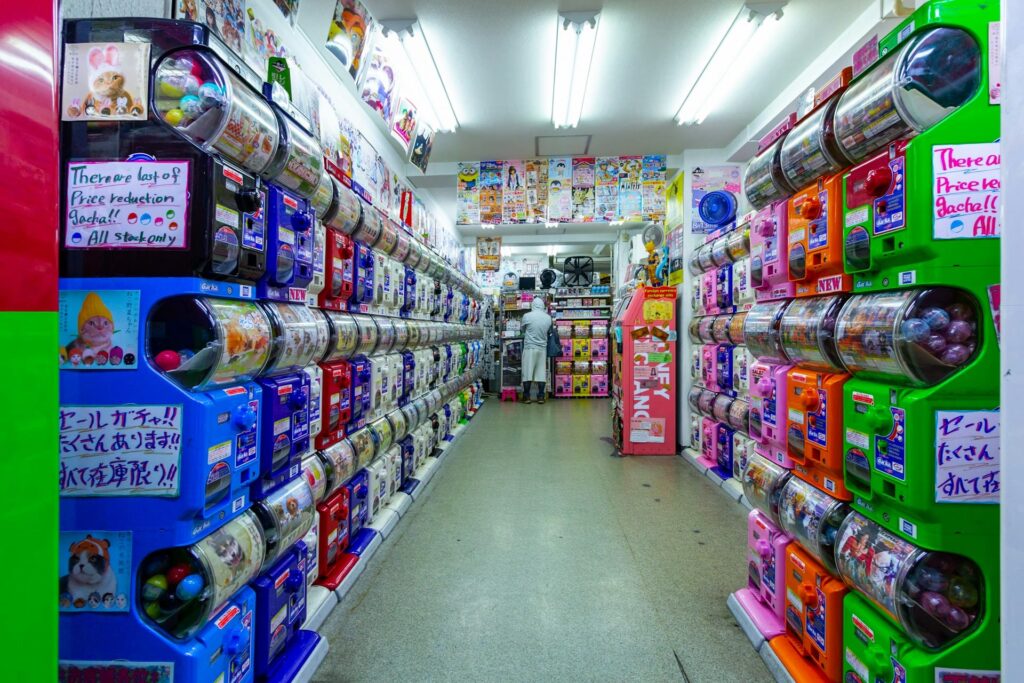
Japan’s vending machine culture reaches peak density in Akihabara. Gachapon—capsule toy machines that dispense small plastic-encased figures and trinkets for ¥200 to ¥500 per turn—have become a legitimate attraction in their own right.
Gachapon Kaikan (Sotokanda 3-15-5) is the dedicated capsule toy specialist. Current hours are 11:00 to 20:00 Monday through Thursday, 11:00 to 22:00 on Friday and Saturday, and 11:00 to 19:00 on Sundays and holidays. The shop is lined wall-to-wall with machines offering everything from miniature food replicas and animal figures to character collabs from popular anime and games. The selection rotates frequently, so what’s available during your visit may be completely different from last month’s stock. Best for: anyone who enjoys the thrill of a random vending machine pull—great for kids and souvenir hunting.
You’ll also find capsule toys inside arcades and at Animate Akihabara ANNEX, whose B1 and 1F now form a dedicated capsule-toy area. What I’d tell a first-timer: stick to a budget of ¥1,000–¥2,000 and choose machines where you can see the actual product through the capsule window—some machines show only the box art, and the result can be underwhelming.
④ Electronics & Gadgets
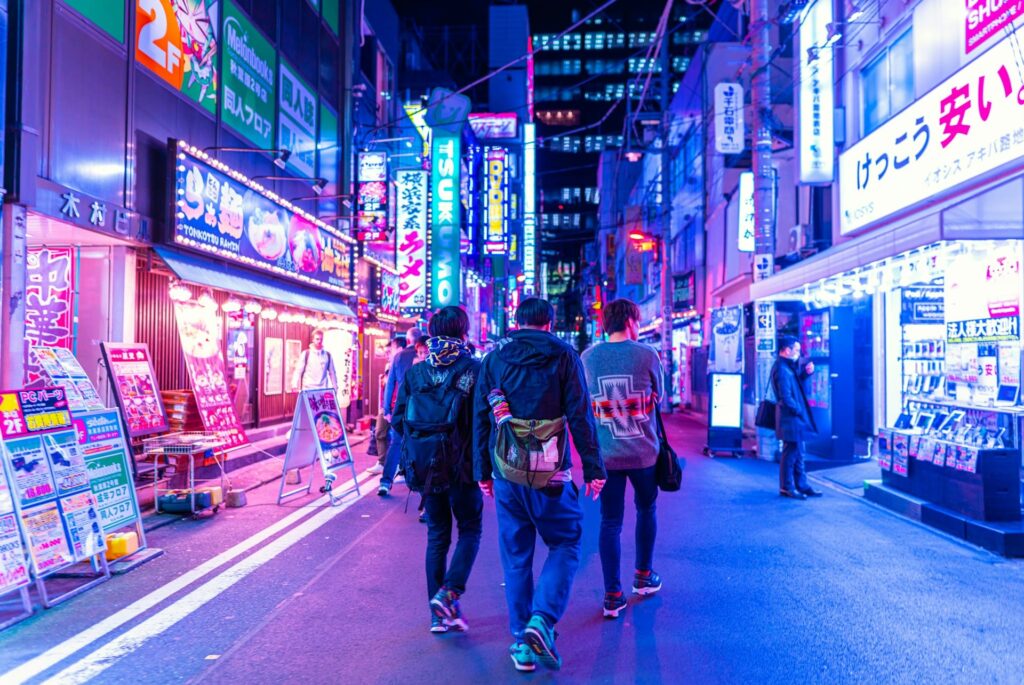
Akihabara’s original identity was “Electric Town,” and while the focus has shifted toward anime and gaming over the years, electronics are still very much part of the neighborhood. The kind of electronics shopping you’ll do here is different from what it was in the 1990s—today, it’s less about DIY components and more about consumer gadgets and tax-free shopping for tourists.
Yodobashi Akiba (beside Akihabara Station’s Central Gate on the east side) is the largest and most convenient electronics retailer in the area. Open 9:30 to 22:00, it spans multiple floors covering cameras, smartphones, laptops, gaming consoles, household appliances, watches, and luggage. The store offers tax-free shopping for eligible visitors, and staff are accustomed to assisting international customers. They also carry voltage converters and overseas-spec electronics, which is useful if you’re buying appliances to take home. Best for: one-stop electronics shopping, especially cameras, headphones, and gaming hardware.
Sofmap has several locations in Akihabara, with a strong focus on computers, PC parts, and secondhand electronics. Their used section can be a goldmine for discounted laptops, monitors, and peripherals in excellent condition. Best for: PC builders and bargain hunters.
Dospara specializes in PC components and custom-built gaming computers. If you’re looking for specific internal parts (graphics cards, motherboards, memory), this is your best bet in the neighborhood. Best for: tech enthusiasts building or upgrading a PC.
Tax-free tip: Until October 31, 2026, eligible visitors can generally buy qualifying goods tax-free at participating stores when the same-day purchase total at that store reaches ¥5,000 before tax; bring your passport. General goods such as electronics are not automatically subject to the sealed-bag rule—the special packaging requirement mainly applies to consumables. For purchases from November 1, 2026, Japan switches to a refund system: you pay the tax-inclusive price at the store, then the consumption-tax amount is refunded after customs confirms the goods are leaving Japan. Some smaller shops do not participate in tax-free shopping, so check before you commit.
⑤ Maid Cafes — What They’re Really Like

Maid cafes are one of the most misunderstood experiences in Akihabara. The media caricature—a kitsch, overpriced gimmick—isn’t entirely wrong, but it also misses the point. In reality, a maid cafe is a themed café where waitresses dressed in maid costumes treat you as “master” or “mistress” returning to your personal mansion. The experience is part performance, part hospitality, and entirely a form of escapist entertainment unique to Japan.
Here’s what to expect—and what to watch out for.
How the experience works: When you enter, you’re seated and given a menu. Almost all maid cafes operate on a time-based system: you pay a cover charge (typically around ¥880) for a one-hour session, plus the cost of food and drinks (¥1,200–¥2,200 per item). Most venues require at least one food or drink order on top of the cover charge. Expect to spend between ¥2,000 and ¥3,500 per person total.
Photo rules: Do not assume every maid cafe has the same photography policy. At @home café, for example, you may photograph items such as your food and menu under the cafe’s rules, but photographing maids or other guests is restricted unless it is part of an approved photo service; video and audio recording are not allowed. Other cafes set their own rules, so check before taking out your phone. If you want a souvenir photo with a maid, established cafes usually sell an official photo option as part of the experience.
What the maids actually do: They greet you with cheerful ceremony, draw a cute design (usually a heart or cat) on your plate using ketchup or chocolate syrup, pose for a photo, and chat with you in Japanese or simple English. The younger generation of maids working at tourist-friendly cafes like @home café are increasingly comfortable with basic English conversation. The tone is playful and wholesome—think children’s birthday party meets theatrical performance, not anything suggestive.
Best for first-time visitors: @home café is widely considered the most foreigner-friendly option. They offer an English menu and have experience serving international guests. Its Main Building is at Sotokanda 1-11-4; the Don Quijote location is a separate branch, not the main location. Maidreamin is another established chain with multiple locations in Akihabara, English-language information, and discounted admission for students depending on age and school category. Both accept credit cards, electronic money, and QR code payments.
Kai’s tip: Don’t use the person’s costume, gender, or nationality as your safety test. Chiyoda City regulates street solicitation around Akihabara, and the simplest rule for a visitor is not to follow street touts into an unfamiliar bar or cafe. If you want a maid cafe, choose the venue yourself, check its official menu and pricing first, and walk directly to the listed location. If someone pressures you to follow them, avoids showing clear prices, or tries to steer you somewhere you did not choose, walk away.
⑥ Beyond Otaku Culture — Unexpected Sides of Akihabara
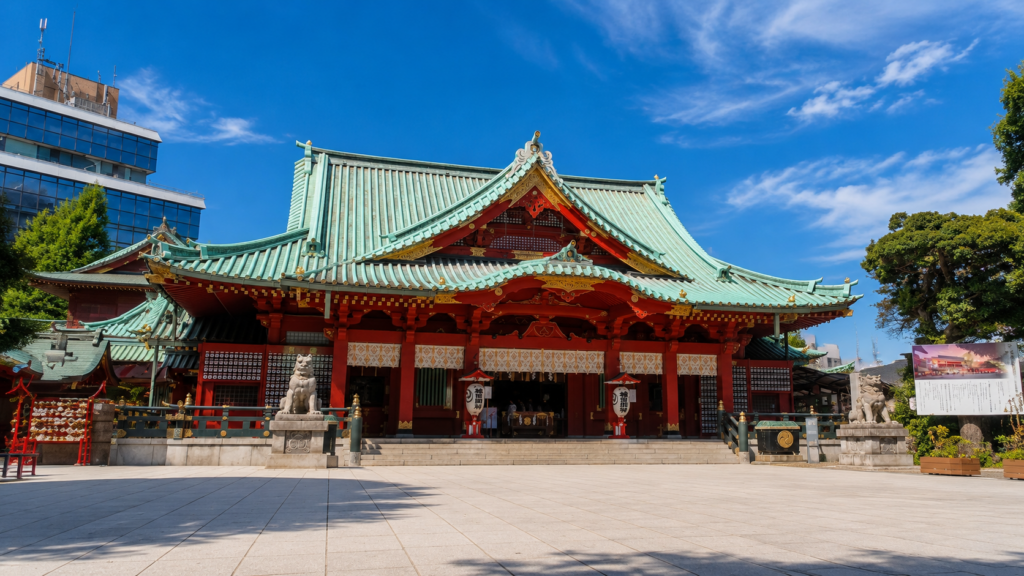
Most people don’t realize that Akihabara has more to offer than anime and electronics. A few lesser-known spots in the area give you a completely different side of the neighborhood—and they’re worth knowing about, especially if you’re traveling with someone who isn’t into the otaku scene.
Kanda Myojin Shrine is a 7-minute walk from the station and has been a spiritual anchor for the area since the 8th century. Free to enter and open 24 hours for basic worship, it’s particularly significant in Akihabara’s context because many anime and game creators come here to pray for success in their work—especially during development of new titles or before release. The shrine’s ema (wooden prayer plaques) are decorated with anime-style drawings from visitors, which gives it a unique pop-culture character. If you visit in mid-May during an odd-numbered year, the main Kanda Matsuri festival transforms the neighborhood with portable shrines and street festivities. Best for: anyone wanting a quiet break from the neon and crowds.
2k540 Aki-Oka Artisan is a crafts market under the railway tracks between Akihabara and Okachimachi stations. Open 11:00 to 19:00 (closed Wednesdays), this elevated arcade houses about 50 workshops and stores run by artisans—jewelry makers, leather crafters, woodworkers, ceramic artists, and knife forgers. It’s a completely different atmosphere from the rest of Akihabara: quiet, naturally lit, and focused on craftsmanship rather than pop culture. Best for: travelers interested in handmade Japanese goods, gifts, or a calm alternative to the main strip.
Akiba Fukurou is an owl cafe about 3 minutes from the station. It operates on a small-group, reservation-only system, with current published hours of 11:00 to 19:00. Because pricing and available reservation slots can change, check the official booking page before building your day around it. Best for: travelers specifically interested in an animal-cafe experience and willing to reserve ahead.
The area around Mansei Bridge and UDX offers a more modern, open side of Akihabara with seating, a large building hosting corporate offices and convention spaces, and a view of the station that works well for photos.
When to Go — Timing for Different Goals
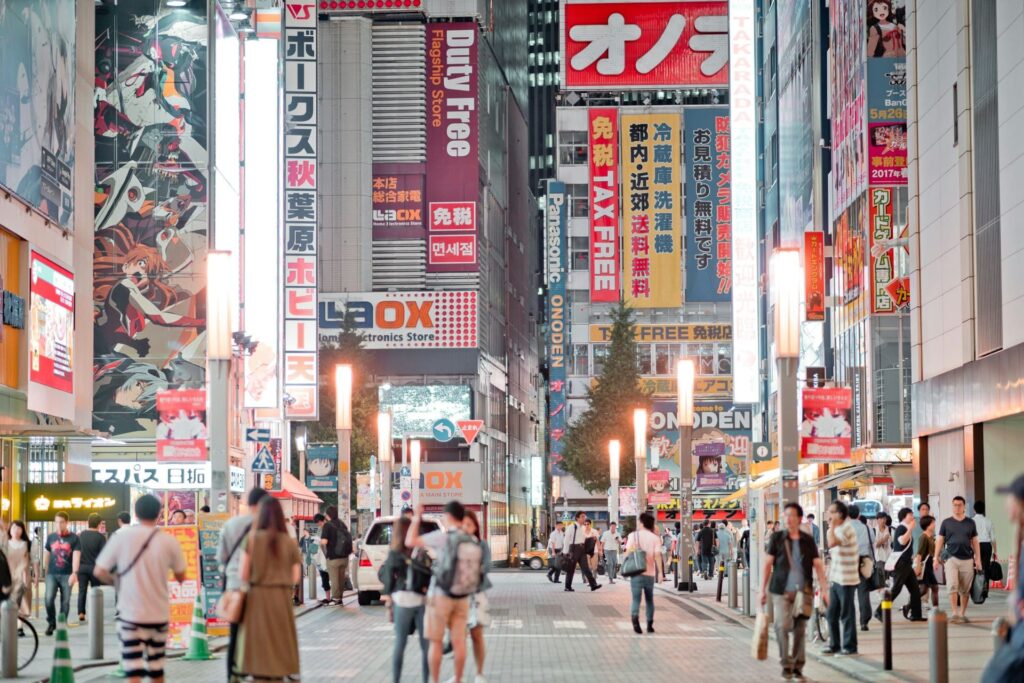
The time of day and day of the week you visit Akihabara completely changes the experience. Here’s how to match your timing to your priorities.
Sunday Afternoon (Pedestrian Paradise)
Every Sunday from around 13:00, Chuo-dori—Akihabara’s main street—closes to vehicle traffic between Sotokanda 5-chome and Mansei Bridge intersections. The exact end time varies by season: 17:00 from October through March, 18:00 from April through September. It can be cancelled because of rain, stormy weather, strong winds, or a forecast of bad weather.
The appeal is simple: for a few hours, you can walk down the middle of Chuo-dori instead of being confined to the sidewalks, which makes the scale and energy of Akihabara much easier to take in and photograph. Do not expect an official street-performance or market event—sales, performances, street live music, and cycling are prohibited inside the pedestrian zone. It is still one of the busiest times to visit, and popular stores can feel much more crowded than on a weekday.
Kai’s tip: Sunday afternoon is excellent for spectacle and photos, but it’s the worst time for serious shopping. If you want to browse Super Potato’s retro game selection, sort through Mandarake’s used figures, or ask staff questions about electronics, go on a weekday morning instead. On a Sunday, staff are too busy managing queues to give you the time of day. For buying, I always recommend weekday mornings (11:00–13:00); for atmosphere and photos, Sunday afternoon is unmatched. Pick your priority.
Weekday Mornings (11:00–14:00)
The ideal window for focused shopping and photography. Crowds are thin, store staff are available for questions, and you can move through buildings at your own pace. The trade-off: some shops don’t open until 11:00 or 12:00, and you won’t get the car-free Chuo-dori atmosphere of Sunday afternoon. If your goal is to find specific merchandise without the rush, this is your window.
Evening / Night (19:00–23:00)
Electronics shops begin closing around 20:00, and most anime stores are shut by 21:00. What remains active: arcades (Taito Station open until 23:45 and Silk Hat Akihabara until 24:00), maid cafes (some locations have evening/night sessions), and restaurants. The neon signs on Chuo-dori are fully lit after dark, making it a good time for photos of the street itself. Best for: arcade gaming, a maid cafe dinner experience, or evening photography of the neon signage.
How to Navigate Akihabara — A Local’s Approach
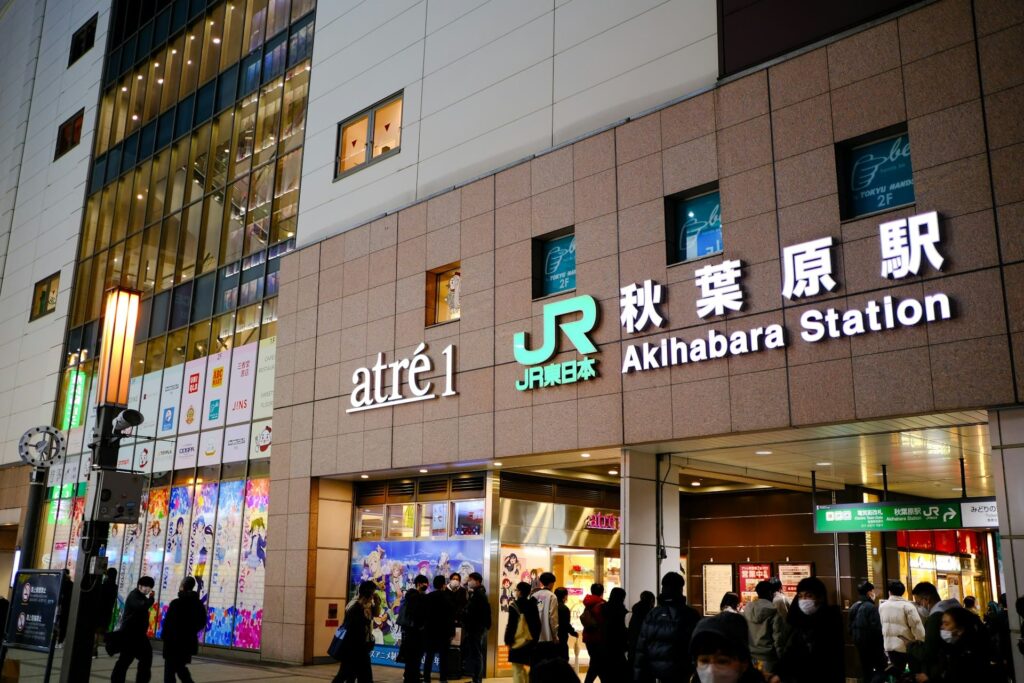
The single biggest mistake first-time visitors make in Akihabara is staying at street level. The ground-floor shops along Chuo-dori are the most visible—they have English signs, wide entrances, and prime foot traffic. But that’s exactly why they’re the most expensive and least interesting options.
Kai’s tip: The real Akihabara is hidden in plain sight—upstairs and downstairs. The buildings that look unremarkable from street level often contain the best shops on their 5th or 6th floors. A small signboard in Japanese near the entrance (not visible from across the street) is usually what you’re looking for. The efficient way to explore: walk into any building that looks promising, take the elevator to the top floor, then walk down floor by floor. This is how local enthusiasts shop. You’ll find Mandarake’s best used figure floor is the 8th floor of their building. Radio Kaikan itself has shops from the lower floors upward, but the broader point still holds: many of Akihabara’s best stores are above street level. If you only walk the street, you see maybe 20% of what Akihabara actually offers.
Getting there: If your first goal is Radio Kaikan, the anime shops, or the west side of the district, arrive at JR Akihabara Station and use the Electric Town Exit. Yodobashi Akiba is instead on the Central Gate/east side of the station. JR Akihabara is served by the Yamanote Line, Keihin-Tohoku Line, and Chuo-Sobu Local Line; the area is also served by the Tsukuba Express and Tokyo Metro Hibiya Line. From Tokyo Station, the Yamanote or Keihin-Tohoku Line is a short direct ride; from Shinjuku, the Chuo-Sobu Local Line runs directly to Akihabara.
DIY vs. Guided Tour — Which Works for You?
Akihabara is perfectly walkable on your own, and if you’re comfortable navigating Japanese retail and have a clear idea of what you want to see, DIY is the way to go. But there’s one scenario where a guided tour makes genuine sense, and it’s worth being honest about it.
DIY is best if: You’re already familiar with anime, games, or Japanese pop culture and know what you’re looking for. You’re comfortable going into buildings beyond the street level and exploring floors on your own. You have at least 3–4 hours to spare. You speak some English and Japanese (or are comfortable with gesture-based communication).
A guided tour can help if: You’re visiting Akihabara for the first time and feel overwhelmed by the sheer number of shops and choices. You want to visit a maid cafe but don’t feel confident walking into one alone. You’re worried about accidentally stumbling into a scam bar or paying inflated prices. You have limited time and want someone who knows the buildings to take you directly to the best floors and shops. You’re traveling with non-fans and want a guide who can make the experience engaging for everyone.
What a typical guided experience includes: Most Akihabara pop-culture walking tours run 2.5 to 3 hours and include stops at an anime figure shop, a retro game store, a gachapon hall, and a maid cafe visit with a set menu (so there’s no confusion about pricing). Tours are led by English-speaking guides who explain the cultural context behind what you’re seeing—why certain figures are valuable, how the retro game market works, what the maid cafe etiquette actually means.
The honest middle ground: You can also do a hybrid—explore the main street on your own for the first hour, then book a short guided session that focuses on the specific area (like a maid cafe visit) you’re least confident about. The key is knowing your own comfort level with navigating a dense, multi-floor shopping district where most signage is in Japanese.
If you fall into that camp — you want the maid cafe and hidden-shop experience, but wandering alone would not satisfy you — this is the one booking to compare before deciding.
Why I’d book this one
- Recent travelers consistently mention the value of having a guide who can translate Akihabara’s pop-culture layers rather than just point at shops.
- The route fits the exact first-timer problem in this guide: anime stores, games, gachapon, and a maid cafe without having to guess which building or floor to enter.
- It is a low-commitment way to test Akihabara: check the current start times, cancellation terms, and recent reviews before deciding whether it belongs in your Tokyo schedule.
Practical Tips for Your Visit
- Cash vs. card: Major stores (Yodobashi, Animate, Bic Camera) accept credit cards and IC cards (Suica, Pasmo—see our Tokyo Subway Ticket vs Suica comparison). Many smaller used-goods shops and independent retro game dealers are cash-only. Maid cafes like @home café and Maidreamin accept cards. Carry at least ¥10,000 in cash to be safe.
- Tax-free shopping: Bring your passport and check that the store participates. Japan’s tax-free procedure changes on November 1, 2026; see the detailed tax-free note in the Electronics section above for the current rule.
- Luggage: Coin lockers are available at and around Akihabara Station. On busy weekends they can fill up, so if you’re carrying a large suitcase, store it before you start browsing the narrow multi-floor shops.
- Touts and scams: Don’t follow street touts into a venue you did not choose yourself. For a maid cafe, check the official location and prices first, then walk there directly.
- Escalator etiquette: Current safety guidance is to stand still rather than walk on the escalator, and to hold the handrail when possible. Don’t assume the old “stand left, walk right” habit is the rule you should follow.
- Restrooms: This sounds trivial, but public restrooms are scarce in Akihabara. Available inside: Yodobashi Akiba (multiple floors), Radio Kaikan (basement and upper floors), and Taito Station. Convenience stores (7-Eleven, FamilyMart) have restrooms but are for paying customers.
Akihabara + Nearby Areas (Easy Add-Ons)
One of Akihabara’s underrated advantages is its proximity to other parts of Tokyo that work well as a combined visit.
Ueno and Ameyoko (15-minute walk or 2 stops on the Yamanote Line): From Akihabara Station, the Yamanote Line reaches Ueno in two stops, via Okachimachi. Ameyoko is the lively market street under the tracks—great for street food, discount cosmetics, and sports apparel. It’s a completely different energy from Akihabara: more traditional market chaos than pop-culture spectacle.
Asakusa (about 4–5 minutes by Tsukuba Express): The Tsukuba Express from Akihabara Station reaches Asakusa in about 4–5 minutes, or you can take the Tokyo Metro Hibiya Line from Akihabara to Ueno and transfer to the Ginza Line. Senso-ji Temple and Nakamise-dori shopping street offer the traditional Tokyo that Akihabara deliberately isn’t (you can pair them using our perfect Asakusa half-day itinerary).
Suggested half-day combo: Morning in Akihabara (shopping and arcades, crowd-free) → early lunch → walk north through Okachimachi toward Ueno → Ameyoko market → Ueno Park for a break. This fills a half-day comfortably without backtracking.
FAQ — Akihabara for First-Timers
Is Akihabara worth visiting if I’m not into anime?
Yes, but with the right expectations. If you’re not into anime or gaming, your Akihabara experience will be about the spectacle—the neon-lit arcade façades, the density of electronics and gadget stores, the car-free Chuo-dori atmosphere on Sunday afternoons, and the sheer novelty of a district built entirely around pop-culture consumerism. Give it two hours, walk the main street, visit Yodobashi Akiba and the 2k540 artisan market, and you’ll leave with a solid sense of why the neighborhood is famous. You probably don’t need to go into the multi-floor anime shops below street level—those are aimed at fans.
Are maid cafes safe for solo travelers and women?
Yes—established maid cafes regularly serve solo travelers, women, couples, and families. Check the official menu and pricing before you go, and expect to pay for the themed experience, not just the food or drink.
How much time do I need in Akihabara?
For a quick look: 2 hours (walk Chuo-dori, visit one arcade and one electronics store). For a satisfying visit with anime shopping and a maid cafe: 4 hours. For a full deep dive including retro gaming, multiple figure shops, and evening arcades: plan for 5–6 hours or come back on a Sunday afternoon for the pedestrian paradise. Most travelers find that 3–4 hours strikes the right balance between seeing everything and not feeling overwhelmed.
What’s the best day to visit Akihabara?
It depends on your priority. If you want to walk Chuo-dori without traffic and see Akihabara at its busiest, come on a Sunday afternoon during the pedestrian zone. If you want to shop efficiently with fewer crowds, come on a weekday morning (Tuesday through Thursday are usually easier). Avoid Saturdays if you dislike crowds, and note that many smaller shops open later (around 12:00) or close on irregular days.
Can I buy tax-free electronics in Akihabara?
Yes, at participating retailers such as Yodobashi Akiba, Sofmap, and Bic Camera. Bring your passport and confirm the store’s current tax-free procedure before paying; the Electronics section above explains the current rule and transition in detail.
Final Verdict — Choose Your Akihabara Experience
For first-time visitors: Start at the Electric Town Exit and go first to Radio Kaikan, then continue to Super Potato for nostalgia browsing. If you’re curious about maid cafes, choose an established venue such as @home café and check its official location and menu before you go. Total time: 3–4 hours. Don’t skip the 2k540 artisan market if the arcades feel overwhelming—it’s a calm reset.
For anime and gaming fans: Radio Kaikan and Mandarake Complex are your primary targets. Budget at least 2 hours between them. Add Animate if you want current-season merchandise, and end with the 5th floor retro arcade at Super Potato or one of the larger modern arcades such as Taito Station or Silk Hat. Consider visiting on a Sunday for the car-free Chuo-dori atmosphere—but do your actual shopping on a separate weekday trip.
For non-fans / curious travelers: Skip the deep-dive anime buildings. Walk Chuo-dori for the neon spectacle, visit Yodobashi Akiba for electronics (the camera floor is particularly good for demo-ing gear), and spend time at 2k540 Aki-Oka Artisan for the craft market. Kanda Myojin Shrine is a 7-minute walk and offers a genuine piece of Tokyo history. Total time: 2 hours is enough to say you’ve seen it.
For families with kids (ages 8+): Taito Station (crane games and rhythm games) and Gachapon Kaikan (capsule toys) are the most kid-friendly activities. Super Potato’s retro arcade on the 5th floor is also fun for children who enjoy classic games. Maid cafes are generally fine for older kids who understand the “performance” aspect, but younger children may find the format confusing. Avoid the densest shopping floors (Radio Kaikan’s upper figure floors) during peak hours—the aisles are narrow.
For repeat visitors: Skip the main street and focus on what’s changed since your last visit. Check for new floors at existing buildings (Mandarake Complex 2 opened in 2025), explore the side streets west of Chuo-dori for independent hobby shops, or try a themed experience you skipped last time—a maid cafe dinner, a retro arcade tournament, or a visit to Akiba Fukurou if you haven’t done an animal cafe. The neighborhood evolves quickly enough that even a yearly visitor finds something new.

Hi, I’m Kai. I’m a Tokyo-based travel writer, tourism industry insider, and the author of a published guidebook for international visitors to Japan. With over 10 years of professional experience at a leading Japanese tourism company, my mission is to help you skip the tourist traps and navigate Japan’s best destinations like a local. I believe the perfect day trip is like a traditional kaiseki meal: a beautiful balance of precise planning and unforgettable seasonal discovery. When I’m not out conducting field research, you’ll usually find me drafting new itineraries with one of my favorite fountain pens!