
Yes, Okinawa is one of the most tattoo-friendly destinations in Japan. Visible tattoos are generally accepted at public beaches, most sightseeing spots, restaurants, and casual coastal areas. However, each hotel and facility sets its own rules, and the same resort can allow tattoos at the beach while restricting them at the pool, spa, or public bath.
I’m Kai Tanaka, a Japan-based travel writer, and this is the question I hear most from inked travelers planning Japan: “Where can I actually swim and bathe without being asked to cover up?” Okinawa is the best answer in the country — but only if you pick the right hotel. This 2026 guide explains where you can swim, soak, and explore with visible ink, which resorts have clear tattoo policies, and how to plan at least one low-stress day where tattoo rules simply do not matter.
Quick Answer for Tattooed Travelers
Yes, Okinawa is relatively tattoo friendly by Japan standards, but rules still vary by facility. Public beaches and sightseeing spots are usually easy. Hotel pools, resort beaches, spas, and public baths need more checking.
- Public beaches — usually the lowest-risk option for visible tattoos.
- Resort pools — check the hotel policy before booking. Some allow tattoos, others restrict them.
- Resort-managed beaches — often more relaxed than pools, but still controlled by the hotel or beach operator.
- Public baths and hotel spas — the most likely places to have tattoo restrictions.
- Private baths — the easiest bath option for large tattoos, sleeves, or anyone who wants no shared-bath stress.
- Clothes-on sightseeing — Churaumi Aquarium, Cape Manza, Kouri Island, American Village, markets, castles, and scenic cafes are the safest itinerary choices for visible ink.
Important: Pool rules, beach rules, and public bath rules are not always the same, even inside the same hotel. Always check each facility separately.
If you want one easy day with no pool, spa, or bath rules to think about, build your route around clothes-on sightseeing. For many first-time visitors, that means Churaumi Aquarium, Kouri Island, Cape Manza, and American Village instead of a pool-and-onsen day.
Tattoo-Friendly Okinawa at a Glance
| Place or Facility | Visible Tattoo Risk | Cover-Up Likely Needed? | Best For | Check Before You Go |
|---|---|---|---|---|
| Natural or public beaches | Low | Usually no | Relaxed swimming, casual beach days, photos | Swimming conditions, jellyfish nets, lifeguards, parking |
| Resort-managed beaches | Low to medium | Sometimes | Families, beach rentals, showers, safer facilities | Hotel beach rules and day-visitor access |
| Hotel pools | Medium to high | Depends on the resort | Resort stays and family travel | Official pool policy for visible tattoos |
| Public baths and hotel spas | High | Often yes | Travelers with small tattoos that can be fully covered | Tattoo rules, cover-seal size, public bath access |
| Private baths or rooms with private baths | Low | Usually no | Couples, families, large tattoos, full sleeves | Whether the bath is fully private and bookable |
| Sightseeing spots | Very low | No | Churaumi Aquarium, Cape Manza, Kouri Island, American Village | Opening hours, tickets, transport, weather |
Resort Pool and Beach Policies — What to Check First
For tattooed travelers, the biggest mistake is assuming all Okinawa resorts follow the same rule. They do not. The table below groups major hotels into practical categories: clearer tattoo-friendly policies, reported friendly, conditional access, and restricted or unverified policies.
Treat this table as a planning starting point, not a final guarantee. Policies can change by season, renovation, crowding, management decision, or the specific facility you want to use. Before booking, confirm directly with the hotel in writing.
| Resort or Facility | Pool | Beach | Public Bath or Spa | Cover Needed? | Planning Category |
|---|---|---|---|---|---|
| Oriental Hotel Okinawa Resort & Spa (Nago) | Garden pool is listed as tattoo-OK by Japanese travel media and tattoo-friendly facility directories | Check beach or partner-facility rules separately | Bathing facilities are also reported as tattoo-permitted under the hotel FAQ — confirm in writing | Not generally required under the reported policy | ✅ Clearer policy |
| Hyatt Regency Seragaki Island Okinawa (Onna) | Tattoos permitted under the listed hotel policy | Tattoos permitted under the listed hotel policy | Guest reports as of 2026 describe tattooed guests using pool, sauna, and spa facilities without restriction — no official written bath policy found, so confirm before booking | Not generally required for pool or beach, unless the tattoo may be considered intimidating or offensive | ✅ Clearer policy |
| Hotel Monterey Okinawa Spa & Resort (Onna) | Sunset Garden pool area is listed as tattoo-OK in Japanese tattoo-friendly facility directories | Check resort beach rules separately | Check directly — pool listings do not cover the bath and spa facilities | Confirm by facility | ⚠️ Reported friendly — verify |
| Okinawa Kariyushi Beach Resort Ocean Spa (Onna) | Listed as tattoo-OK in Japanese tattoo-friendly facility directories | Check resort beach rules separately | Check directly before booking | Confirm by facility | ⚠️ Reported friendly — verify |
| ANA InterContinental Manza Beach Resort (Onna) | Check current pool policy before booking | Check directly before booking | Reported as tattoo-friendly for its ocean-view bathing as of 2026 — confirm the current policy in writing | Confirm before relying on visible-tattoo access | ⚠️ Reported friendly — verify |
| Grand Mercure Okinawa Cape Zanpa Resort (Yomitan) | Check current pool policy before booking | Check resort beach rules separately | Public bath access is conditional if tattoos can be covered with approved hotel cover stickers | Yes for public bath use if tattoos are visible | ⚠️ Conditional |
| Okinawa Prince Hotel Ocean View Ginowan | Tattooed guests are not allowed to use the pool area under the listed FAQ policy | Check separately | Tattoos are also restricted in the listed spa-area policy | Covering may not be enough | ❌ Restricted |
| Hilton Okinawa Chatan Resort / Halekulani Okinawa | Check directly before booking | Check directly before booking | Check separately — spa policies may differ from pool rules | Confirm cover-up requirements in writing | ⚠️ Unverified in this guide |
Booking tip: When you contact a hotel, ask about the pool, beach, spa, and public bath separately. A simple “Are tattoos allowed?” may not get you a precise answer.
Kai’s tip: I always tell readers to ask about the exact place they plan to use, not the hotel in general. A front desk may say “tattoos are okay” for the beach, while the large public bath has a separate rule. Write one email that lists pool, beach, spa, public bath, and private bath as separate questions.
Where to Stay: The Two Safest Bets for Tattooed Travelers in 2026
If you want the pool-and-resort experience with the least policy anxiety, two properties stand out because their tattoo acceptance is documented in multiple independent sources rather than rumored:
Oriental Hotel Okinawa Resort & Spa (Nago)
The strongest documented case in Okinawa. The hotel’s tattoo acceptance is listed in Japanese travel media and tattoo-friendly facility directories, covering its signature 170-meter garden pool with a long waterslide, a dedicated kids’ pool, and East China Sea sunset views. There is also a year-round heated indoor pool and a spa floor with five bath types. All 361 rooms are 44㎡ or larger with ocean-view balconies following the 2024 full renovation, and a free shuttle runs to a nearby private beach. It is the rare Okinawa resort where even the bathing facilities are reported as tattoo-permitted under the hotel’s own FAQ — though I would still get that in writing before you book.
Check room rates and availability for Oriental Hotel Okinawa Resort & Spa
Hyatt Regency Seragaki Island Okinawa (Onna)
A resort spread across its own small island linked by bridge to the Onna coast, with all 343 rooms in two ocean-view complexes. The draw for tattooed travelers is the water circuit: outdoor seawater pools, a warm indoor pool, jacuzzi, sauna, and an ocean-view spa, where guest reports through 2026 consistently describe tattooed visitors using every facility openly. Overnight guests also get early pool access before day visitors arrive — worth it for the quiet morning water alone. Two practical notes: some outdoor facilities close seasonally from early December to mid-March, and a small resort fee applies per person per night during the main season, so check both against your dates.
Check room rates and availability for Hyatt Regency Seragaki Island Okinawa
Both are on the resort coast north of Naha, so pair them with a rental car or a guided day tour for sightseeing. And even for these two, the golden rule holds: policies can change, so save a written confirmation before you travel.
Why Okinawa Feels More Relaxed Than Mainland Japan
Okinawa often feels more relaxed for tattooed travelers than places such as Tokyo, Kyoto, or traditional onsen towns. International tourism, beach culture, and the long presence of overseas residents mean visible tattoos are not unusual in many public areas.
That relaxed atmosphere does not remove private business rules. Hotels, pools, spas, and beach operators can still set their own policies. Think of Okinawa as a more comfortable destination for tattooed travelers, not as a place where every facility is automatically tattoo friendly.
In practical terms, the split is simple: streets, beaches, cafes, restaurants, and sightseeing spots are usually easy; paid water facilities and shared baths need checking.
One more thing worth knowing before you plan a “tattoo-friendly onsen” day here: Okinawa has almost no volcanic hot springs. Unlike Beppu, Hakone, or Kurokawa, the island’s bathing scene is built on resort hotel spas and mineral-rich water pumped from deep underground, with only a handful of facilities labeled tennen onsen (natural hot spring). That is actually good news for inked travelers: resort-run baths answer to hotel policy rather than old onsen-town tradition, which is a big part of why Okinawa’s bathing culture is the most negotiable in Japan. It also reflects a wider shift — some Japanese bathhouses have publicly dropped their tattoo bans in recent years, citing the lack of any legal basis and the growth of international tourism.
Public Beaches vs Resort-Managed Beaches
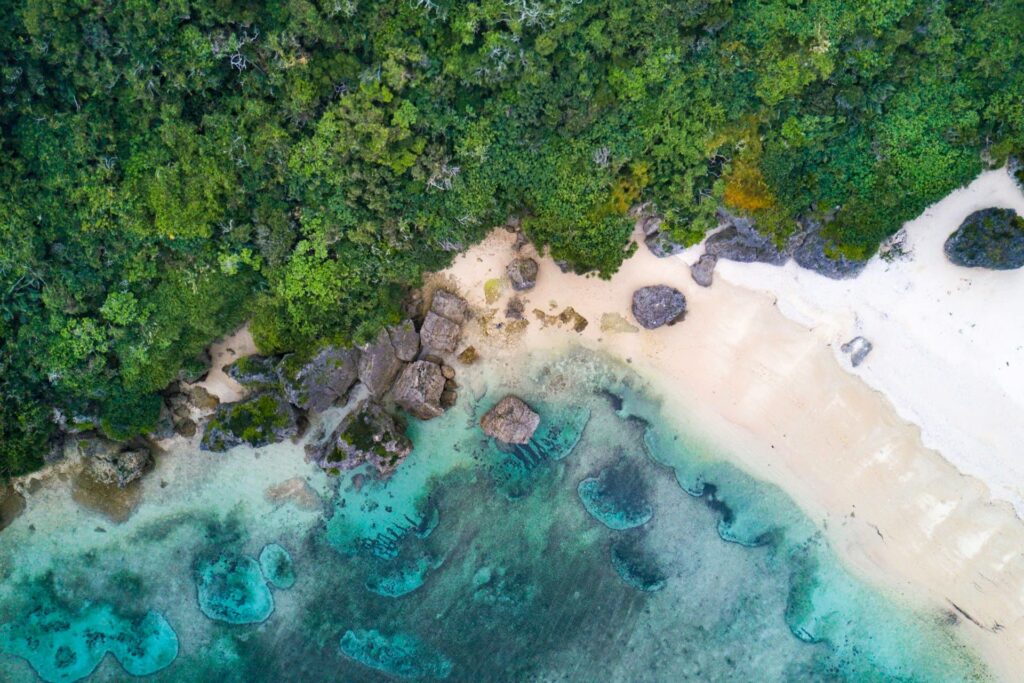
Beach rules in Okinawa depend on who manages the beach. A natural public beach is usually more relaxed, but it may have fewer safety facilities. A resort-managed beach is more convenient, but staff may enforce hotel rules.
| Feature | Natural or Public Beach | Resort-Managed Beach |
|---|---|---|
| Visible tattoo risk | Usually low | Low to medium, depending on the resort |
| Staff enforcement risk | Low, if the beach is open and unmanaged | Higher, because hotel or beach staff may check rules |
| Cover-up likely needed? | Usually no | Sometimes, especially at family-focused resorts |
| Facilities | Basic toilets or limited showers | Showers, rentals, cafes, lifeguards, beach houses |
| Safety facilities | Varies widely | More likely to have lifeguards and jellyfish nets |
| Best for | Independent travelers, photos, relaxed beach visits | Families, resort stays, rentals, easier facilities |
| Examples | Kouri Beach, Mibaru Beach, local island beaches | Busena Beach, Moon Beach, hotel-operated beach areas |
If you have large tattoos and want the lowest chance of an awkward conversation, public beaches are usually easier. If you want showers, rentals, and safer swimming areas, a resort-managed beach may be worth it — but check the rules first.
Kai’s tip: The mistake I see travelers make is choosing only by tattoo comfort and forgetting ocean safety. A relaxed public beach is not automatically the best swimming beach, especially with children or weak swimmers. If you are choosing between a casual beach and a managed beach, compare lifeguards, jellyfish nets, showers, parking, and water conditions before you compare tattoo rules.
Rash Guards, Jellyfish and Cover-Up Tips
In Okinawa, a rash guard is not just a tattoo cover-up. It is practical beach gear. Many local swimmers and visitors wear rash guards for sun protection, jellyfish protection, and comfort in the water.
- UV protection: Okinawa’s sun can be intense, especially from late spring through early autumn. A rash guard helps reduce sunburn risk during long beach days.
- Jellyfish protection: Box jellyfish and Habu jellyfish are seasonal safety concerns in Okinawa. A long-sleeve rash guard gives your skin an extra barrier.
- Weather planning: If your trip overlaps with the warmer swimming season, check this Okinawa weather and swimming-season guide before building a beach-heavy itinerary.
- Social buffer: At a stricter pool or resort beach, a rash guard can help avoid unwanted attention without making you feel out of place.
- Backup plan: Even if you choose tattoo-friendly hotels, carrying a light rash guard or cover-up gives you flexibility if rules are enforced differently on the day. Some Okinawa-prefecture resorts — particularly on the outer islands — officially allow tattooed guests at pools only if tattoos are fully hidden by a seal or rash guard, so packing one keeps every facility type open to you.
For sea swimming, prioritize beaches with lifeguards, jellyfish nets, and clear swimming conditions. Tattoo rules matter, but ocean safety matters more.
Kai’s tip: When I send friends to Okinawa, I tell them to pack a rash guard even if they have no tattoos at all. It solves three problems at once: sun, minor marine-sting protection, and last-minute cover-up requests at stricter facilities. Choose one you can actually swim in, not just a loose shirt that becomes heavy in the water.
Public Baths, Hotel Spas and Private Baths
Onsen-style baths, hotel spas, sento, and large public baths are the places where tattoo rules are most likely to feel strict. Even in Okinawa, a relaxed beach atmosphere does not automatically mean visible tattoos are allowed in shared bathing areas.
The key difference is privacy. Shared baths usually have stricter rules because everyone uses the same bathing space. Private baths are easier because you are not sharing the bath with other guests.
| Bath Type | Tattoo Risk | Best Option For | What to Check |
|---|---|---|---|
| Large public bath | High | Travelers with small tattoos that can be fully covered | Whether cover seals are allowed and what size is accepted |
| Hotel spa or relaxation bath | Medium to high | Guests who can confirm the policy before arrival | Whether the spa has a separate tattoo policy from the pool |
| Private bath | Low | Large tattoos, sleeves, couples, families | Whether the bath is fully private and bookable in advance |
| Room with private bath | Very low | Travelers who want no shared-bath stress | Whether the bath is in-room, open-air, or shared by reservation |
If you want a bath experience in Okinawa and have large tattoos, look for rooms with private baths or bookable private bathing spaces. This usually avoids the main issue: visible tattoos in a shared public bath.
Do not assume that “pool allowed” also means “public bath allowed.” These rules are often separate, even within the same resort.
Tattoo Cover Seals in Okinawa — Do They Work?
Tattoo cover seals, also called tattoo cover stickers, are skin-colored adhesive patches designed to hide tattoos in public baths and pools. They can work well for small tattoos, but they have real limitations in Okinawa’s beach and pool environment.
Where cover seals actually help
- Public baths and hotel spas — Some facilities explicitly allow tattoos if they are covered with approved seals. Check the accepted size and type before buying.
- Stricter hotel pools — A few resorts accept cover seals for pool use, though many do not. Confirm by email before relying on this option.
Where cover seals may not work
- Beaches and ocean swimming — Salt water, sand, and sun exposure can cause adhesive seals to peel off quickly.
- Large tattoos and sleeves — Standard cover seals usually cannot hide full sleeves, large back pieces, or large leg tattoos.
- Facilities with strict no-tattoo policies — Some resorts do not allow tattooed guests in certain areas even if the tattoos are covered.
Where to buy cover seals in Okinawa
- Amazon Japan — Search for “tattoo cover seal” or “tattoo cover patch.” Delivery timing to Okinawa varies, so order early if you need them.
- Don Quijote — Major locations in Naha and American Village sometimes stock cover seals in the cosmetics section.
- Drugstores — Larger pharmacy chains occasionally carry tattoo cover products near first-aid or cosmetics supplies.
- Bring from home — If you already know you will need cover seals, buying them before your trip is the most reliable option.
Bottom line: Cover seals are a useful backup for small tattoos at stricter pools and public baths, but they are not a guaranteed solution for all facilities. A rash guard or choosing tattoo-friendly hotels is usually more reliable.
Sample Itinerary: A Tattoo-Friendly Day in Okinawa
If you want a full day with zero tattoo stress, build the day around sightseeing instead of pools and shared baths. This sample route keeps you in clothes-on places where visible tattoos are generally not an issue.
| Part of Day | Activity | Tattoo Notes |
|---|---|---|
| Morning | Churaumi Aquarium — whale sharks, coral exhibits, Ocean Expo Park | No tattoo restrictions. Good indoor option for hot, rainy, or windy weather. |
| Lunch | Ocean-view cafe near Motobu, Kouri Island, or Onna | No tattoo restrictions at most casual restaurants and cafes. |
| Afternoon | Kouri Island, Cape Manza, or a public beach stop | Low tattoo risk. Wear a rash guard for sun protection and peace of mind. |
| Late afternoon | Coastal lookout, bridge viewpoint, or photo stop | No tattoo restrictions. |
| Evening | Dinner at American Village, Naha, or a local izakaya | No tattoo restrictions at most restaurants and bars. |
Other good clothes-on options to swap in: Shuri Castle Park, local markets, scenic cafes, and coastal viewpoints. If you are planning a short trip without renting a car, compare your base and route with this Okinawa 3-day no-car itinerary, and read my Okinawa without a car guide before you choose a remote resort.
Recommended low-stress option: Okinawa highlights full-day tour
If your main concern is avoiding awkward pool, spa, or bath conversations, the easiest choice is not always a different resort. Sometimes it is a smarter day plan. A clothes-on northern Okinawa tour lets you enjoy the island’s biggest sightseeing highlights while completely avoiding the facilities where tattoo rules are most likely to be enforced. For a broader route comparison, see my Churaumi Aquarium tour guide from Naha and this organized northern Okinawa day trip guide.
Why I’d book this one
- It avoids the tattoo-rule problem entirely: Churaumi Aquarium, scenic viewpoints, island bridges, and town stops are not shared bathing or pool facilities.
- It solves the no-car problem: Northern Okinawa is spread out, and public transport can be slow or awkward for first-time visitors.
- It gives you a structured backup day: If your resort pool has stricter rules than expected, or if beach weather is poor, you still have a full Okinawa day planned.
Recent traveler feedback on similar Okinawa highlights tours tends to mention organized pacing, helpful guiding, and the convenience of seeing several distant stops in one day. As always, check the booking page for the latest route, reviews, inclusions, cancellation terms, meeting point, and ticket details before you reserve.
Check Availability: Okinawa Full Day Tour — see current stops, reviews, and inclusions
| Choice | Best For | Tattoo Stress | Planning Work | Cost Note |
|---|---|---|---|---|
| DIY by rental car | Confident drivers and repeat visitors who want flexible beach and cafe stops | Low for sightseeing, but you must check pools, beaches, and baths yourself | High — driving, parking, route timing, weather changes | Varies by rental, insurance, fuel, parking, and tickets |
| Guided full-day tour | First-time visitors, no-car travelers, arrival-day planning, bad-weather backups | Very low if the route focuses on clothes-on sightseeing | Low — transport and pacing are handled | Check current price and inclusions on the booking page |
Booking Checks for Tattooed Travelers
Before booking a hotel, search the official FAQ for the words “tattoo,” “pool,” “beach,” “spa,” “public bath,” and “large bath.” If the policy is unclear, email the hotel before you reserve.
Use a direct question instead of asking only whether the hotel is tattoo friendly. A better message is:
Hello, I am planning to stay at your hotel and I have visible tattoos. Could you confirm whether visible tattoos are allowed at the pool, beach, spa, and public bath? If cover seals are required, could you tell me the allowed size and whether large tattoos can be covered with clothing or a rash guard?
Save the reply on your phone. If there is confusion at check-in or at the pool desk, a written answer from the hotel can make the conversation much easier.
- Ask separately: pool, beach, spa, and public bath rules may differ.
- Check cover rules: some facilities only allow small tattoos that can be fully hidden with approved seals.
- Confirm day-visitor access: some resort beaches and pools are for hotel guests only.
- Keep a backup plan: bring a rash guard, light cover-up, or beach shirt.
- Recheck close to travel: hotel policies can change by season, renovation, or management decision.
FAQ
Is it illegal to have tattoos in Japan?
No. Having tattoos is not illegal in Japan. Tattoo restrictions at pools, spas, gyms, and public baths are private business policies, not laws — in fact, some Japanese bathhouses have publicly lifted their tattoo bans in recent years, noting that public bathing law provides no legal basis for excluding tattooed guests.
Is Okinawa more tattoo friendly than mainland Japan?
For many travelers, yes. Okinawa feels more relaxed because of its beach culture, international visitors, and resort atmosphere. However, private facilities can still enforce tattoo rules, especially at pools and shared baths. If your trip also includes a traditional mainland onsen town, the rules there are stricter and vary by ryokan — for the Kyushu area, see my dedicated guide to tattoo-friendly bathing in Kurokawa Onsen.
Are there real onsen in Okinawa?
Only a few. Okinawa has almost no volcanic activity, so most bathing facilities are resort hotel spas or baths using mineral-rich water pumped from deep underground, with a small number labeled tennen onsen. For tattooed travelers this is an advantage: resort-run baths follow hotel policy, which is easier to confirm — and sometimes friendlier — than traditional onsen-town rules.
Can I show my tattoos at public beaches in Okinawa?
Usually, yes. Natural and public beaches are generally the lowest-risk places for visible tattoos. Always check swimming conditions, local signs, lifeguard information, and jellyfish warnings regardless of tattoo rules.
Can I use hotel pools in Okinawa with tattoos?
It depends on the hotel. Some Okinawa resorts clearly allow visible tattoos at pools, while others restrict tattooed guests entirely. Always check the official pool policy before booking — covering may not be accepted at stricter properties.
Are resort beaches different from public beaches?
Yes. Resort-managed beaches may be controlled by a hotel or beach operator, so staff can enforce private facility rules. Public or natural beaches are usually more relaxed, but may have fewer showers, rentals, lifeguards, or jellyfish nets.
Can I enter onsen or public baths in Okinawa with tattoos?
Shared baths are the highest-risk category. Some facilities allow small tattoos if fully covered with approved seals, while others do not allow visible tattoos at all. Private baths or rooms with in-room baths are the easiest alternative.
Do tattoo cover seals actually work at pools and beaches?
Cover seals work best at public baths and spas for small tattoos. They do not hold well in salt water, sand, or sun exposure at beaches. For large tattoos and full sleeves, a rash guard or choosing a tattoo-friendly hotel is more reliable than cover seals.
What should I do if a hotel confirms tattoos are allowed but staff ask me to cover up at check-in?
Stay polite and show the written confirmation you received by email. Most front desk staff will try to follow the documented policy once they see it. If the issue persists, ask to speak with a manager.
Can I show tattoos at Churaumi Aquarium or American Village?
Yes. Major sightseeing places such as Churaumi Aquarium, American Village, Cape Manza, and Kouri Island generally do not have tattoo restrictions.
What is the best Okinawa plan for travelers with large tattoos?
Choose hotels with clear written tattoo policies, use public beaches or private baths when you want water time, and keep at least one clothes-on sightseeing day in your itinerary. If you are staying in Naha without a car, a northern Okinawa day tour is one of the easiest low-stress options.
Final Verdict — Which Okinawa Experience Is Right for You?
Choose a hotel with clear tattoo policies if… you want to use the pool and beach without worrying about rules. Oriental Hotel Okinawa and Hyatt Regency Seragaki are the strongest starting points for 2026, but still confirm directly before booking.
Choose public beaches if… you have large tattoos or full sleeves and want the lowest possible stress. Kouri Beach, Mibaru Beach, and other natural beaches are usually your most relaxed option.
Choose a private bath or in-room bath if… you want a hot bath experience without shared-bath restrictions. This is the safest bath strategy for large tattoos, sleeves, and couples or families who want privacy.
Choose a sightseeing-focused itinerary if… you prefer not to deal with pool or bath policies at all. Churaumi Aquarium, Cape Manza, Kouri Island, and American Village are all tattoo-friendly stops that work well together on a northern Okinawa day.
For families traveling with visible tattoos: Resort-managed beaches with lifeguards and facilities are practical, but confirm the pool and beach rules before booking. Public beaches are more relaxed but offer fewer safety features for children.
For first-time visitors with tattoos: Start with a sightseeing day tour to get comfortable with Okinawa’s atmosphere. Then add beach time or switch to a tattoo-friendly resort for the rest of your stay.
The best strategy is simple: choose hotels with clear tattoo policies, ask about pool and bath rules separately, bring a rash guard for sun and jellyfish protection, and keep at least one clothes-on sightseeing day in your itinerary.
My final recommendation
If you are staying in Naha, not renting a car, or feeling unsure after reading several different hotel policies, I would make your first full day a northern Okinawa sightseeing day. It gives you Churaumi Aquarium and coastal highlights without forcing you to negotiate tattoo rules at a pool, spa, or public bath.
Why I’d book this one
- Best fit for tattoo anxiety: the value is not just sightseeing; it is removing the facility-rule problem for a full day.
- Best fit for no-car travelers: northern Okinawa is time-consuming by public transport, especially if you want more than one stop.
- Best fit for weather flexibility: aquarium and sightseeing routes are easier to salvage than a pure beach day when conditions are poor.
Book a Stress-Free Okinawa Highlights Tour — check current availability, reviews, and inclusions
Hotel policies, facility rules, cover-seal conditions, tour inclusions, opening hours, and seasonal operations can change at any time. Always confirm directly with each hotel or facility in writing, and check your selected booking page before finalizing your trip.

Hi, I’m Kai. I’m a Tokyo-based travel writer, tourism industry insider, and the author of a published guidebook for international visitors to Japan. With over 10 years of professional experience at a leading Japanese tourism company, my mission is to help you skip the tourist traps and navigate Japan’s best destinations like a local. I believe the perfect day trip is like a traditional kaiseki meal: a beautiful balance of precise planning and unforgettable seasonal discovery. When I’m not out conducting field research, you’ll usually find me drafting new itineraries with one of my favorite fountain pens!