

Noboribetsu is small enough to visit in a few hours, but spread out enough to frustrate anyone who doesn’t understand its layout. The mistake I see most often from first-time visitors is treating it like a single sightseeing zone—then realising the theme park is a 10-minute drive from the hot spring town, and the JR station is another 15 minutes beyond that.
This guide breaks down every worthwhile thing to do in Noboribetsu by where it sits, how long it takes and who it works best for. Whether you have two hours or a full night, you’ll know exactly what to prioritise—and what to skip.
If you are based in Sapporo and want to combine Noboribetsu with Lake Toya without managing separate train and bus connections, check available dates, departure details and recent traveler reviews for this guided Hokkaido day tour.
The Best Things to Do in Noboribetsu at a Glance
| Attraction | Best For | Area | Suggested Time | Cost (Adult) | Priority |
|---|---|---|---|---|---|
| Jigokudani (Hell Valley) | Volcanic landscape, steam vents, night walk | Onsen town | 30 min–2 hr | Free | ★★★★★ |
| Onibi no Michi (night walk) | Atmospheric evening experience | Onsen town (same path) | 20–40 min | Free | ★★★★★ |
| Day-use onsen | Real Noboribetsu onsen without staying overnight | Onsen town | 1–2 hr | ¥500–¥2,250 | ★★★★★ |
| Oyunuma River Natural Footbath | Free riverside hot spring dip | Onsen town (20 min walk) | 30–60 min | Free | ★★★★☆ |
| Date Jidaimura | Edo-period park, ninja & oiran shows | Naka-Noboribetsu | 2–4 hr | ¥3,300 | ★★★☆☆ |
| Noboribetsu BearPark | Brown bear viewing, ropeway views | Onsen town (ropeway) | 1–2 hr | ¥3,200 | ★★☆☆☆ |
| Marine Park NIXE | Indoor aquarium, rainy-day activities | Near JR Station | 2–3 hr | ¥3,200 | ★★☆☆☆ |
The core experience—Hell Valley plus an onsen bath—is free or very cheap. Adding a paid attraction is worthwhile if you have time, but the five-star items alone make the trip worth taking.
First, Understand the Layout of Noboribetsu
Noboribetsu has three clusters, and they are not within walking distance of each other:
- Noboribetsu Onsen (hot spring town): Where Hell Valley, the footbath, most ryokan and the day-use onsen facilities are located. This is where first-time visitors should spend their time.
- Naka-Noboribetsu: A short drive or bus ride from Onsen town. This is where Noboribetsu Date Jidaimura is located.
- JR Noboribetsu Station area: 15 minutes by bus from Onsen town. Marine Park NIXE is a short walk from the station.
The distance between these areas is the most common source of confusion. Noboribetsu Station and the Onsen town are roughly 8 km apart—about 15 minutes by Donan Bus (¥350–450). If you arrive by train, you cannot simply walk to Hell Valley. For a complete breakdown of transportation options, check our detailed guide on how to get to Noboribetsu Onsen.
1. Walk Through Noboribetsu Jigokudani (Hell Valley)

Jigokudani—”Hell Valley”—is the reason most travellers come to Noboribetsu. This 450-metre-wide crater sits right at the edge of the Onsen town, and it is still geothermally active: roughly 10,000 tons of mineral-rich hot spring water rise from the ground here every day.
The moment you step onto the boardwalk, the sulfur smell hits you. Steam rises from cracks in the rock face, and the bare, jagged terrain looks nothing like the rest of Hokkaido’s green landscape. It is genuinely unusual—closer to what you might expect at an active volcanic site than a tidy onsen resort.
From personal observation, the most common reaction I see from first-time visitors is surprise at how close you can get to the steam vents. In many volcanic areas in Japan, the viewing platforms are set well back. Here, the main walkway brings you within a few metres of the boiling water and rising vapour. It is dramatic, and it is free.
How Long Do You Need at Hell Valley?
It depends on how far you walk:
- Quick stop (30–45 minutes): Walk from the entrance to the main Jigokudani Observatory and back. You see the iconic steam-covered hillside, the boiling vents and the Sanzu River. This is what most bus tours do.
- Moderate walk (1–1.5 hours): Follow the full loop past Tessen Pond and up toward the Mt. Hiyori viewing area. The elevated path offers a wider perspective of the crater.
- Extended walk (2+ hours): Continue past the Park Service Center and walk the trail through the forest to Lake Oyunuma and the natural footbath. This involves hills and stairs.
Kai’s tip: The boardwalk looks like an easy city path, but the surface can be uneven and slippery near the steam vents where moisture condenses. I have watched several travellers in sandals or dress shoes struggle with the grip, especially on the Oyunuma extension. Wear closed-toe shoes with decent tread—it makes the entire experience more comfortable and lets you focus on the landscape rather than your footing.
Hell Valley Map: Which Route Should You Take?
There is no single trail map posted at the entrance, so here is how to orient yourself:
- The short loop (yellow route, ~20 min): Starts at the main entrance near the Hell Valley sign. Passes the observation deck and the steam vents, then loops back. Suitable for everyone, including those using the wheelchair-accessible ramp to the first observatory.
- The extended loop (orange route, ~45 min): From the observatory, continue uphill toward Tessen Pond and the Mt. Hiyori viewpoint. You will see fewer crowds here.
- The Oyunuma trail (green route, ~60 min one way): From the far side of the loop, the path continues into the forest toward Lake Oyunuma. This is unpaved in sections and involves stairs. Note: this section may be closed during winter months—check locally before setting out.
Free English and Japanese maps are available at the Park Service Center near the Hell Valley entrance. The staff can also advise on current trail conditions.
2. Continue to Lake Oyunuma and the Natural Footbath
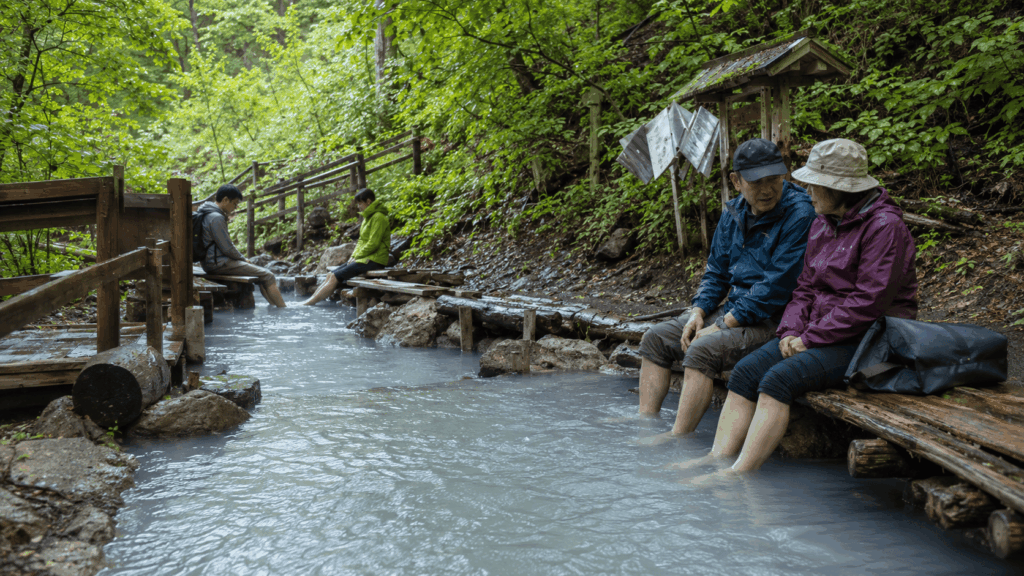
If you have time and reasonably steady footing, the walk to Lake Oyunuma and the Oyunuma River Natural Footbath is a worthwhile extension. Lake Oyunuma is a small volcanic crater lake with milky-blue-green water, created by a 1908 eruption. It is quieter than the main Hell Valley loop, and the trail passes through a forested section that feels very different from the open crater.
The natural footbath is free. You sit on the rocks by the riverbank and soak your feet in warm water that flows directly from the hot spring source. The temperature varies along the river—some spots are genuinely hot, others barely lukewarm—so you can move until you find a comfortable spot.
What to know before you go:
- The walk from Hell Valley takes about 20–25 minutes each way, plus time at the footbath. Budget at least 1 hour total.
- Bring a small towel to dry your feet afterwards. There are no facilities at the footbath itself.
- The footbath area is open roughly 8:00–17:00, but the trail may be closed in winter due to ice and snow.
- If you do not want to walk, there is a small parking area near Oyunuma—but it is also closed in winter.
3. See Hell Valley After Dark

If you are staying until evening—whether you are on an overnight trip or simply taking the last bus out—the night walk along Onibi no Michi (“Valley of Fantasy and Mystery”) is worth rearranging your schedule for.
The same boardwalk you walked during the day is lit with low amber-coloured lights from sunset until 21:30. The steam catches the light in a way that is impossible to describe accurately—it moves and shifts, and the dark sky behind the crater makes the whole valley feel like a different place. It is free, it is open year-round, and it is consistently the part of Noboribetsu that I recommend most strongly to anyone who asks.
One practical note: the lighting follows the same route as the short boardwalk loop near the main entrance. The Oyunuma extension is not lit. If you want to see the lit trail, arrive while there is still some daylight—the transition from dusk to full darkness, with the lights gradually becoming visible, is part of the experience.
4. Take a Real Onsen Bath

Visiting Noboribetsu without taking an onsen bath misses the entire point of the town. The hot spring water here comes directly from the volcanic source beneath Hell Valley, and you do not need to be a hotel guest to use it.
| Facility | Hours (Reception) | Adult Fee | Note |
|---|---|---|---|
| Yumoto Sagiriyu | 9:00–21:00 (until 20:30) | ¥500 | Basic public bath. Towel not included. Best budget option. |
| Takimotokan | 9:00–21:00 (entry until 18:00) | ¥2,250 | Large complex with 5 spring types. Towels included. Most impressive day-use choice. |
| Sekisuitei | 11:00–19:00 (until 18:00) | ¥1,200 | Hotel onsen with garden views. Quieter than Takimotokan. |
| Noboribetsu Grand Hotel | 12:30–16:00 only | ¥1,500 | Short window. Check before planning around this. |
Which one should you choose? If you want a quick, inexpensive soak without fuss, Yumoto Sagiriyu at ¥500 is hard to beat and stays open until 21:00. If you want the full onsen experience with multiple bath types (and you have the budget), Takimotokan is the most famous option—its day-use wing includes indoor and outdoor baths drawing from five different spring sources. Entry closes at 18:00, so plan to arrive in the early afternoon.
If you have visible tattoos, policies vary by facility. You can check our tattoo-friendly guide to Noboribetsu Onsen, or call ahead to the specific facility before visiting—some allow entry with small tattoos covered, others do not.
5. Explore Noboribetsu Date Jidaimura

Noboribetsu Date Jidaimura is an Edo-period theme park located in the Naka-Noboribetsu area, about 10 minutes by car or taxi from the Onsen town. Before visiting, I assumed it was a children’s attraction—costume dressing, simplified history, the kind of place you bring kids for an hour. In reality, the production quality of the live performances is strong enough that I found myself genuinely entertained.
The park recreates a streetscape from the Edo period (1603–1868). You walk through wooden buildings, a ninja house with hidden doors and trap mechanisms, and open-air theatres where shows run throughout the day. What makes it work for international visitors is that the performances are visual and physical—the ninja show, the oiran (courtesan) dance and the outdoor action show require almost no Japanese comprehension to enjoy.
Check the Show Schedule Before You Walk Around
The park publishes a daily show timetable at the entrance and on its official website. The key performances are:
- Kasumi Ninja House Ninja Show (20 min) — 4 shows/day
- Japanese Culture Theater Oiran Show (30 min) — 4 shows/day
- O-Edo Theater Nyanmage Comedy (25 min) — 3 shows/day
- Open-air Theater Ninja Fort Outdoor Action Show (15 min) — 2 shows/day
Kai’s tip: The most common mistake I see visitors make is wandering the streets first and then realising they have missed a show. The Ninja Fort outdoor show and the Oiran show run at specific times with long gaps in between. As soon as you enter, check the schedule board and plan your route around the shows you want to see—not the other way around. This is especially important in winter when the park closes at 16:00 (last entry 15:00).
Details at a glance:
- Hours: 9:00–17:00 (Apr–Oct), 9:00–16:00 (Nov–Mar). Last entry 60 min before close.
- Admission: Adults ¥3,300, Elementary ¥1,700, Ages 4+ ¥600
- Closed: Early March for maintenance (dates vary annually)
- Getting there: 6 min by bus from JR Noboribetsu Station, 10 min by car/taxi from Onsen town
If Date Jidaimura is the paid attraction you choose, compare the current admission, costume and activity packages for your date before finalising the rest of the itinerary.
6. Choose One Paid Attraction

If you have a full day or overnight stay, adding one paid attraction makes sense. Adding two does not—the distances, entrance fees and time commitment add up quickly. Here is how to decide which one fits your situation.
Noboribetsu BearPark
BearPark sits on a hill above the Onsen town, accessed by a 7-minute ropeway ride. The main attraction is the brown bear enclosure, where you can buy feed and watch the bears from a viewing deck. There is also a museum on Hokkaido’s indigenous Ainu culture on the same site.
| Detail | Info |
|---|---|
| Hours | 9:00–17:00 (Apr–Oct), 9:30–16:30 (Oct–Apr) |
| Admission | ¥3,200 (includes ropeway round-trip) |
| Min time needed | 1–1.5 hours |
| Best for | Families with children, animal enthusiasts, good-weather days |
| Skip if | You have limited time, or you are uncomfortable with zoo-style animal viewing |
Noboribetsu Marine Park NIXE
Marine Park NIXE is an aquarium located near JR Noboribetsu Station, in the opposite direction from the Onsen town. It features a large tank with manta rays and sharks, dolphin and sea lion shows, and a penguin walk that runs daily in winter.
| Detail | Info |
|---|---|
| Hours | Reception 9:00–16:30, facility closes 17:00 |
| Admission | ¥3,200 (adult), ¥1,600 (child 4+), free for 0–3 |
| Min time needed | 2–3 hours |
| Best for | Rainy days, families with young children, travellers arriving by train |
| Skip if | You are only in Noboribetsu for the Onsen town and Hell Valley |
Which one should you pick? If the weather is good and you are already in the Onsen town, BearPark is the more practical choice—it is a short ropeway ride from where you will already be. If the weather is poor or you are arriving by train and want an indoor activity before the bus up to the Onsen town, Marine Park NIXE sits right by the station. Neither is a “must-do”—they are options to fill time if your itinerary allows.
How Much Time Do You Need in Noboribetsu?

Half-Day Noboribetsu Itinerary (3–4 hours)
Suitable for: Sapporo day-trippers on a tight schedule, or travellers passing through en route to Hakodate or Lake Toya.
- Arrive at Noboribetsu Onsen bus terminal (by direct bus from Sapporo or from JR Noboribetsu Station).
- Walk the short loop of Hell Valley (30–40 min).
- Optional: extend to Tessen Pond lookout (add 30 min).
- Visit a day-use onsen—Yumoto Sagiriyu is fastest at ¥500 (1 hr).
- Walk back through Gokuraku Street for a quick meal or soft cream before the return bus.
What you skip: Oyunuma footbath, Date Jidaimura, paid attractions, night walk.
One-Day Noboribetsu Itinerary (6–8 hours)
Suitable for: Most first-time visitors. Enough time for the core experience plus one optional attraction.
- Arrive at Noboribetsu Onsen by mid-morning.
- Walk the full Hell Valley loop including Tessen Pond (1–1.5 hr).
- Continue to Lake Oyunuma and the natural footbath (add 1 hr).
- Lunch on Gokuraku Street or at a ryokan restaurant.
- Choose one paid activity: Date Jidaimura (2–3 hr), BearPark (1.5 hr) or Marine Park NIXE (2.5 hr).
- Finish with a proper onsen bath—Takimotokan if you arrive before 18:00.
- Return to Sapporo or continue south.
What you skip: Night Hell Valley walk (you leave before dark).
Kai’s tip: One-day visitors often try to pack in both Date Jidaimura and a paid attraction like BearPark. The distance between the Onsen town and Naka-Noboribetsu means you lose about 30 minutes each way in travel, and Date Jidaimura takes a minimum of 2 hours to see properly. Commit to one extra attraction and you will leave satisfied. Try to add a second and you will spend most of the day checking your watch.
Overnight Noboribetsu Itinerary (1 night, ~24 hours)
Suitable for: Travellers who want the full Noboribetsu experience. An overnight stay is the only way to see Hell Valley both in daylight and after dark, and to enjoy a proper ryokan meal and onsen session without rushing.
- Day 1 afternoon: Arrive, check into your ryokan. Walk the short Hell Valley loop before sunset.
- Day 1 evening: Return to Hell Valley after dark for Onibi no Michi (sunset–21:30). Enjoy a kaiseki dinner at your ryokan. Evening onsen.
- Day 2 morning: Early morning onsen (less crowded). Breakfast. Check out.
- Day 2 late morning: Walk the Oyunuma trail and footbath, or visit Date Jidaimura (opens 9:00).
- Day 2 afternoon: Depart Noboribetsu.
What you can add: BearPark or Marine Park NIXE on Day 2 if you have extra time and energy. Most travellers find the overnight pace satisfying without any additional attractions.
Self-Guided or a Tour From Sapporo?
If you are based in Sapporo and deciding between making your own way to Noboribetsu or joining a guided day tour, here is an honest comparison of what each option delivers.
| Factor | Self-Guided | Sapporo Day Tour |
|---|---|---|
| Travel logistics | Train to JR Noboribetsu (1 hr 10 min) + bus to Onsen town (15 min). Total ~1.5 hr each way. | Direct bus from Sapporo station. No transfers. Total ~1 hr 50 min each way. |
| Hell Valley time | Unlimited—stay as long as you like | Approximately 40 minutes free time |
| Oyunuma footbath | Possible (adds ~1 hr) | Not included |
| Day-use onsen | Possible—choose any facility | Not included (some tours stop at a rest area) |
| Night view | Only if you stay overnight or take a very late return | Not included—day tours return mid-late afternoon |
| Flexibility | Full control over pace and choices | Fixed schedule, but no navigation stress |
| Winter driving concern | Not relevant if using public transport | No concern—professional driver |
| Cost (round trip) | JR ~¥9,780 + bus ~¥800–900 = ~¥10,600 | ¥6,000–¥8,000 (includes transport, guide, sometimes lunch) |
| Best for | Independent travellers who want to explore the Onsen town fully, take an onsen bath and walk the trails at their own pace | Travellers who want a hassle-free day out, don’t mind limited Hell Valley time and value seeing multiple destinations (some tours combine Noboribetsu with Lake Toya) |
Kai’s tip: The main trade-off is time versus convenience. A tour from Sapporo makes the trip effortless—you board a bus and do not think about timetables or transfers. What you lose is the ability to slow down. Forty minutes at Hell Valley is enough to see the main observatory and take photos, but it does not leave room for the Oyunuma extension, a proper onsen bath or waiting for sunset. If your priority is to genuinely experience the Onsen town rather than check a box, self-guided transport gives you the breathing room to do that. If you are short on time or travelling in winter when road conditions are unpredictable, the tour removes a layer of uncertainty.
If you fall into that second camp—you want to see both Noboribetsu and Lake Toya in one day, but arranging the connections yourself would add more stress than value—this is the guided option that best fits the plan.
Why I’d book this one
- Recent travelers consistently mention knowledgeable, friendly guides who keep the route clear and organised.
- The itinerary combines several Hokkaido landscapes that are difficult to link efficiently by public transport in a single day.
- You can review the current cancellation terms, start time and payment options before committing to a date.
Practical Tips Before You Go
Noboribetsu Hell Valley Opening Hours
Hell Valley itself is physically accessible at all hours—there are no gates. However, the illuminated night path (Onibi no Michi) operates from sunset until 21:30. The observatory area near the entrance retains some lighting beyond that time, but you should not plan on walking the full boardwalk in darkness after 21:30. For the Oyunuma trail, plan between 8:00 and 17:00—the area is unlit and sections close in winter.
Winter Conditions and What Shoes to Wear
Noboribetsu receives substantial snow from December through March. If you are planning a cold-weather trip, check our guide to visiting Noboribetsu in winter. The Hell Valley boardwalk is cleared of snow, but the surface stays icy in places due to condensation from the steam vents. The Oyunuma trail is often closed in winter—check at the Park Service Center or your ryokan before setting out. Walking poles and boots with good grip are strongly recommended in winter. In warmer months, the same surfaces can be slick from moisture, so sturdy closed-toe shoes are advisable year-round.
Luggage, Food and Bus Timing
Luggage: If you are travelling between Sapporo and Hakodate and want to stop in Noboribetsu with luggage, the Park Service Center near the Hell Valley entrance may hold bags (ask at the counter). Several ryokan also offer luggage storage if you are a dining guest. Coin lockers are limited at the Onsen bus terminal.
Food: Gokuraku Street, the pedestrian lane connecting the bus terminal to the Hell Valley entrance, has a handful of restaurants serving local dishes—including wanko soba and jingisukan (grilled lamb). Meal prices are typical for a tourist town: ¥1,000–¥2,000 for a set meal. For specific recommendations, check our guide on what to eat and where to find the best food in Noboribetsu. If you are staying at a ryokan, dinner is usually included—do not skip it.
Bus timing: Donan Bus operates roughly two buses per hour between JR Noboribetsu Station and the Onsen town. The last bus from the Onsen town to the station is around 21:00–21:30 depending on the season. Confirm the return time when you arrive so you are not caught off guard after the night walk.
Frequently Asked Questions
Is Noboribetsu worth visiting as a day trip from Sapporo?
Yes, for the core experience of Hell Valley and an onsen bath. The train takes roughly 1 hour 10 minutes each way (limited express from Sapporo to JR Noboribetsu, then a 15-minute bus to the Onsen town). You can comfortably visit Hell Valley, walk the main loop, use a day-trip onsen and have a meal within a 6-hour window. What you cannot do in a day trip is the night walk on Onibi no Michi, the longer Oyunuma footbath walk (if you also want to add an optional attraction) or the Oyunuma trail in combination with a paid attraction.
Can you visit Hell Valley at night?
Yes, and I recommend it. The Onibi no Michi (Valley of Fantasy and Mystery) is illuminated from sunset until 21:30 along the main boardwalk. The lighting transforms the steam and rock formations into something quite different from the daytime view. There is no admission fee. The Oyunuma trail extension is not lit at night.
Can you visit an onsen without staying overnight?
Absolutely. Four facilities in the Onsen town offer day-use admission: Yumoto Sagiriyu (¥500, 9:00–21:00, basic), Takimotokan (¥2,250, entry until 18:00, most impressive), Sekisuitei (¥1,200, 11:00–19:00) and Noboribetsu Grand Hotel (¥1,500, 12:30–16:00 only). The ¥500 option at Yumoto Sagiriyu is practical for a quick soak between sightseeing.
How far is Hell Valley from Noboribetsu Station?
About 8 km—roughly 15 minutes by Donan bus (¥350–450 one way). You cannot walk from the station to Hell Valley. The bus terminal at the Onsen town is a short walk from the Hell Valley entrance. The station itself is in a different area entirely, closer to Marine Park NIXE.
Is Hell Valley open in winter?
The main Hell Valley boardwalk remains open in winter and snow is cleared from the path. However, the Oyunuma trail and footbath access are often closed from December through March due to ice and snow on the unpaved sections. The steam vents naturally keep some areas snow-free, but the surrounding path can be icy—wear boots with good grip. Onibi no Michi (night walk) operates year-round.
Is Date Jidaimura worth visiting for adults without children?
Yes, if you enjoy live theatre and cultural performances. The ninja show and oiran (courtesan) dance are visual and physical, requiring no Japanese language comprehension. The production quality is noticeably higher than many similar period parks in Japan. That said, if you have no interest in historical reenactments or live shows, the ¥3,300 admission may not feel worthwhile—the ‘explore the streetscape’ portion alone is less engaging than the performances.
Can I do Noboribetsu and Lake Toya in one day from Sapporo?
This is the itinerary offered by most Sapporo day tours (Noboribetsu Hell Valley + Lake Toya in a single 10-hour trip). Hell Valley time is typically around 40 minutes. You will see both destinations, but you will have limited time at each and no opportunity for an onsen bath or the Oyunuma walk. If seeing both landscapes in one day is your priority, the tour is an efficient option. If you want to experience Noboribetsu in depth, keep it as a standalone destination.
Is there luggage storage near Hell Valley?
Limited. The Park Service Center at the Hell Valley entrance may hold small bags if you ask at the counter. Several ryokan near the bus terminal offer luggage storage for dining guests. Coin lockers are available at the Noboribetsu Onsen bus terminal but are limited in number. If you are coming from Sapporo and continuing to Hakodate, consider using a luggage-forwarding service rather than carrying bags on the bus.
Final Verdict: Which Plan Fits Your Trip?
Noboribetsu is not a destination that needs to be “seen” in a checklist way. The core—Hell Valley and an onsen bath—is compact and inexpensive. Everything else is optional, and the right choice depends entirely on your time, your travel style and the season.
Choose the half-day plan if you are passing through between Sapporo and Hakodate, or you have limited time and want to see the volcanic landscape with a short soak. You will see the essential Hell Valley viewpoint, feel the steam and leave with a clear impression of what makes Noboribetsu different from other Japanese hot spring towns. Skip the paid attractions and the footbath.
Choose the one-day plan if this is your first visit and you have a full day to spend. The extra hours allow you to walk the extended Hell Valley loop, reach the natural footbath and add one paid attraction—Date Jidaimura if you enjoy live shows, BearPark if you are travelling with children or Marine Park NIXE if the weather is poor. The one-day pace is the most common choice for first-time visitors and it covers everything that matters without rushing.
Choose the overnight plan if you travel to experience places rather than visit them. An overnight stay unlocks two things that day-trippers cannot access: the night walk on Onibi no Michi, which is genuinely different from the daytime view, and the unhurried rhythm of a ryokan—dinner, evening bath, morning bath, breakfast. If you are making the trip from Sapporo specifically for Noboribetsu (rather than passing through), the overnight stay transforms it from a stopover into a highlight of your Hokkaido itinerary.
For families with children: The one-day option with Date Jidaimura or Marine Park NIXE works well. Date Jidaimura’s shows are visual and engaging for school-aged children, and Marine Park NIXE has the dolphin show and penguin walk. BearPark is the easiest choice if you are based in the Onsen town and want a short activity that kids enjoy. The Oyunuma footbath is free and novel but requires a sustained walk on uneven ground that may not suit younger children.
For winter travellers (December–March): The overnight plan is the most reliable. Daylight hours are shorter, the Oyunuma trail is often closed and the bus schedule is less forgiving if you miss the last connection. Staying overnight gives you the night walk (the steam is especially dramatic against snow), a proper onsen session and a stress-free morning departure. If you must do a day trip, consider the Sapporo tour option—the bus handles winter driving conditions and eliminates the need to navigate icy station-to-onsen transfers on your own.
For repeat visitors: Skip the paid attractions entirely. Walk the extended Hell Valley loop to Oyunuma if it is open, take a slow onsen bath at a facility you did not try last time (Sekisuitei is quieter than Takimotokan) and spend the night walk on Onibi no Michi. This is the Noboribetsu that most travellers miss—not because it is hidden, but because they were too busy adding extra attractions to a half-day schedule.

Hi, I’m Kai. I’m a Tokyo-based travel writer, tourism industry insider, and the author of a published guidebook for international visitors to Japan. With over 10 years of professional experience at a leading Japanese tourism company, my mission is to help you skip the tourist traps and navigate Japan’s best destinations like a local. I believe the perfect day trip is like a traditional kaiseki meal: a beautiful balance of precise planning and unforgettable seasonal discovery. When I’m not out conducting field research, you’ll usually find me drafting new itineraries with one of my favorite fountain pens!