
Hakone and Kinosaki are the two names that come up most often when first-time visitors to Japan search for a ryokan-and-onsen night. On paper they look similar: hot spring baths, traditional inns, a night away from the city. In practice they offer two very different experiences, and the mistake I see travelers make is choosing based on which name they have heard more often instead of which stay actually matches what they want.
Already leaning Hakone? If the lake, ropeway, shrine, and museums appeal to you but stitching Hakone’s spread-out transport together does not, you can check the current itinerary and availability for a private Hakone guide who starts from your hotel.
Hakone vs Kinosaki: The Short Answer
If your main goal is to experience a classic Japanese onsen town for the first time, choose Kinosaki. If your main goal is an easy overnight stop from Tokyo that combines hot springs with serious sightseeing, choose Hakone.
Kinosaki suits travelers who want to stay in a compact bathhouse town: slip into a yukata after check-in, walk lantern-lit streets in geta, and move between several public baths in a single evening. Hakone suits travelers who want a broader itinerary: a ryokan stay plus Lake Ashi, volcanic scenery, museums, and mountain transport, with the baths mostly at your lodging.
When friends planning their first Japan trip ask me to choose their single onsen night, I have often pointed them to Kinosaki. The reason is simple: in Kinosaki the whole town is the onsen experience, while in Hakone the onsen is one ingredient in a larger sightseeing area. That difference matters more than any comparison of water quality.
Choose Kinosaki if walking out of your ryokan in yukata sounds like the highlight of the trip, you want to try several public baths, and the overnight itself is the destination. Choose Hakone if you are basing the stop in a Tokyo itinerary, you want lake views, museums, and ropeway scenery around the stay, and you care more about your ryokan’s own baths than about public bath hopping.
Neither town is “objectively better.” They simply reward different priorities, and the table below is the fastest way to see which one rewards yours.
| Category | Hakone | Kinosaki | Best for |
|---|---|---|---|
| Overall first-time onsen-town experience | Strong ryokan stay, but the town is spread out | The classic bath-hopping town immersion | First-timers who want the full town experience |
| Access from Tokyo | About 80 minutes by Romancecar from Shinjuku | 5+ hours door to door via Kyoto or Osaka | Short Tokyo itineraries |
| Traditional onsen-town atmosphere | Resort area mixing ryokan, hotels, and sights | Compact bathhouse town built around the onsen | Yukata-and-lantern atmosphere |
| Public bath hopping | Not the local culture; bathing centers on your lodging | The town’s signature activity | Trying several baths in one evening |
| Sightseeing variety | Lake cruise, ropeway, museums, possible Mt. Fuji views | Town stroll, temple, river; little beyond that | Full days of sightseeing around the stay |
| Walkability | Transport needed between areas | Compact and walkable; the town takes about 20 minutes to cross end to end | Easy evenings with no transfers |
| Tattoo friendliness | Varies by property; check ahead | All public bathhouses welcome tattoos | Tattooed travelers using public baths |
| One-night stay | Works well if you arrive early | Works well; the experience is built around one evening | Travelers with only one night to spend |
| Winter experience | Cold-weather onsen with possible clear Fuji views | Snow-town mood and crab season (roughly November to March) | Winter atmosphere and seafood |
| Couples | Many ryokan and hotels offer private reserveable baths | Romantic town strolls; privacy depends on the ryokan | Depends on whether you value privacy or atmosphere |
| Travelers short on time | Easiest option from Tokyo | A genuine detour that needs a full night | Tight Tokyo-based schedules |
The Biggest Difference: Kinosaki Is an Onsen Town, Hakone Is a Larger Onsen Region
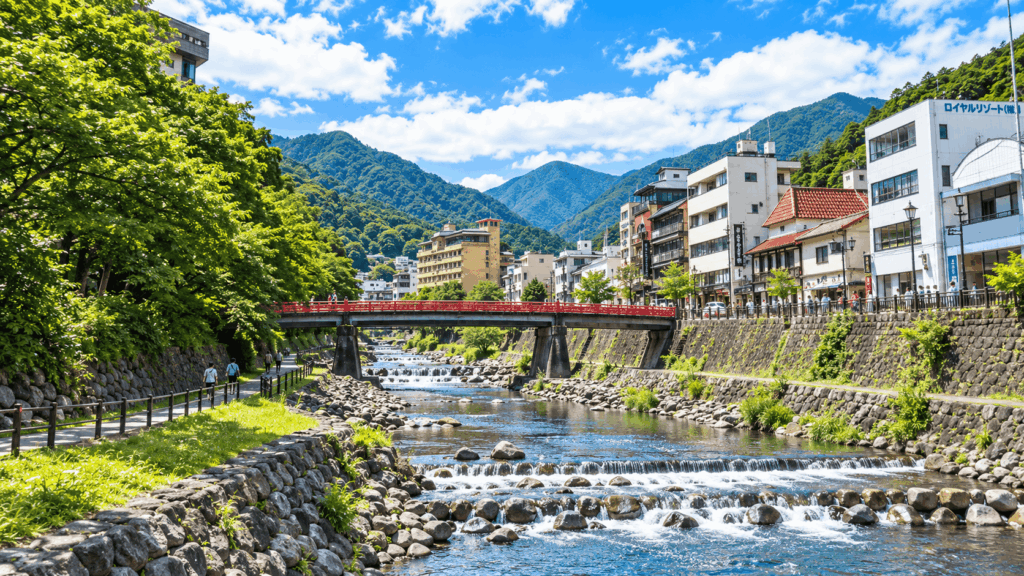
The structural difference drives everything else. Kinosaki is a single compact town where the station, ryokan, river, temples, and public bathhouses are connected on foot; the official tourism site estimates about 20 minutes to walk from one end of the town to the other. Hakone is a mountain region made up of several distinct areas, each with its own character: Hakone-Yumoto at the base, Gora and the ropeway in the middle, Lake Ashi and Hakone Shrine on the upper side, plus museums scattered in between.
That changes how you spend a night. In Kinosaki the movement pattern is: check in, put on yukata, leave the ryokan, walk the town, visit baths, return to the ryokan. In Hakone the pattern is: choose an area and a ryokan, combine the baths with Lake Ashi, Owakudani, or a museum, and get between them by train, cable car, ropeway, or bus. Visitors’ reviews tend to sort themselves the same way: Kinosaki is described as compact and walkable, while Hakone is described as transport-heavy, with the journey itself part of the experience.
What a Night in Kinosaki Actually Feels Like
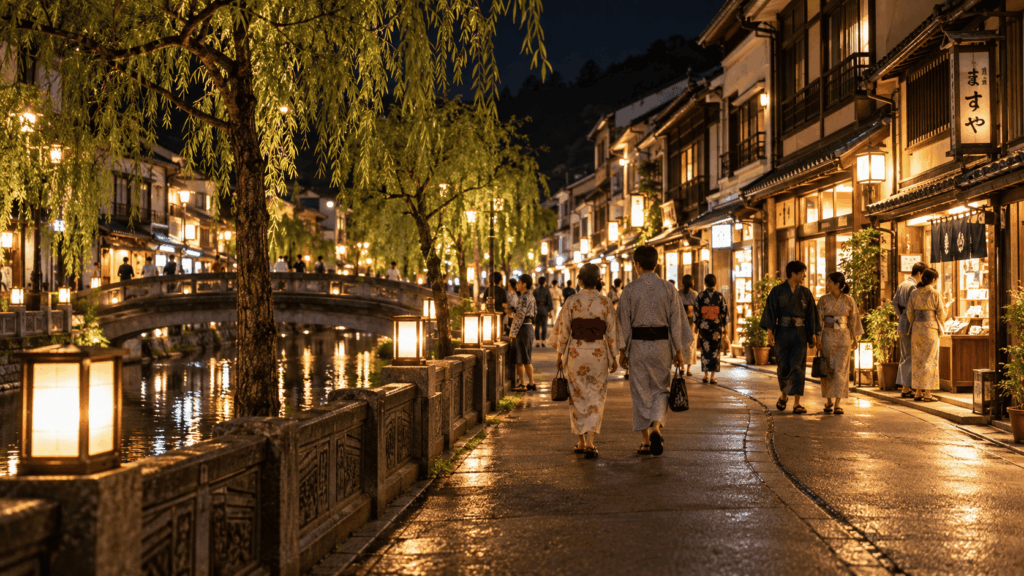
Most ryokan in Kinosaki hand you a yukata and a pair of geta at check-in, and guests actually wear them outside. That is not a costume ritual; it is how the town works, because the baths are a short walk away and the streets are safe to wander in the evening. Walking the willow-lined streets beside the Otani River, with the click of geta on stone and steam rising from bathhouse roofs, is the closest Japan gets to the onsen-town image most travelers arrive with.
Your ryokan will usually give you a pass to the public bathhouses (the yumeguri pass) for the nights of your stay, and the habit is to visit more than one bath. Each has a different character, which is what makes hopping between them entertaining rather than repetitive. Kinosaki is known for its “seven public baths,” although not all seven are open at any given time — closing days rotate by bath, and at the time of writing (September 2026) two of the seven are closed for renovation — so check the current line-up before planning your route (more on that below).
One of my clearest memories of Kinosaki is a June evening when fireflies appeared along the river after dark — a seasonal bonus that is worth knowing about if you travel in early summer, though it is never something you can count on in any given year.
What a Stay in Hakone Is More Likely to Feel Like
To be fair to Hakone: a night there is not “worse,” it is structured differently. You pick a base — often Hakone-Yumoto for convenience, Gora for the ropeway and museum district, or the Lake Ashi side for views — and build an itinerary around it. The day might combine your ryokan stay with the Hakone Ropeway over volcanic terrain, a cruise on Lake Ashi, the lakeside torii gate of Hakone Shrine, or the sculpture collection at the Hakone Open-Air Museum.
Bathing in Hakone centers on your own ryokan or hotel rather than on public bathhouse hopping, which suits travelers who want a private or reserveable bath after a day of sightseeing. The trade-off is logistics: moving between Hakone’s areas takes trains, cable cars, and buses that can be crowded in peak season, and the classic “Hakone loop” itinerary is easy to overstuff. Mt. Fuji views depend heavily on the weather, and ropeway operations around Owakudani can be affected by weather, maintenance, or volcanic-gas conditions, so it is worth checking current conditions before you lock in plans.
Which Is Easier to Fit Into a Japan Itinerary?
The honest answer is that itinerary fit depends entirely on where your trip starts and ends.
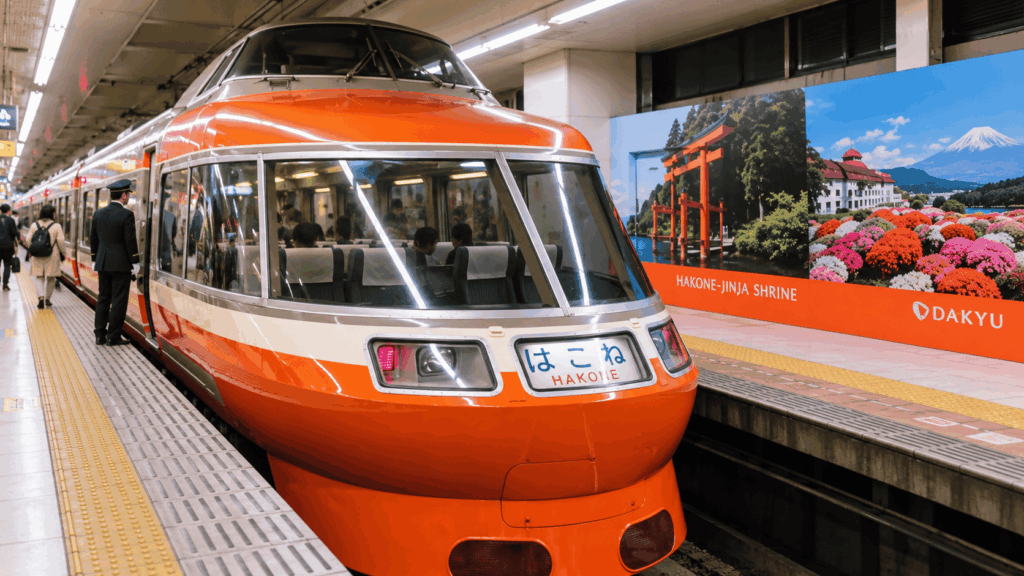
From Tokyo, Hakone wins on convenience. The Odakyu Romancecar runs direct from Shinjuku to Hakone-Yumoto in about 80 minutes with all seats reserved, which makes it a natural one-night addition to a Tokyo itinerary. The alternative route — shinkansen from Tokyo to Odawara (around 35 to 40 minutes) and a short local train to Hakone-Yumoto — is nearly as easy.
Kinosaki is the realistic choice for itineraries that already include Kyoto or Osaka. Limited express trains run direct from both cities: roughly 2.5 hours from Kyoto and 2 hours 45 minutes to 3 hours from Osaka. From Tokyo, however, you are looking at five hours or more door to door via Kyoto or Osaka, which is a big commitment for one night.
This is why so many trip-planning threads ask whether Kinosaki is “worth the detour.” The question only makes sense once you know what kind of stay you want: if you want the compact onsen-town evening, the detour is the point. If you simply want a pleasant ryokan night attached to a Tokyo sightseeing week, Hakone delivers that with far less travel.
Choose Hakone If You Are Traveling From Tokyo
If Hakone is your choice, build the stop like this: leave Tokyo mid-morning, arrive at Hakone-Yumoto by lunch, spend the afternoon on one sightseeing component near your ryokan’s area, eat an onsen-town dinner, and use the next morning for one more stop before returning. If you plan to move around Hakone by train, cable car, ropeway, and boat, the Hakone Freepass — around 7,100 yen for adults for a two-day pass from Shinjuku, as of 2026 — usually covers the round trip plus unlimited local transport, with a separate surcharge for Romancecar reserved seats. Check the current price before you go, since fares were revised in late 2025.
Choose Kinosaki If You Can Spare a Dedicated Overnight Stop
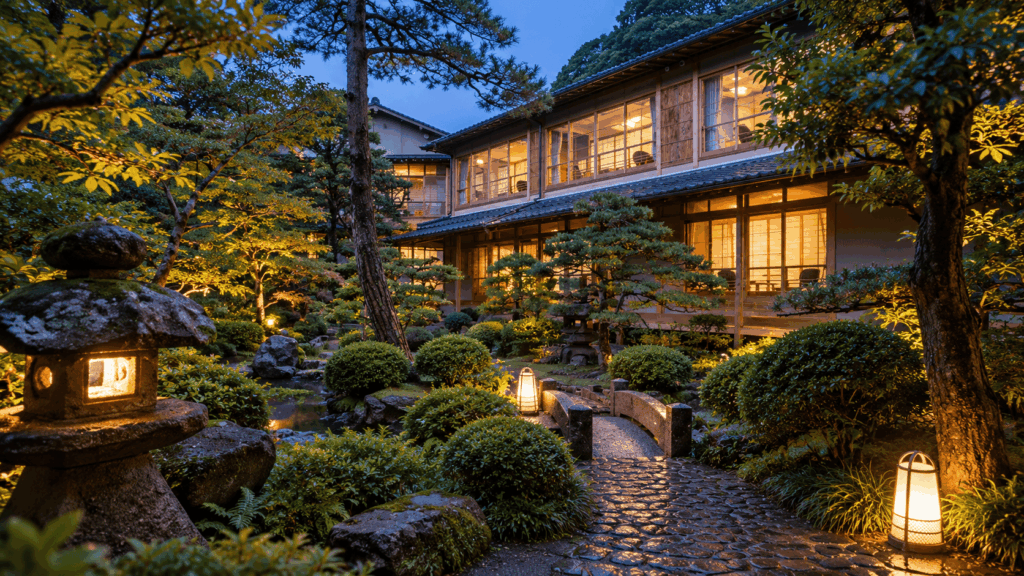
Kinosaki rewards travelers who treat it as a destination rather than a pass-through. Because the town is small, you do not need a full day: arrive mid-afternoon, check in, change into yukata, and you can be soaking in your first public bath within an hour of stepping off the train at Kinosaki Onsen Station. The next morning, one more bath or a walk up to Onsenji Temple fits comfortably before a late-morning departure.
Seats on the limited express trains from Kyoto and Osaka are all reserved, so book them in advance online or at the station ticket office as soon as your dates are fixed. Luggage is rarely a problem: the station sits at the edge of the town, and most ryokan are a short flat walk away, so even a large suitcase is manageable.
Which Has the Better Onsen Experience for a First-Timer?
For a traveler trying Japanese public bathing for the first time, Kinosaki is the easier town to enjoy, because the baths are the activity rather than an add-on. Nobody has to organize transport to reach them: you leave your ryokan in yukata, walk a few minutes, pay with the pass your ryokan gave you, and soak. If one bath feels intimidating or crowded, you simply try a different one twenty minutes later. That low-pressure rhythm is exactly what a nervous first-timer needs.
Hakone’s onsen experience is different but still strong: the bathing happens mostly at your own ryokan or hotel, often in well-designed indoor and outdoor baths, and many properties offer private reserveable baths (kashikiri) that remove the public-bath step entirely. For a couple or a traveler who wants privacy and zero guesswork about bathhouse etiquette, a Hakone ryokan with a reserveable bath is genuinely hard to beat.
What Kinosaki adds is variety you can feel in one evening. Ichino-yu is known for its atmospheric cave-like bath, Goshono-yu reopened as an open-air-only bathhouse after renovation, and Yanagi-yu is the one I found noticeably hotter than the others — a subjective impression, not a measurement, since bath temperatures change through the day. Recent visitors consistently describe comparing the baths as the highlight of the stay, which is exactly why the town asks you to visit more than one.
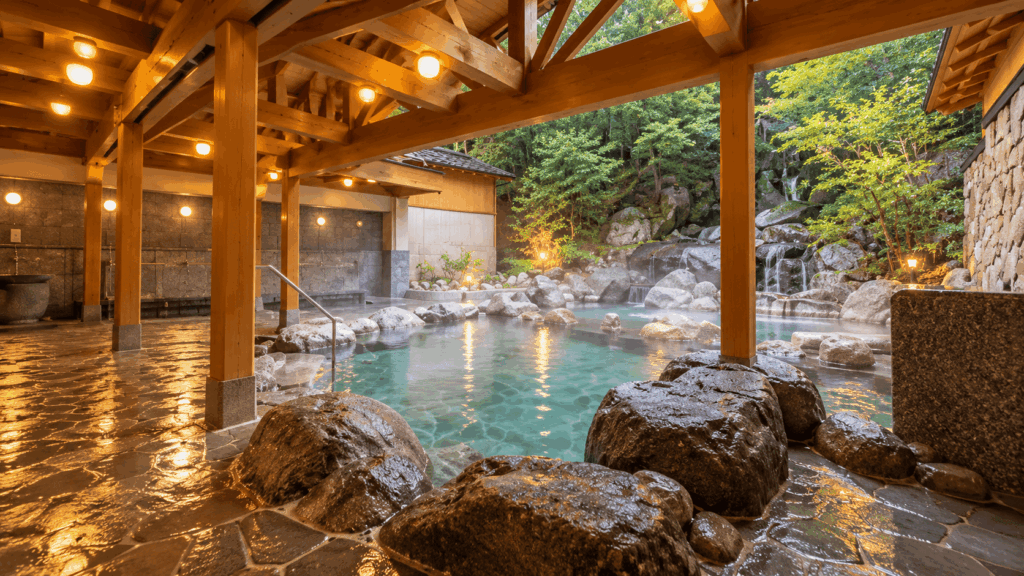
Kai’s tip: On a first visit, plan your bath hopping around the hours, not the map. Yanagi-yu and Mandara-yu only open in the afternoon (from around 15:00), while Ichino-yu, Goshono-yu, and Jizo-yu open in the morning, and each bath takes one full day off per week on a rotating schedule. The most relaxed route is an afternoon check-in, one bath before dinner, one after — and if the post-dinner queue looks long, reverse the order and go later, since the bathhouses stay open until 23:00. Confirm that your ryokan gives you the bath pass (yumeguri pass) at check-in; most do, but it is worth asking when you book.
A Note About Kinosaki’s “Seven Public Baths”
You will read everywhere that Kinosaki has seven public baths, and that is the town’s heritage identity — but it is not a promise about what is open on the day you visit. At the time of writing (September 2026), Satono-yu (the bath closest to the station) has been closed indefinitely for renovation since April 2024, and Kono-yu is closed for renovation through October 30, 2026. That leaves five operating baths, and each closes one day a week on a rotating basis, so “seven baths” should be read as the town’s tradition rather than a guaranteed menu.
This is not a reason to skip Kinosaki — five baths is still more public bathing variety than almost any other town in Japan — but check the official bath list and each bathhouse’s current status before you plan your evening. Operating hours and renovation schedules change, and the town publishes up-to-date information including live crowd status for the bathhouses.
Which Is Better for Sightseeing Beyond the Onsen?
If you want a full day of non-bathing sightseeing around your ryokan night, Hakone is the clear winner, and this is where its scale becomes an advantage. On the Lake Ashi side you can ride the Hakone Sightseeing Cruise, photograph the lakeside torii gate of Hakone Shrine, and — on clear days — see Mt. Fuji across the water. Around Gora, the Hakone Ropeway climbs over volcanic terrain toward Owakudani, where the famous black eggs are cooked in the sulfur springs, and the Hakone Open-Air Museum combines sculpture gardens with mountain views. Hakone-Yumoto itself has a compact station-town feel with riverfront ryokan and easy access to the mountain transport network.
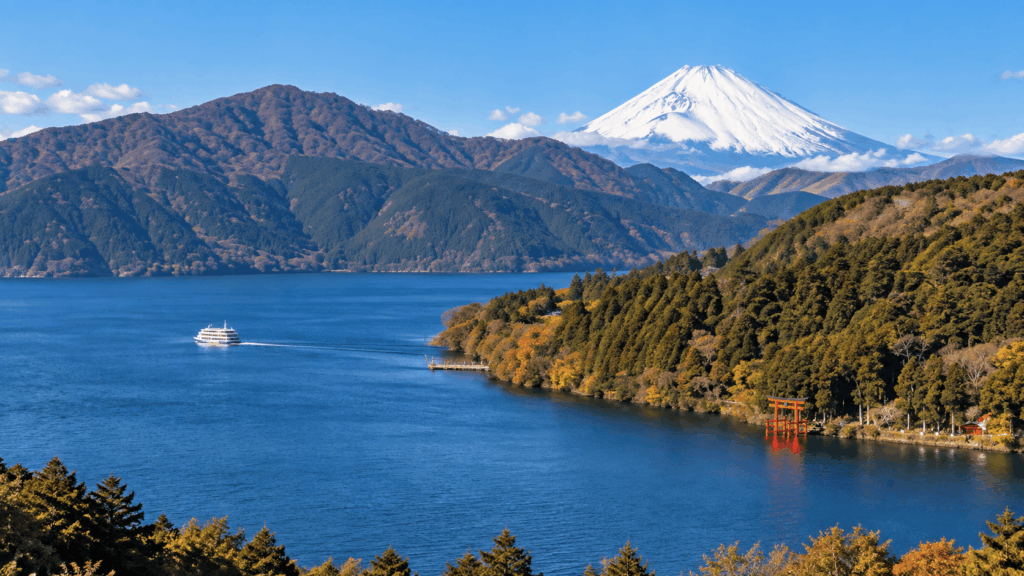
The honest counterweight is that Hakone’s sightseeing is spread out, and visitors commonly report buses and ropeway queues eating into the day. The classic mistake is trying to complete the entire “Hakone loop” — mountain railway, cable car, ropeway, cruise, and bus — in the hours around a one-night stay. Pick two components and leave the rest for a return trip. Also note that ropeway service toward Owakudani can be suspended because of weather, maintenance, or volcanic-gas conditions, so check the current operating status before you commit to that leg.
If that is the part of Hakone that gives you pause — you want the sightseeing, but not a day spent working out every connection yourself — a private guide is the option worth comparing with a DIY day.
Why I’d book this one
- It addresses Hakone’s awkward part: a local guide can help connect the lake, ropeway, shrine, museums, and your hotel without forcing you to chase the full loop.
- The day is flexible: recent travelers commonly mention knowledgeable guides, adaptable pacing, and itineraries adjusted to the group’s interests rather than a rigid checklist.
- You can check the commitment before deciding: the listing shows current availability, start times, cancellation terms, and recent traveler feedback before you finalize the day.
Kinosaki offers a quieter counterpoint: a walk along the Otani River, the willow-lined streets, Onsenji Temple on the hillside, and little else in the way of major attractions. Travelers who need museums, lakes, and cable cars around their onsen stay should be honest with themselves that Kinosaki will feel quiet. Travelers who want the onsen town itself to be the entire experience will not mind at all.
Which Is Better for Walking Around in Yukata?
This is Kinosaki’s home turf, and it is the reason I have recommended the town to so many first-time international visitors. Hakone has ryokan that lend yukata, but the areas around most Hakone properties are ordinary streets and roads where walking in yukata feels out of place. Kinosaki, by contrast, is designed for it: the ryokan, the public bathhouses, the restaurants, and the river are all a few minutes apart, and half the people on the streets after dinner are wearing the same thing you are. You are not putting on a costume for a photo — you are joining the town’s evening rhythm.
The walkability also solves the two worries that make first-timers hesitate about ryokan stays: you do not need to navigate buses after dark, and the town is safe to wander late into the evening. Recent visitors consistently describe the yukata stroll between baths as the single most memorable part of a Kinosaki night.
The Trade-Off: Evening Bath Crowds
Kinosaki’s greatest strength and its main weakness come from the same source. Because every ryokan guest heads out in yukata after dinner, the bathhouses are busiest roughly between 19:00 and 21:30. On one evening I found the women’s changing room full enough that guests were waiting for lockers to free up — an experience echoed in many recent reviews of the town, especially in peak season and on weekends.
This is manageable, but it is worth planning for rather than discovering at the bathhouse door.
Kai’s tip: The two busiest hours are the ones every guidebook implies you should go — right after dinner. If you can, take your first bath just before dinner (many ryokan serve dinner from around 18:00, which makes a 17:00 soak a quiet one) and your second bath after 21:30, when the post-dinner wave has thinned. Carry only what you need into the bathhouse: a small towel from your ryokan and your bath pass, with valuables left in your room. The town’s official site publishes live crowd status for each bathhouse, so a quick check before you leave the ryokan tells you which one to walk to.
Which Is Better for Travelers With Tattoos?
For travelers with tattoos who want to use public baths, Kinosaki is one of the easiest places in Japan. All of the town’s public bathhouses officially welcome guests with tattoos of any size — no cover-ups required — which is rare enough to be worth planning a trip around. The caveat is that this policy applies to the public bathhouses; individual ryokan may set their own rules for their private or guest baths, so confirm with your accommodation if you plan to bathe only at your ryokan.
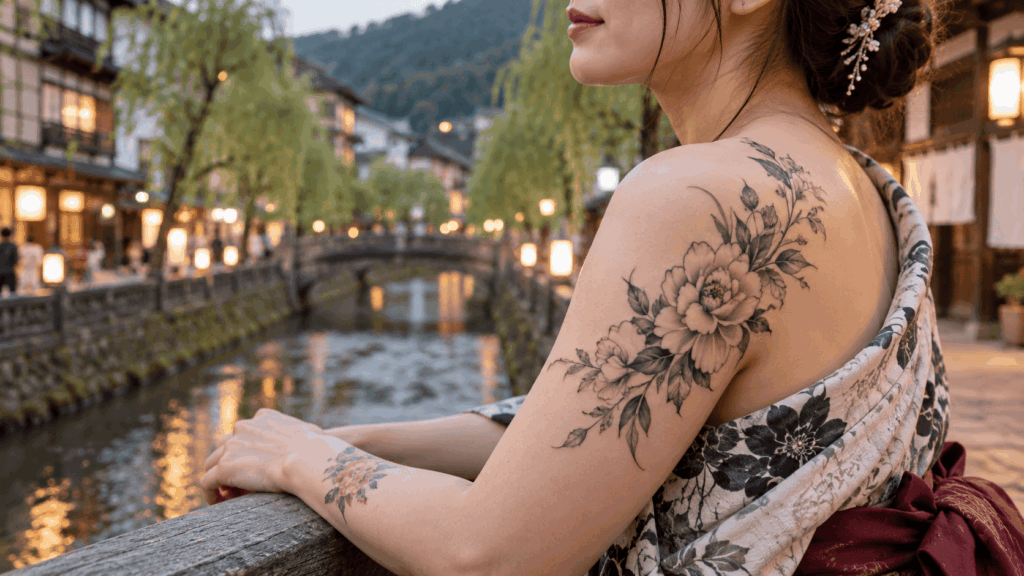
Hakone does not have a town-wide policy. Some properties are tattoo-friendly, others are not, and the only reliable approach is to check each ryokan or hotel’s policy before booking — or to book a property with a private reserveable bath, where tattoo rules rarely apply. If your trip is built around Hakone’s sights and you have tattoos, filter accommodation searches by properties that state they accept tattooed guests or offer kashikiri baths.
Which Is Better in Winter?
Winter is when Kinosaki shows off: snow on the rooftops, steam rising from the bathhouses against the cold air, and the town at its most atmospheric. It is also crab season — roughly November through March, when the local matsuba crab appears on ryokan menus and in shops near the station. On a March visit I found the station area busy with travelers who had come specifically for the crab, and the combination of a snowy town, hot baths, and a crab kaiseki dinner is one of Japan’s most memorable winter experiences.
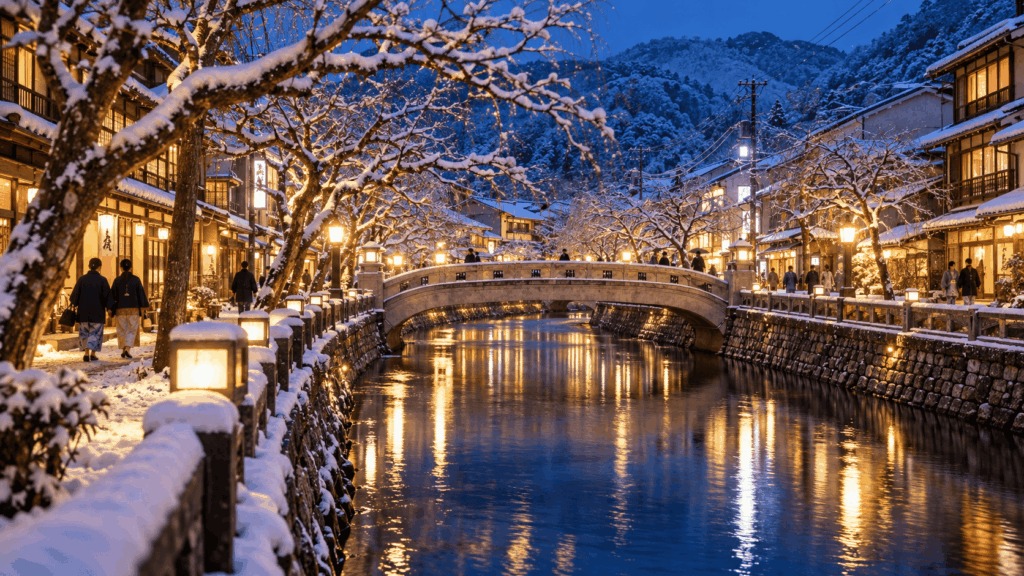
The practical catch is the snow itself. Kinosaki runs water over the streets to melt snow in winter, which keeps the walking routes safe but leaves the pavement wet, and ordinary sneakers end up soaked within a block. In my experience, footwear matters more than any other piece of winter gear here.

Kai’s tip: If snow is forecast during your stay, ask your ryokan in advance whether they can lend you waterproof boots — many properties have pairs for guests, though you should not assume it. If they cannot, pack shoes that handle wet, cold pavement rather than relying on sneakers. The yukata-and-geta stroll is wonderful on a dry evening, but on a snowy night you will be grateful for warm, waterproof feet between baths.
Hakone vs Kinosaki by Traveler Type
Here is how the comparison resolves for the traveler types we hear about most often:
- First-time visitor to Japan wanting a classic onsen-town night: Kinosaki. The compact, walkable, bath-hopping evening is the experience most first-timers are imagining.
- Tokyo-based itinerary with one spare night: Hakone. The travel time is roughly an hour each way versus five hours or more to Kinosaki.
- Traveler who wants sightseeing around the stay: Hakone, for the lake, ropeway, museums, and possible Mt. Fuji views.
- Traveler who wants yukata streets and public bath variety: Kinosaki, without much of a contest.
- Tattooed traveler planning to use public baths: Kinosaki, where the town-wide policy removes the guesswork.
- Couple wanting a private reserveable bath: This comes down to the specific property in either town, so judge by the ryokan rather than the destination.
- Winter traveler who wants food and atmosphere: Kinosaki, for crab season and snow-town mood — with the right footwear.
- Traveler building a Mt. Fuji-area trip: Hakone, which sits naturally on the Tokyo–Fuji–Hakone circuit.
| Choose Hakone if… | Choose Kinosaki if… |
|---|---|
| You are based in Tokyo and want a short, easy transfer | You want the onsen town itself to be the destination |
| You want Lake Ashi, the ropeway, museums, or Mt. Fuji views around the stay | You want to walk between several public baths in yukata |
| You prefer bathing at your ryokan or in a private reserveable bath | You want the whole town to feel like part of the onsen experience |
| You are comfortable using trains, cable cars, and buses to sightsee | You want everything walkable and no transport decisions after dark |
| You have tattoos but plan to use a private reserveable bath at your ryokan | You have tattoos and want public baths with a clear welcome |
| Your one night is a small part of a larger Tokyo-area week | Your one night is the centerpiece of the trip and worth a detour |
What About Kusatsu, Arima, or Yudanaka?
If neither town feels right, three other onsen destinations cover the gaps. Kusatsu Onsen is for travelers who want dramatic onsen scenery — the huge steaming Yubatake field in the middle of town and famously strong acidic water — though it sits inland from Tokyo and requires a longer bus journey. Arima Onsen is the convenient choice if your trip centers on Kobe or Osaka, with two very old spring types and an easy position near the city. Yudanaka Onsen and neighboring Shibu Onsen pair a hot spring stay with the Jigokudani Snow Monkey Park, which makes them the pick for a Nagano-area itinerary; Shibu in particular offers its own compact bath-hopping streets that fans of Kinosaki often enjoy. Each deserves its own full comparison — the short version is that they solve different itinerary problems than Hakone or Kinosaki do.
FAQ: Hakone vs Kinosaki
Is Kinosaki better than Hakone for a first-time onsen experience?
For the experience most first-timers picture when they imagine a Japanese onsen town — walking out of your ryokan in yukata, visiting several public baths in one evening, and soaking in the town’s atmosphere — yes, Kinosaki is the stronger choice. Hakone is the better fit when the priority is an easy stop from Tokyo with sightseeing around the stay. Neither is the better onsen overall; they are better at different jobs.
Is Hakone or Kinosaki easier to visit from Tokyo?
Hakone, clearly. The Romancecar takes about 80 minutes from Shinjuku to Hakone-Yumoto, which makes it a natural one-night add-on to a Tokyo itinerary. Kinosaki is five hours or more door to door from Tokyo via Kyoto or Osaka. If your trip already includes Kyoto or Osaka, the balance shifts: Kinosaki is about 2.5 to 3 hours from either city by direct limited express.
Is one night enough in Kinosaki Onsen?
Yes. Kinosaki is compact enough that a single night works well: arrive mid-afternoon, take a bath before dinner and one after, then use the next morning for another bath or a walk up to Onsenji Temple before departing. A second night makes sense if you want to try every operating bath without rushing, or if you are visiting during crab season and want two full kaiseki dinners.
Is Kinosaki more tattoo-friendly than Hakone?
For public bathing, yes. Kinosaki’s public bathhouses officially welcome guests with tattoos of any size, which removes the guesswork entirely. Hakone has no town-wide policy, so you need to check each ryokan or hotel before booking, or choose a property with a private reserveable bath. In both towns, confirm your specific ryokan’s rules as well, since accommodation policies can differ from public bathhouse policies.
Can I visit both Hakone and Kinosaki on the same Japan trip?
It is possible but expensive in travel time. A realistic route is Tokyo → Hakone (one night) → back through Tokyo → shinkansen to Kyoto or Osaka → Kinosaki (one night) → return to Kyoto or Osaka, which adds roughly two full travel days. Most travelers should pick one unless the onsen is the main theme of the trip. A practical middle ground is a Hakone day trip from Tokyo plus one overnight in Kinosaki on the Kansai leg.
Final Verdict: Hakone or Kinosaki?
If you only have room for one classic onsen stay on a first trip to Japan, and the onsen-town experience itself is your priority, Kinosaki is the stronger choice. It gives you the yukata streets, the walkable town, and the public bath variety that most first-timers are actually hoping for, with the main bathhouses and town streets within easy walking distance of most central ryokan. Choose Hakone instead when it fits your Tokyo route more naturally, or when sightseeing beyond the baths — the lake, the ropeway, the museums — matters as much as the soak.
For first-time onsen visitors: Kinosaki. The town removes every obstacle that makes public bathing intimidating: the baths are close, the policy on tattoos is clear, and everyone around you is doing the same thing.
For travelers on a tight Tokyo schedule: Hakone. The hour-and-a-half transfer beats a five-hour detour, and a ryokan with its own baths still delivers a proper onsen night.
For sightseeing-focused travelers: Hakone, with a realistic plan to pick two or three sights rather than chase the whole loop.
For couples who want a private bath: Judge by the property, not the town. Both destinations have ryokan with private reserveable baths; choose the room that fits your budget and dates.
For winter travelers: Kinosaki, for the snow-town mood and crab season — provided you sort out waterproof footwear before you arrive.
That is why I have often recommended Kinosaki to first-time international visitors asking where to spend their single onsen night: it is the town that turns the onsen stay into an evening you can walk through, rather than a bath you take between sightseeing stops. If the idea of stepping out of your ryokan in yukata and following the steam to the next bathhouse sounds like the Japan trip you have been planning, Kinosaki is waiting. If it sounds like one stop among many, Hakone will treat you well.
Operational details in this article — bathhouse closures and hours, prices, train times, and policies — were checked against official sources in September 2026 and change frequently. Confirm the latest information on the official Kinosaki and Hakone tourism sites before you travel.
Hi, I’m Kai. I’m a Tokyo-based travel writer, tourism industry insider, and the author of a published guidebook for international visitors to Japan. With over 10 years of professional experience at a leading Japanese tourism company, my mission is to help you skip the tourist traps and navigate Japan’s best destinations like a local. I believe the perfect day trip is like a traditional kaiseki meal: a beautiful balance of precise planning and unforgettable seasonal discovery. When I’m not out conducting field research, you’ll usually find me drafting new itineraries with one of my favorite fountain pens!