
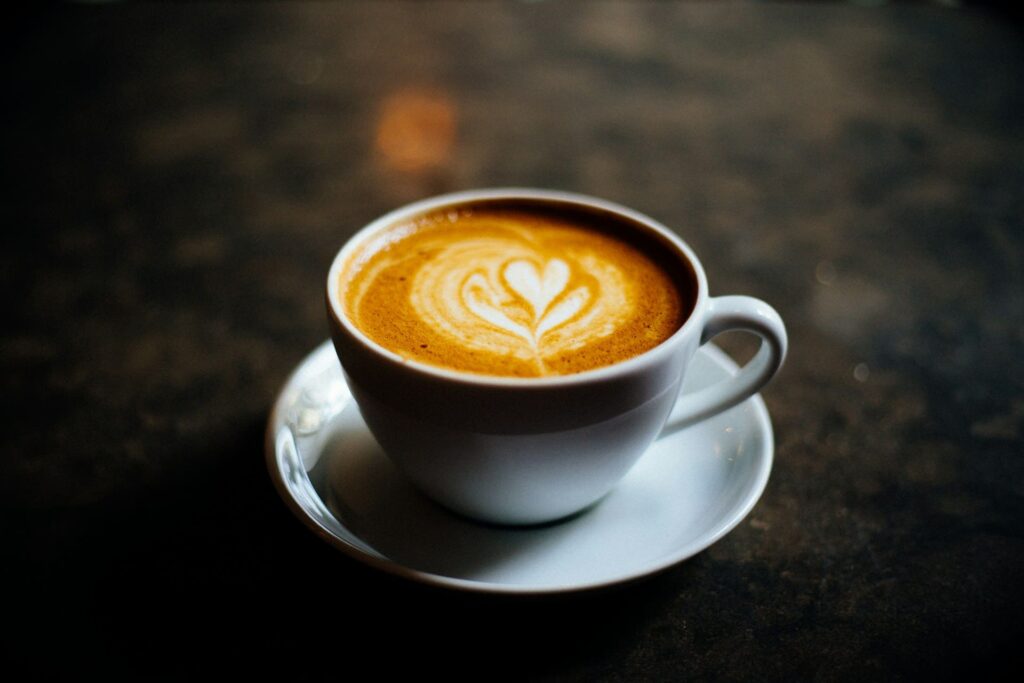
Tokyo has more specialty coffee shops per square kilometer than most cities have in total. The problem isn’t finding coffee—it’s choosing the right one when you’re only in town for a few days and every blog post tells you a different story.
This guide skips the catalog approach. Instead, I’ve broken down Tokyo’s coffee scene by traveler type and neighborhood cluster—so you can figure out in two minutes whether you’re a Koffee Mameya person, a Chatei Hatou person, or neither, and exactly where to find your match without wasting half a day on the subway.
If you would rather turn Tokyo coffee into one guided morning instead of building your own route from scratch, you can check availability, start times, and recent traveler reviews for this Kanda/Jimbocho coffee culture walk before choosing your neighborhood.
What Kind of Coffee Traveler Are You?
Tokyo’s coffee culture isn’t one thing. It’s three distinct worlds that barely overlap—and picking the wrong one for your mood can cost you an hour of queuing and a dose of disappointment. Here’s a quick self-diagnosis:
- Type 1: The Specialty Purist — You want excellent coffee, fast, and unpretentious. Standing counters, takeout cups, single-origin espressos, and baristas who treat coffee like science. You’re fine without a seat if the cup is exceptional.
- Type 2: The Kissaten Seeker — You’re here for the atmosphere. Wood-paneled walls, classical music, a senior master pouring nel-drip coffee in slow motion. You have time to sit, sip, and absorb a Tokyo that’s disappearing. This isn’t a caffeine stop—it’s a time machine.
- Type 3: The Tasting Pilgrim — You want the omakase treatment. A multi-course coffee tasting guided by a barista who explains every origin note and brewing variable. This is an activity, not a pit stop. Budget 90 minutes.
Kai’s tip: The mistake I see most first-time visitors make is trying to visit Shibuya, Kiyosumi-Shirakawa, and Nakameguro in a single day. Tokyo’s coffee scene is spread across the city, and each neighborhood deserves a morning or afternoon on its own. Pick one cluster, dive deep, and save the others for your next trip. Half your day disappears on the subway if you try to do everything at once—and the jet lag doesn’t help.
Type 1: The Specialty Purist — Quick, Precise, Standing
If you recognize names like single-origin, light roast, and pour-over, this is your world. Tokyo’s third-wave scene is dominated by tiny, standing-room-only counters where the coffee is the event and the seating is optional. Here’s where to find the best ones, organized by neighborhood so you can plan a walking route instead of a train marathon.
Omotesando / Shibuya Cluster
This is Tokyo’s densest coffee neighborhood. You can hit four excellent spots on foot between Omotesando and Shibuya stations without breaking stride.
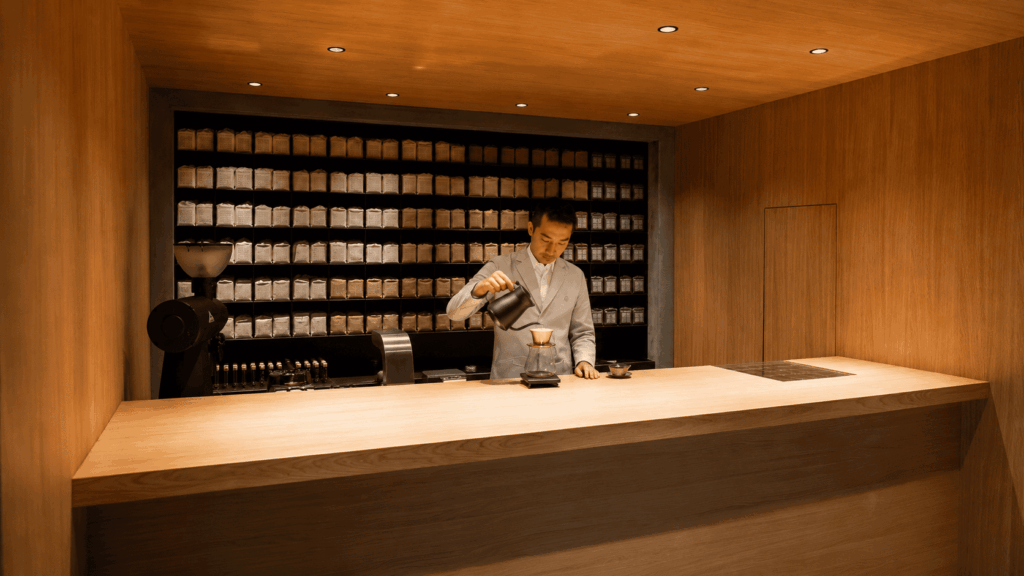
Koffee Mameya is the most photographed coffee shop in Tokyo for good reason—and the most misunderstood. It’s a coffee bean shop with a standing tasting counter that fits about six people. The barista walks you through a menu of single-origin beans, asks about your flavor preferences, brews you a sample, and sends you off with a bag of beans or a takeout cup. It’s a beautiful, minimalist ritual—but it’s not a café.
Kai’s tip: What catches most travelers out is the expectation gap. Koffee Mameya has no seating. None. You queue (30–45 minutes on weekends), taste standing, and leave. If you arrive hoping to settle in with a latte and a book, that queue will feel twice as long. Save Mameya for a quick, focused coffee stop—or skip it entirely and head to Koffee Mameya Kakeru in Kiyosumi-Shirakawa, where you can book a seated tasting counter experience instead.
Hours are approximately 10:00–18:00 daily. Cash only. Expect a line by mid-morning.
A five-minute walk away, About Life Coffee Brewers operates a tiny takeout-focused stand on a Shibuya side street. It opens early (around 8:00–9:00 depending on the location), uses beans from Onibus and other local roasters, and has a couple of standing spots inside plus a bench outside. Best for: a quick morning cortado before the area gets busy.
Streamer Coffee Company in Shibuya is the opposite of Mameya’s minimalism—loud music, latte art competitions, and counter seating. Open daily 8:00–20:00, credit cards accepted. Best for: travelers who want a proper espresso drink in a seat and don’t need silence.
Café Kitsuné in Aoyama (9:00–19:00 daily) sits beside the Maison Kitsuné flagship store. It’s as much about the aesthetic as the coffee—small fox logo on every cup, minimalist interior, mostly outdoor seating. The coffee is solid third-wave, but you’re partly paying for the branding. Best for: a photo-worthy stop if you’re shopping in Aoyama anyway.
Nakameguro / Daikanyama Cluster
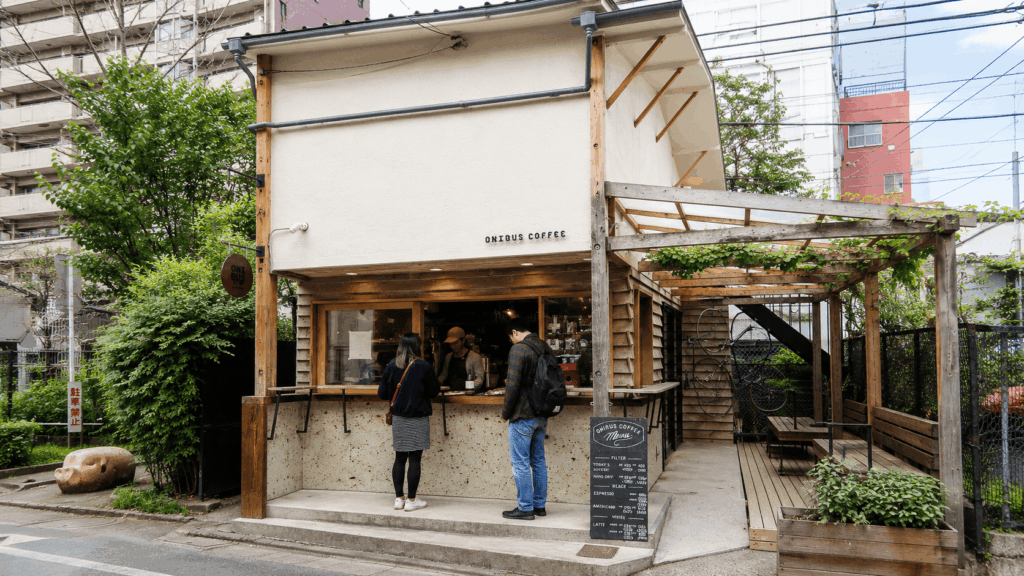
Onibus Coffee Nakameguro occupies a renovated old Japanese house right by the Tokyu train tracks. It’s a short walk from Nakameguro Station, has a small counter and a few indoor seats, plus outdoor benches overlooking the train line. Hours are approximately 9:00–18:00, though the shop doesn’t have fixed closing days. The coffee is consistently excellent—Onibus roasts its own beans and supplies several other Tokyo shops. Best for: pairing with a walk along the Meguro River or browsing the boutiques in Daikanyama.
Kiyosumi-Shirakawa Cluster — Tokyo’s Coffee Town
If you only visit one neighborhood for coffee in Tokyo, make it Kiyosumi-Shirakawa. This quiet eastern Tokyo district has the highest concentration of specialty roasters and cafés within walking distance of any area in the city.
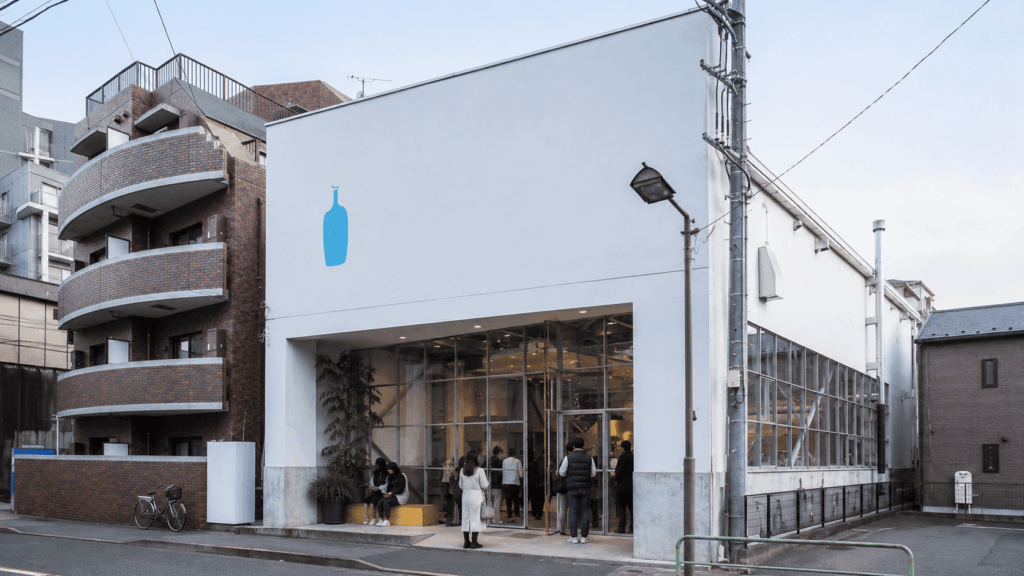
Blue Bottle Coffee Kiyosumi-Shirakawa was the brand’s first Japan location (opened 2015) and remains its flagship. Housed in a converted warehouse with high ceilings and plenty of seating, it’s a rare Blue Bottle that feels genuinely spacious. Full table service, pastries, and a visible roastery. Hours from around 8:00 daily. Best for: a sit-down coffee with room to work or plan your afternoon.
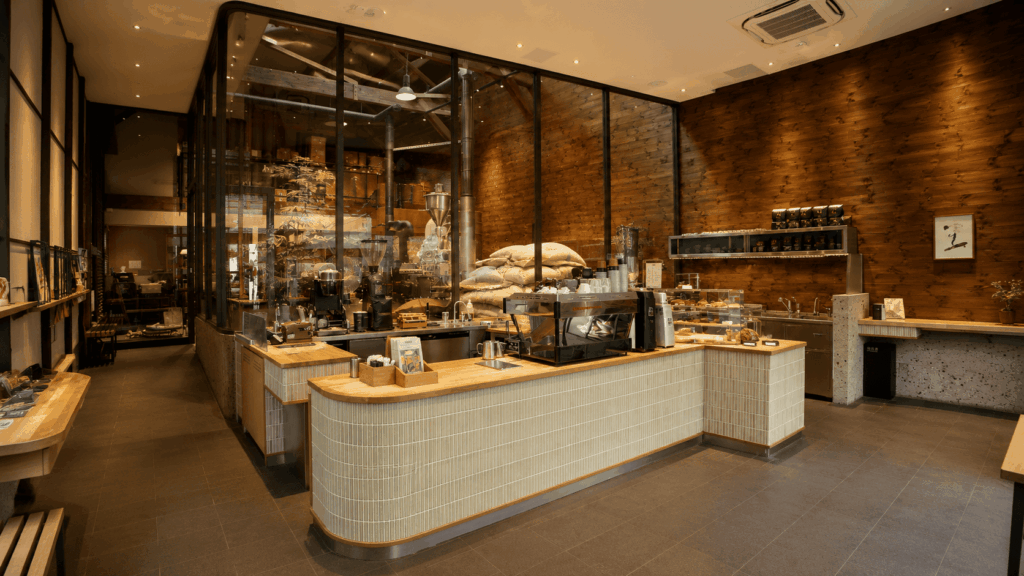
Allpress Espresso Tokyo Roastery & Cafe, a five-minute walk away, occupies a converted factory space with a similar industrial-aesthetic feel. The New Zealand-born roaster offers espresso-based drinks and pour-overs in a warehouse setting with indoor and outdoor seating. Weekday hours roughly 8:00–17:00, weekends 9:00–18:00. Best for: a quieter alternative to Blue Bottle with excellent pastries.
Koffee Mameya Kakeru (also in this neighborhood) belongs to Type 3 below—it’s a reservation-only tasting experience, not a walk-in café.
Other Standouts Worth the Trip
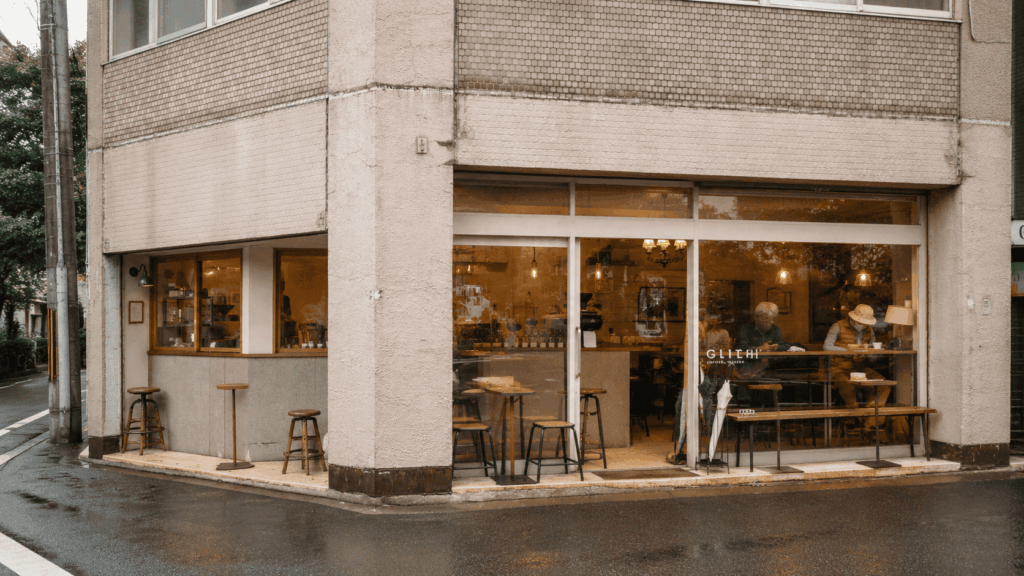
Glitch Coffee & Roasters (Jimbocho / Kanda) is widely considered one of Tokyo’s most serious specialty roasters. The main shop near Jimbocho Station is tiny—a few counter seats and a constant stream of coffee pilgrims. Weekdays roughly 8:00–19:00, weekends 9:00–19:00. Best for: travelers who want to taste some of the best light-roast single-origin coffee in Japan and are comfortable with a no-frills standing setup.
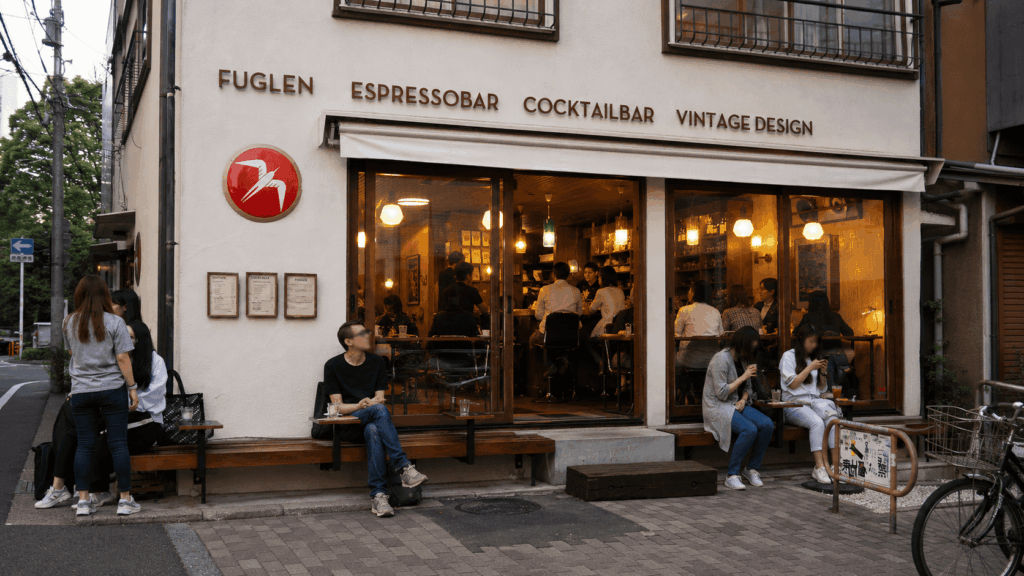
Fuglen Tokyo in Tomigaya (near Yoyogi Park) is a Norwegian-Japanese hybrid that serves exceptional light-roast coffee by day and cocktails by night. The interior is mid-century Scandinavian furniture, and the outdoor terrace is one of the best people-watching spots in the neighborhood. Hours are roughly 7:00–23:00 on weekdays, extended to 1:00 AM Wednesday through Sunday. There’s a second location—Fuglen Asakusa—near Senso-ji temple, open from 8:00 AM with the same excellent coffee and waffles with brown cheese. Best for: early birds who want coffee from 7 AM, or evening visitors who want to transition from coffee to cocktails without changing venue.
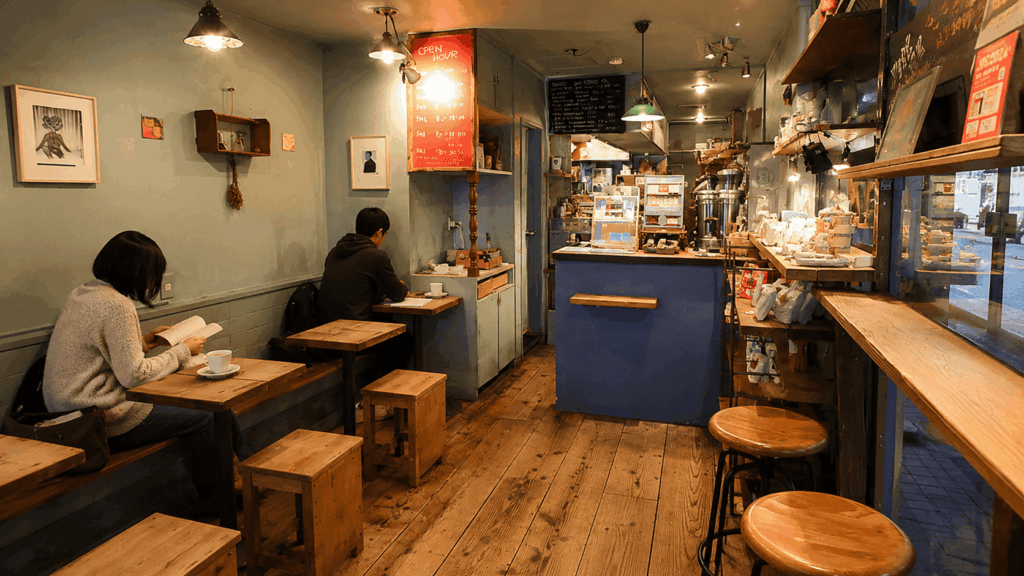
Sarutahiko Coffee in Ebisu is the original location of a now-small chain, and it’s open late (until around 22:30 on weeknights, later on Fridays), making it one of the few specialty options for evening coffee. Two minutes from Ebisu Station’s east exit. Credit cards accepted. Best for: a reliable late-evening coffee when everything else has closed.
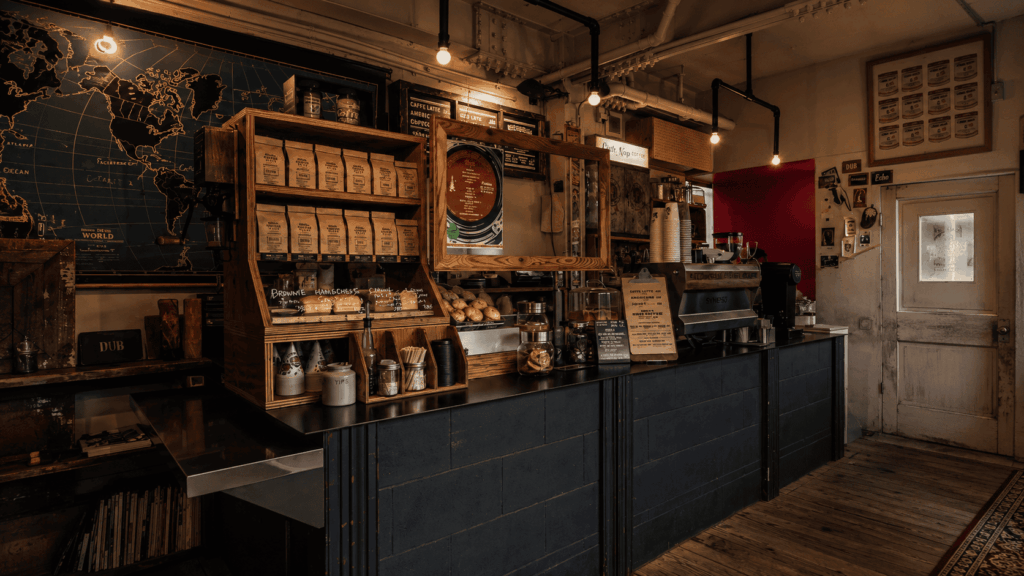
Little Nap Coffee Stand in Yoyogi is a tiny stand near Yoyogi-Hachiman Station with a bench or two outside and standing room inside. Closed Mondays. Hours approximately 9:00–19:00 (18:00 on weekdays). Best for: a takeaway coffee before a walk through Yoyogi Park.
Kitasando Coffee near Kitasando Station (one stop from Harajuku on the Fukutoshin Line) is a small, bright shop serving single-origin pour-overs and espresso. Cashless only (card or phone payment). Weekdays roughly 8:00–18:00, weekends from 10:00. Best for: a calm stop between Harajuku and Shinjuku without the crowds.
Counterpart Coffee Gallery in Nishi-Shinjuku is a neighborhood cafe that also functions as a small gallery space. Hours are irregular and worth checking before visiting (currently open Tue/Wed/Fri/Sun 9:00–18:00, Sat 9:00–14:00, closed Mon and Thu). Unusually for Tokyo, it’s cards-only (no cash). Best for: travelers staying in west Shinjuku who want a local, non-chain option.
Type 2: The Kissaten Seeker — Slow, Vintage, Atmospheric
If the idea of a standing counter with minimalist concrete makes you feel rushed, you’re looking for a kissaten—the traditional Japanese coffee house that’s been serving slow, deliberate coffee since before the third-wave existed. This is where Tokyo’s coffee culture gets personal: each shop is a reflection of its master’s taste in beans, cups, music, and pacing.
Kai’s tip: The mistake I see travelers make is treating a kissaten like a third-wave café. Every single one of these shops is cash-only. Wi-Fi is generally nonexistent. Some allow smoking. Service is slow by design—the master works one cup at a time with a nel drip, and that cup can take five to seven minutes. This isn’t an inconvenience. It’s the whole point. Pick a kissaten when you have an hour to spare and zero need to check email. If you’re in a rush or need to work, choose a specialty café instead.
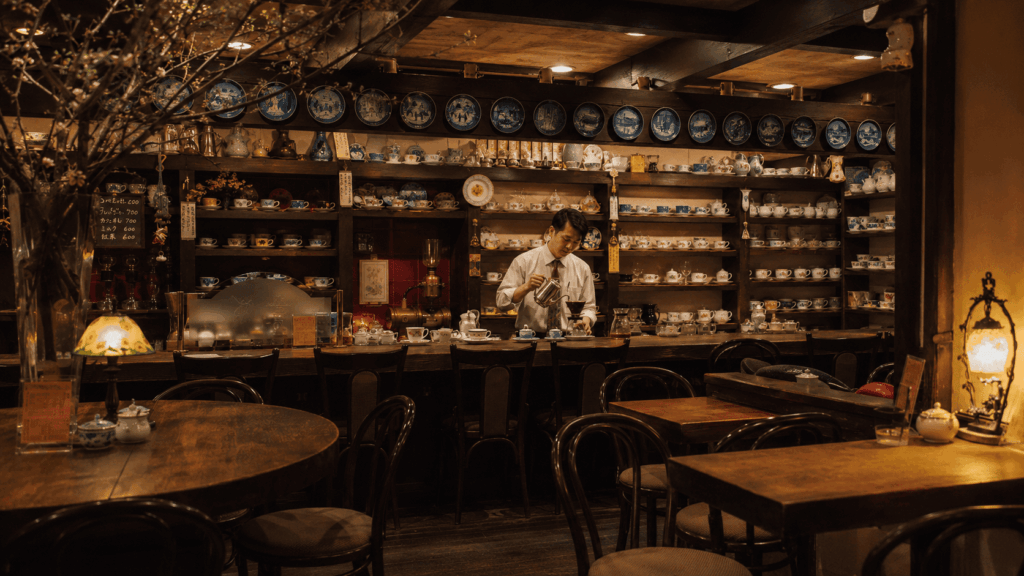
Chatei Hatou (Shibuya, a three-minute walk from Shibuya Station’s Hachiko Exit) is the quintessential Shibuya kissaten and the one most frequently recommended to visitors—with good reason. The interior is all dark wood, stained glass, antique lamps, and jazz records. The coffee is nel-drip, served in delicate cups on a tray with a small sweet. A single cup runs approximately ¥1,000–1,500. Open 11:00–23:00 (last order 22:00). Cash only. No Wi-Fi.
Best for: travelers who want the “postcard” kissaten experience without leaving central Tokyo. You’ll queue 15–30 minutes on weekends, but seating is generous once you’re inside.
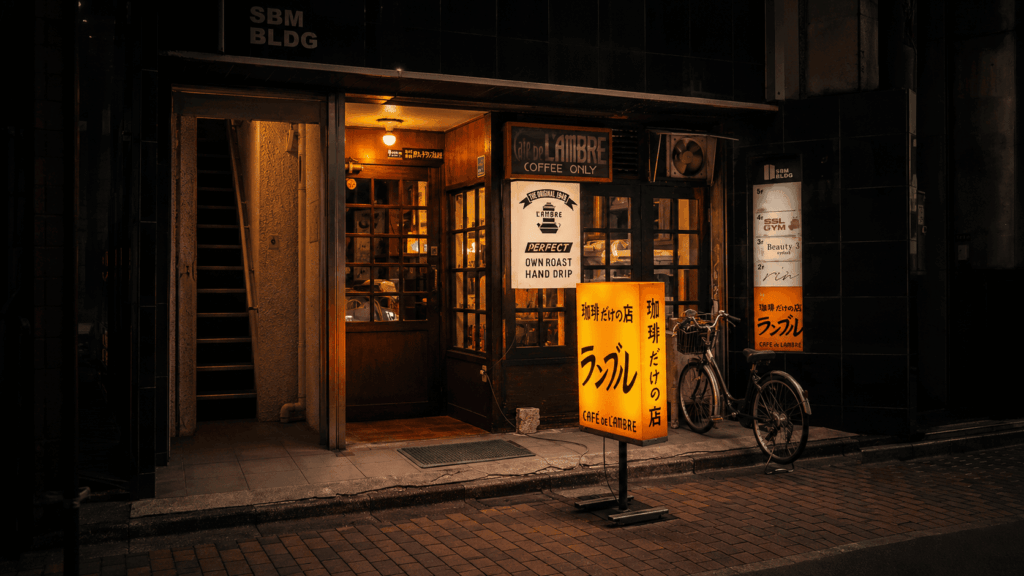
Café de l’Ambre (Ginza) opened in 1948 and has barely changed since. The master roasts and ages his own beans—some beans are stored for decades before brewing. The nel-drip coffee here is unlike anything you’ll taste in a third-wave shop: deep, complex, and served in a silver pot with a demitasse cup. The interior is narrow, smoky (some sections allow smoking), and entirely unconcerned with trends.
Hours: Wednesday–Saturday 12:00–22:00, Sunday 12:00–19:00. Closed Monday and Tuesday. Cash only. No Wi-Fi. The menu is in Japanese only, though the master is used to foreign visitors pointing at beans in the glass case.
Best for: serious coffee drinkers who want to taste aged, dark-roast beans that have no equivalent in the third-wave world. Skip it if you’re sensitive to cigarette smoke.
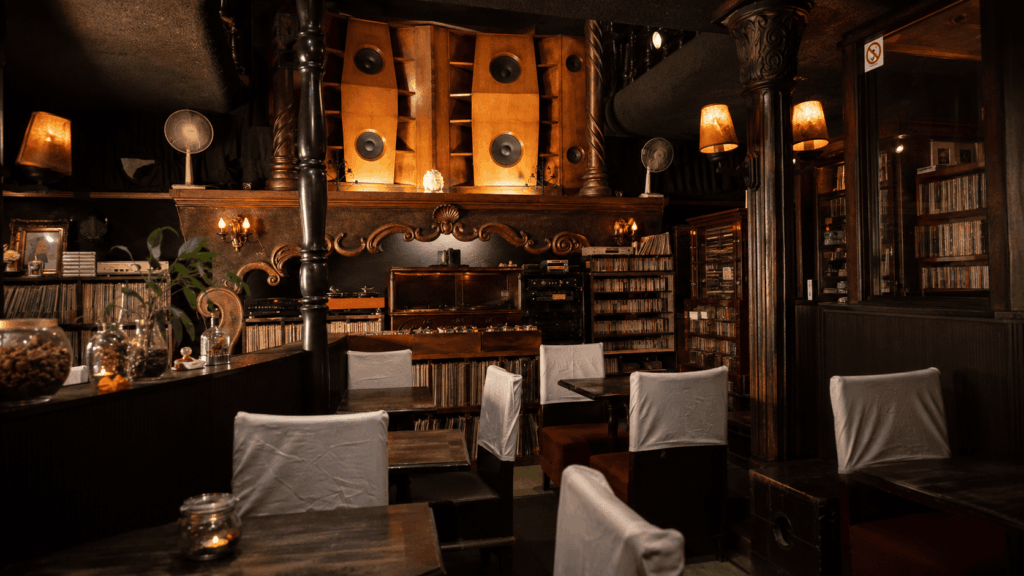
Meikyoku Kissa Lion (Shibuya, a ten-minute walk from the station) opened in 1926 and is Tokyo’s original “listening café”—a quiet room where patrons sit in velvet chairs facing a massive vintage sound system, listening to classical records. Coffee is secondary here (approximately ¥570 for a cup), and conversation is discouraged. Smoking is permitted throughout. No Wi-Fi, no power outlets, no laptops allowed.
Hours vary but generally 11:00–21:00. Cash only.
Best for: travelers who want the most atmospheric coffee experience in Tokyo—one that has nothing to do with coffee quality and everything to do with time travel. Skip it if you need to talk, have any smoke sensitivity, or want a good cup of coffee rather than an experience.
Type 3: The Tasting Pilgrim — Omakase Coffee Experiences
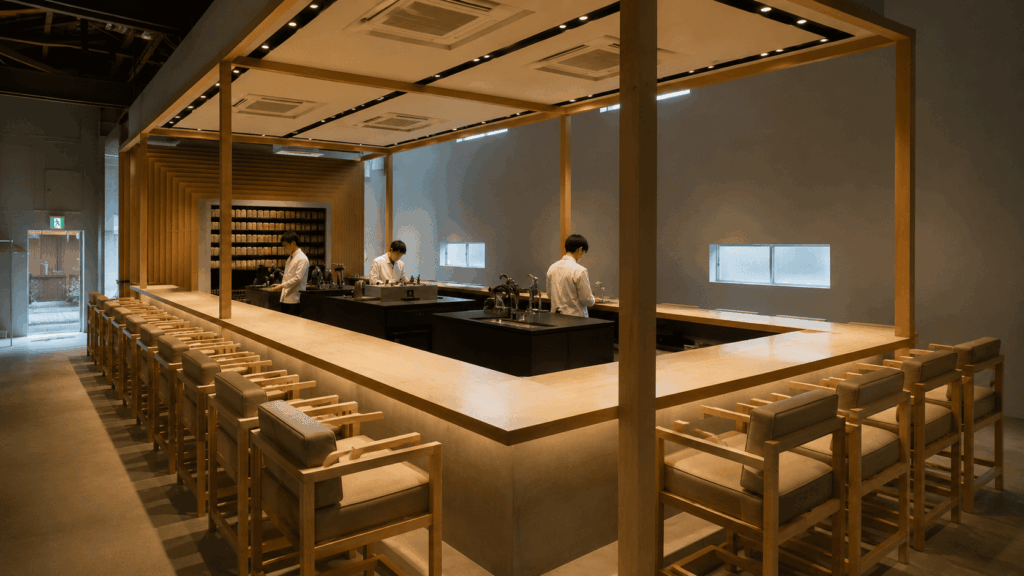
Koffee Mameya Kakeru (Kiyosumi-Shirakawa) is the seated, reservation-only sibling of the standing-only Koffee Mameya. Here, you book a 90-minute omakase-style tasting counter experience (approximately ¥4,000–5,000 per person) where a barista guides you through multiple brewing methods and single-origin beans, explaining each origin and extraction variable along the way. The interior is warm wood and counter seating for about eight people.
Reservations are made through TableCheck and can be booked about two months in advance. They fill up quickly, especially on weekends.
Best for: travelers who treat coffee as a hobby and want a Tokyo-only experience that goes deeper than ordering a pour-over. Skip it if you’re on a tight schedule or just want a quick cup—this is a 90-minute commitment.
Quick Comparison: Which Shop Fits Your Day?
| Shop | Type | Seating? | Queue | Payment | Takeout? | Best for |
|---|---|---|---|---|---|---|
| Koffee Mameya | Specialty | Standing only | 30–45 min | Cash | Beans only | A focused, fast coffee stop in Omotesando |
| About Life Coffee | Specialty | Minimal | Short | Card OK | Yes | A quick cortado on a Shibuya walk |
| Streamer Coffee | Specialty | Counter seats | Short | Card OK | Yes | An espresso drink with a seat in Shibuya |
| Onibus Coffee | Specialty | Indoor + outdoor | Short | Card OK | Yes | A calm pause in Nakameguro |
| Glitch Coffee | Specialty | Minimal counter | Variable | Card OK | Yes | Serious single-origin tasting in Jimbocho |
| Fuglen Tokyo | Specialty / Bar | Indoor + terrace | Short | Card OK | Yes | Coffee by day, cocktails by night |
| Chatei Hatou | Kissaten | Yes, ample | 15–30 min | Cash only | No | The classic kissaten experience in Shibuya |
| Café de l’Ambre | Kissaten | Yes | Short | Cash only | No | Aged-bean coffee in a 1948 setting |
| Meikyoku Kissa Lion | Kissaten / Listening | Yes, velvet chairs | None | Cash only | No | Silence, classical music, time capsule atmosphere |
| Koffee Mameya Kakeru | Tasting (reservation) | Yes, counter | Reserve ahead | Card OK | No | A 90-minute omakase coffee tasting |
Should You Book a Coffee Tour?

If the idea of navigating kissaten etiquette, language barriers, and the logistics of visiting multiple shops in a single morning feels like too much homework, a guided coffee tour solves the problem neatly.
Unveil Tokyo’s Coffee Culture with a Guide is a 3.5-hour walking tour based in Kanda and Jimbocho—the neighborhood with the highest concentration of both historic kissaten and modern specialty roasters in Tokyo. The tour visits seven coffee spots, explains the history and etiquette of each, and handles all the ordering in Japanese. It’s led by an English-speaking guide (recent visitors consistently mention the guide’s knowledge and language fluency) and is rated 5.0 out of 5 by verified travelers.
The tour starts in Akihabara and ends near Jimbocho Station. Drink costs (approximately ¥1,000–3,000 total depending on what you order) are not included in the tour price of around $92 per person.
If you fall into that camp — you want kissaten atmosphere, third-wave coffee, and neighborhood context, but planning several stops in Japanese feels like work — this is the one booking I’d push you toward.
Why I’d book this one
- It matches the article’s strongest DIY pain point: Kanda/Jimbocho has both old kissaten and modern roasters, but the best part is understanding why they sit side by side.
- Recent travelers consistently mention the guide’s knowledge, English fluency, and ability to make the route feel personal rather than like a generic café crawl.
- The format stays manageable for a Tokyo itinerary: a 3.5-hour small-group walk, with drink orders paid separately, so you can control how much coffee you actually drink.
Before locking in your coffee morning, see live availability, start times, and recent traveler reviews for Unveil Tokyo’s Coffee Culture with a Guide.
Book this coffee tour if:
- You’re curious about kissaten culture but feel awkward about etiquette, language, or ordering in Japanese.
- You want to try multiple shops (both kissaten and specialty) without planning the route yourself.
- You only have one morning to dedicate to coffee and want to maximize variety.
Skip the tour if:
- You’re comfortable picking one neighborhood and exploring its coffee scene on foot at your own pace (the Omotesando/Shibuya walk outlined above works perfectly without a guide).
- You only want to visit a single shop, not a crawl.
- You’re on a tight budget—the DIY route costs significantly less.
Where to Base Your Coffee Day (Neighborhood Strategy)

Tokyo’s best coffee is not concentrated in one area. It’s distributed across four distinct clusters, each with a different personality. Pick the one that fits your itinerary and spend your coffee time there rather than sprinting between neighborhoods.
Omotesando / Shibuya — The densest cluster. Koffee Mameya, About Life, Streamer, Café Kitsuné, Chatei Hatou, and Meikyoku Kissa Lion are all within a 20-minute walking radius. Best for: travelers who want maximum variety in a single morning, from standing specialty to seated kissaten. Combine with shopping in Omotesando or Shibuya Crossing sightseeing.
Kiyosumi-Shirakawa — The purest coffee neighborhood. Blue Bottle, Allpress, and Koffee Mameya Kakeru within a ten-minute walk. The area is quiet, flat, and pleasant to walk around, but there isn’t much else besides coffee and the nearby Museum of Contemporary Art Tokyo. Best for: coffee-focused travelers who want to spend a morning doing a roastery crawl. The GYG coffee tour’s neighborhood (Kanda/Jimbocho) is a 15-minute taxi or subway ride away.
Nakameguro / Daikanyama — Coffee meets lifestyle. Onibus Coffee anchors this area, with excellent boutique shopping, the Meguro River promenade, and a more relaxed pace than Shibuya. Best for: travelers who want one great coffee stop paired with a walk and shopping, rather than a coffee-focused day.
Kanda / Jimbocho — The historical coffee core. Glitch Coffee anchors the specialty side while dozens of traditional kissaten line the side streets (many of which appear on the GYG tour). The area is also Tokyo’s used-book district, so browsing antique bookstores fills the gaps between coffee stops. Best for: travelers who want the most diverse mix of old and new coffee culture in a compact, walkable area.
FAQ
Is Koffee Mameya really worth the queue?
It depends on what you’re looking for. If you want to taste exceptional single-origin coffee guided by a knowledgeable barista and you’re comfortable standing for the whole experience, yes—it’s unlike anything you’ll find outside Japan. If you’re hoping for a cozy seat where you can settle in with a latte, the queue will feel wasted. Save yourself the disappointment: treat Mameya as a bean shop with a quick tasting counter, not a café. If you want the same quality in a seated setting, book Koffee Mameya Kakeru in Kiyosumi-Shirakawa instead.
Do I need to speak Japanese to order at these coffee shops?
At most specialty coffee shops (Koffee Mameya, Onibus, Glitch, Fuglen, Blue Bottle, Streamer, Sarutahiko), the baristas are used to foreign visitors and menus are either in English or have English descriptions. Pointing and ordering by origin name works fine. At traditional kissaten (Chatei Hatou, Café de l’Ambre, Meikyoku Kissa Lion), menus are almost entirely in Japanese, though the staff are accustomed to non-Japanese customers. If you’re nervous about kissaten etiquette, a guided tour is a stress-free alternative—the guide handles all ordering and explains the rituals.
Are these coffee shops open on Mondays and Sundays?
Sunday hours are generally reliable at most shops on this list, though some kissaten open later on weekends (Café de l’Ambre opens at noon on Sundays, for example). Monday is trickier: Little Nap Coffee Stand is closed Mondays, Counterpart Coffee Gallery is closed Mondays and Thursdays, and some smaller kissaten take irregular weekdays off. Always check individual shop Instagram accounts or Google Maps before heading out, especially if you’re visiting on a Monday.
Can I find good specialty coffee near Shinjuku or Asakusa?
Yes, but the options are fewer. In Shinjuku, Counterpart Coffee Gallery (Nishi-Shinjuku) is your best local option, though its hours are irregular. In Asakusa, Fuglen Asakusa serves the same excellent Norwegian roast as the Tomigaya original, plus waffles—it’s a 10-minute walk from Senso-ji temple and open from 8:00 AM. Neither area has the density of the Omotesando/Shibuya or Kiyosumi-Shirakawa clusters, so plan for a single stop rather than a crawl.
What’s the difference between a kissaten and a specialty coffee shop, in one sentence?
A kissaten is a traditional Japanese coffee house focused on atmosphere, slow nel-drip brewing, and the master’s personal style—expect cash-only, no Wi-Fi, and service that takes its time. A specialty coffee shop is modern, efficient, and focused on the bean itself—expect card payment, faster service, and often standing-room-only. Neither is better; they serve completely different travel moods.
Final Verdict
There is no single best coffee shop in Tokyo. The right choice depends entirely on what kind of traveler you are and how much time you have. Here’s how to decide.
For first-time visitors who want variety: Base your morning in the Omotesando / Shibuya cluster. Start at Koffee Mameya for the iconic standing tasting, then walk to About Life for a takeaway cortado, and finish with a seat at Chatei Hatou for the full kissaten experience. All within a 20-minute walk, three completely different versions of Tokyo coffee.
For serious coffee enthusiasts: Head to Kiyosumi-Shirakawa or Kanda / Jimbocho. The former gives you Blue Bottle, Allpress, and Koffee Mameya Kakeru in one walkable circuit. The latter gives you Glitch Coffee plus a dozen historic kissaten hidden on side streets—this is also the neighborhood covered by the guided coffee tour if you want context and history with your caffeine.
For travelers on a tight schedule: Pick one neighborhood and stay there. A single well-chosen shop in the right cluster will give you a better experience than rushing between three neighborhoods. If you only have time for one stop and one cup: Fuglen Tokyo opens at 7 AM, serves exceptional coffee, has outdoor seating, and is within walking distance of Yoyogi Park—an efficient, beautiful start to any Tokyo morning.
For kissaten lovers: Don’t skip Chatei Hatou, but push yourself to visit Café de l’Ambre if you have time for Ginza. The aged-bean coffee at l’Ambre has no equivalent in specialty coffee—it’s a taste of a Tokyo that’s disappearing. Pair it with a trip to Meikyoku Kissa Lion for the full listening café experience if smoke doesn’t bother you.
For families or travelers who need seating and space: Blue Bottle Kiyosumi-Shirakawa is the most comfortable choice on this list—warehouse-sized, plenty of seats, full table service, and pastries. Sarutahiko Coffee in Ebisu also has good seating and the latest evening hours on this list.
For repeat visitors who want something new: Book a 90-minute omakase at Koffee Mameya Kakeru. It’s the most Tokyo-unique coffee experience on this list—a tasting counter that rivals a fine-dining omakase in its attention to detail and storytelling.
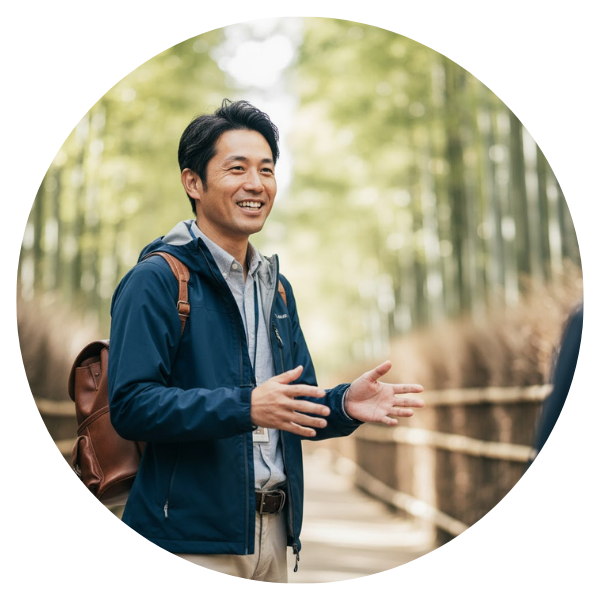
Hi, I’m Kai. I’m a Tokyo-based travel writer, tourism industry insider, and the author of a published guidebook for international visitors to Japan. With over 10 years of professional experience at a leading Japanese tourism company, my mission is to help you skip the tourist traps and navigate Japan’s best destinations like a local. I believe the perfect day trip is like a traditional kaiseki meal: a beautiful balance of precise planning and unforgettable seasonal discovery. When I’m not out conducting field research, you’ll usually find me drafting new itineraries with one of my favorite fountain pens!