
Joren Falls (Jōren-no-taki) is a 25-meter waterfall on the Hontani River, a headwater of the Kano River, in the middle of the Izu Peninsula, about 35 minutes by bus from Shuzenji Station. If you are already moving through Izu — say, from Shuzenji toward Kawazu or Shimoda — it is a worthwhile 30-minute stop. The water drops into a dark basalt bowl, wasabi beds run along the stream below, and the shops by the car park sell wasabi soft serve. If you are thinking of traveling from Tokyo just for this waterfall, it is a long way to go for half an hour.
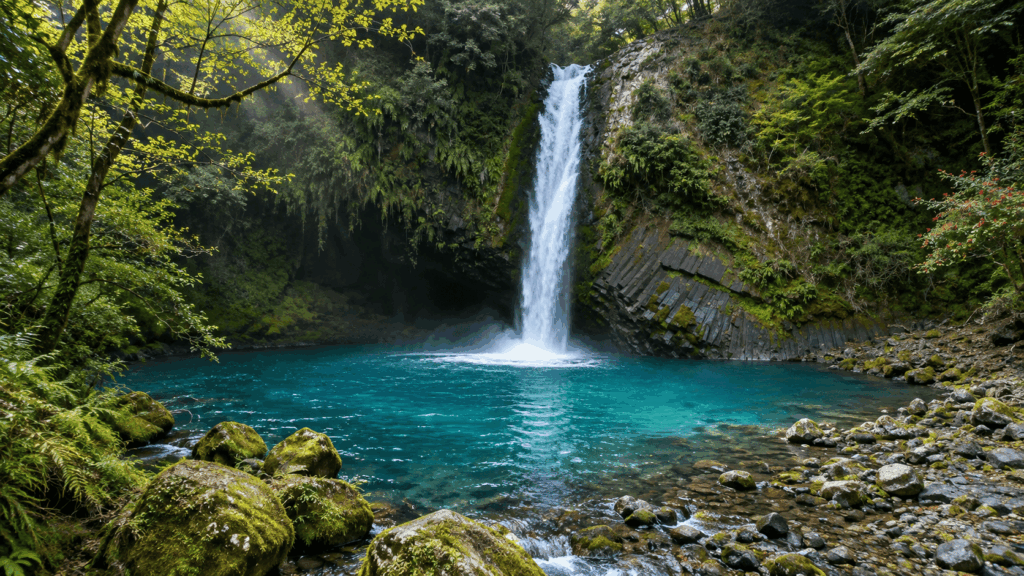
There is one decision to make before anything else: whether you will walk down the roughly 200 steps to the base, or watch from the upper deck and skip them entirely. Everything else about a visit — how long it takes, what you carry, when you leave — follows from that.
- Worth a stop if you are driving or busing through central Izu, like waterfalls, and want wasabi fields and a short walk in the same place.
- Skip it if your day is already full, or if a steep staircase is a dealbreaker and a distant view from a deck would not satisfy you.
- Time to allow: about 30 minutes for the standard visit, 45 to 60 if you want to sit down and shop.
- The decision that matters: down to the base for the full experience, or the upper deck for an easier look.
- Cost: nothing. The falls and the parking are free.
Coming from Tokyo for a full Izu day trip? If you want to combine several stops without coordinating trains and buses or driving the mountain roads yourself, a private car tour is worth comparing. See the private Izu day trip itinerary and current availability. Confirm that Joren Falls can be included and how much time you would have there before booking.
Joren Falls at a Glance
| Detail | What to know |
|---|---|
| Location | Izu City, Shizuoka Prefecture, on National Route 414 |
| Waterfall height | 25 meters high, about 7 meters wide |
| Admission | Free; parking is also free |
| Steps to the base | Roughly 200, the same staircase up and down |
| Typical visit | About 30 minutes; 45 to 60 minutes at an easy pace |
| Parking | Free lot for around 100 cars, open 24 hours, no reservation |
| Nearest bus stop | Joren-no-taki, on Tokai Bus routes from Shuzenji Station |
| Bus from Shuzenji | About 35 minutes, then a short walk to the falls |
| Best feature | The falls, the columnar basalt cliff, and the wasabi beds below |
| Main caution | The return climb, wet steps after rain, and no lighting after dark |
Is Joren Falls Worth Visiting?
Yes, with a condition attached: it is worth visiting as part of an Izu itinerary, not as the reason for one. The falls are one of Japan’s Top 100 Waterfalls, and the combination you get here — a 25-meter drop, a wall of columnar basalt, working wasabi beds, and a cluster of small shops — is hard to find in a single stop elsewhere on the peninsula. What you do not get is a long hike, a visitor complex, or a full day out. This is a place you see, photograph, and leave.
The most common misjudgment I see is treating Joren Falls as a standalone destination. Travelers look at a photo, assume it is a major sight, and build a day around it. Then they arrive, spend 30 minutes, and wonder what to do next. It works far better as a fixed point on a route: Shuzenji in the morning, the falls around midday, then Amagi and down to Kawazu or Shimoda.
It suits you if you are road-tripping through Izu, interested in wasabi as a crop rather than just a condiment, traveling with people who can handle a steep staircase or who are happy to wait on the deck, or visiting in summer, when the air at the bottom of the gorge is noticeably cooler than the road above.
It suits you less if you are coming from Tokyo and back in one day just for the falls, expecting a hiking trail or a full-day nature attraction, traveling with someone who cannot manage 200 steps and would be disappointed by a partial view, or on a tight schedule with a bus to catch and no margin for a missed connection. If you are based in the capital and simply want a day outdoors, consider one of the easy hikes near Tokyo by train instead.
Recent visitors tend to mention the same two things: how good the falls look after rain, and how much more tiring the climb back up is than the walk down. Both are accurate, and both are worth planning around rather than discovering on the stairs.
The 200 Steps: Should You Walk Down?
The path to the base is a steep staircase of roughly 200 steps, and you come back up the same way. The visitor center’s own guidance is about 5 minutes down and about 10 minutes up, which tells you most of what you need to know: the descent is quick, the return is the real work. Handrails run along most of the route, and the steps are stone and uneven in places rather than a smooth, regular flight.
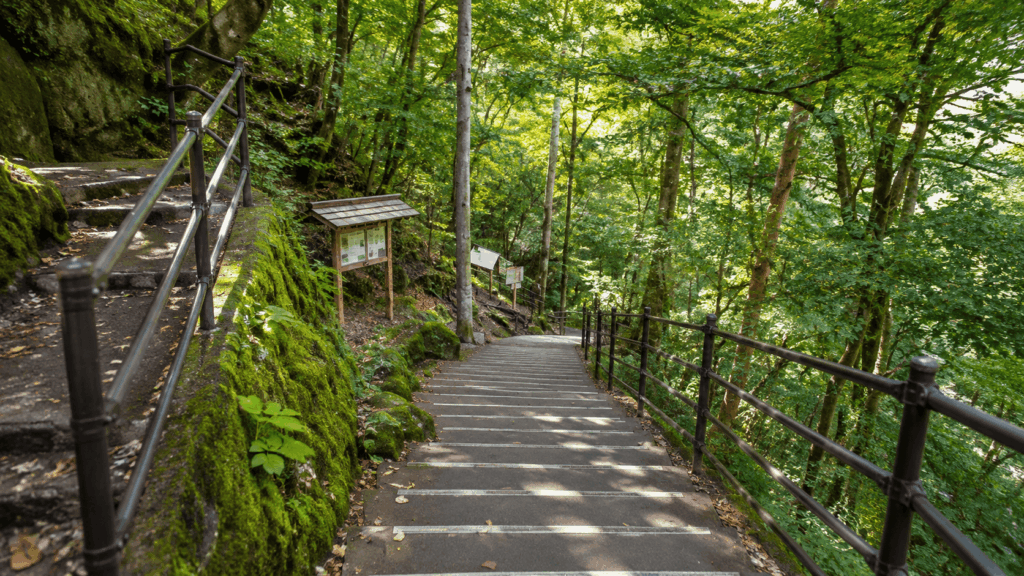
Kai’s tip: The climb back up is the part I prepare people for, because it is where an easy stop turns into a chore. I tell visitors to decide at the top of the stairs, not halfway down — once you are at the bottom, you have already committed to the return. Use the handrail on the way down even if you feel steady, and wear shoes you have actually walked in. The descent is where people slip; the ascent is where they run out of legs.
Upper Observation Deck vs Walking to the Base
Since 2020 there has been a viewing deck above the falls, a two- to three-minute walk from the free car park and reachable without stairs — it was built so that wheelchair users and visitors with limited mobility could see the waterfall. That makes it a genuine option, not a consolation prize. What it is not is the same experience as standing at the bottom.
| Option | What you actually see | Walking effort | Best for |
|---|---|---|---|
| Upper observation deck | A view down onto the top of the falls and the gorge, filtered through trees; you hear the water but do not feel the spray | Two to three minutes from the car park, no stairs; suitable for wheelchairs and strollers | Visitors with knee, hip, or heart concerns; families with very young children; anyone short on time |
| Lower viewing path | The full drop from below, the basalt columns close up, the pool, and the wasabi beds at the foot of the stairs | About 200 steps each way; 5 minutes down, around 10 minutes back up | Travelers who can manage the return climb and want the version of Joren Falls most photos show |
If the photograph you came for is the waterfall seen from below, only the lower path delivers it. If what you want is to see the falls, understand the landscape, and keep the day moving, the deck does that without costing you your knees.
How Hard Is the Climb Back Up?
Harder than the step count suggests, for two reasons. The stairs are steep enough that you are lifting your own body weight with each step rather than strolling up a slope, and the climb comes at the end of your visit, when you are already carrying whatever you brought down. The steps can also be damp even on a dry day, because the gorge holds moisture and spray.
Most reasonably active adults get back to the top in 10 to 15 minutes with a pause or two. Travelers with knee problems, older visitors, and anyone carrying a child will take longer and should plan for it rather than power through. There is no shortcut and no lift; the deck is the alternative, and it is a perfectly good one. Reviews from other visitors regularly describe the return climb as the hardest part of the visit, which matches what I see on the stairs — the people who struggle are almost always the ones who did not expect a climb at all.
What You’ll See at Joren Falls
Most people come for the waterfall and leave talking about the wasabi. The site is compact, and three things sit within a few minutes of each other: the falls and their rock wall, the cool air at the bottom, and the wasabi terraces below.
The Waterfall, the Basalt Wall, and the Air
The falls drop 25 meters over a cliff of columnar basalt, and the rock is the reason the setting looks the way it does. Around 17,000 years ago, lava from the Hachikubo-yama and Maruyama craters flowed through this valley and cooled into vertical columns as it contracted. The Hontani River now spills over the edge of that old flow, which is why the cliff beside the water looks built rather than eroded.
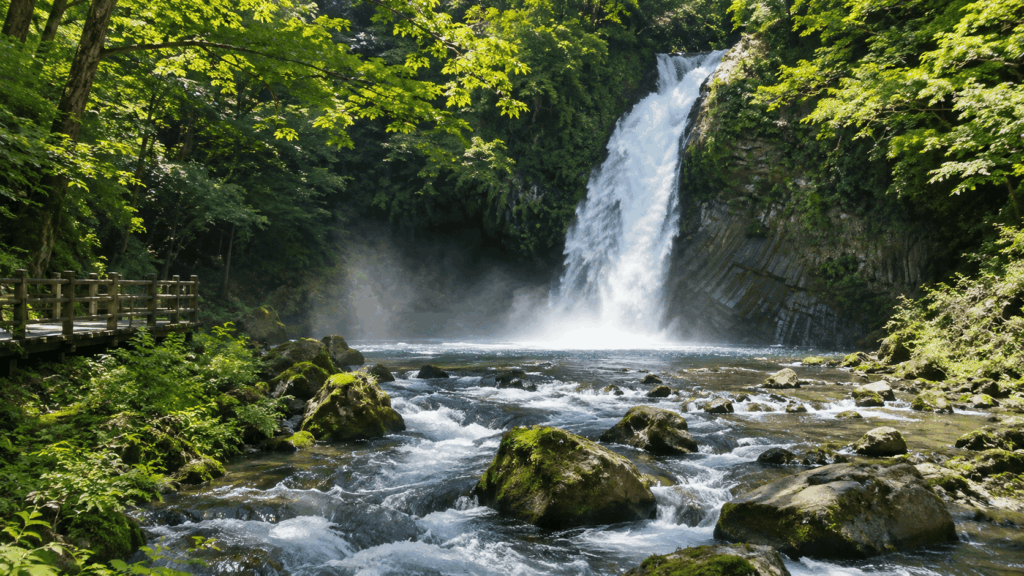
At the bottom, the air changes. In August, walking down, the heat of the road above gives way to something closer to air conditioning within the last stretch of stairs, and the temperature keeps dropping as you approach the pool. The sound is the other thing: at the base, the water is loud enough that a normal speaking voice does not carry, which matters if you are trying to explain something on the way down. Look at the wet rock beside the spray and you may spot haikomochishida, or Joren-shida, a fern that in Japan grows only here and in southern Kyushu. Partway down there is also a small hall, Joren Falls Fudoson, where the force of the water has long been treated as something to pray to rather than just look at.
The Wasabi Fields at the Bottom
Once you reach the bottom, the stream below the falls runs past rows of wasabi beds — flat terraces of stone with water moving through them, green and orderly against the forest. This is the tatami-ishi method, developed in central Izu in the 1890s, in which layers of large, medium, and small stones are stacked so that spring water flows through the bed and keeps the roots cool and clean. In 2018 the system was recognized as a Globally Important Agricultural Heritage System under the name “Traditional Wasabi Cultivation in Shizuoka.”
That is a different designation from World Heritage status, and the distinction matters: this is a working agricultural landscape, not a monument. The beds are farmland, so stay on the path, photograph from the edge, and do not walk into the terraces. From partway up the staircase the green terraces appear between the trees before the water comes into view, which is why the descent feels shorter than the climb back.
How Long Do You Need at Joren Falls?
Three realistic budgets, depending on how much of the site you use:
- 10 to 20 minutes — upper deck only. Park, walk two or three minutes to the deck, look, and leave. This is a legitimate visit if stairs are not an option, not a failed one.
- About 30 minutes — the standard visit. This is the visitor center’s own estimate and covers the car park, the staircase, time at the base, photographs, and the climb back.
- 45 to 60 minutes — the relaxed visit. Add a drink or a wasabi soft serve, a look around the shops, and a slower climb with a pause.
Thirty minutes is enough time to see the falls. Whether it is enough time to enjoy them depends on whether you spend it queuing for the same photograph as everyone else or sitting down afterward.
Planning Around the Bus Schedule
Buses between Shuzenji and Kawazu pass through roughly once an hour for much of the day, but the intervals are uneven, and there are stretches when nothing comes for a while. The timetable is the biggest source of stress for visitors without a car, and almost all of that stress is avoidable by doing one thing: check the departure time of your return bus before you go down the stairs. Times are posted at the stop by the car park.
Kai’s tip: A gap between buses looks like dead time and usually is not. Do the staircase, then sit down with a drink, and the bus tends to arrive around the time you are ready for it. There is a shop at the foot of the stairs as well, so you do not need to carry water down with you. The visitors who end up rushing are the ones who only look at the timetable after they have climbed back up.
How to Get to Joren Falls
There are two realistic ways to arrive: drive, or take the bus from Shuzenji Station and accept that the timetable sets your day. Coming from Tokyo by train, the usual route is the Tokaido Shinkansen to Mishima, then the Izuhakone Railway Sunzu Line to Shuzenji — roughly 35 minutes — and the bus from there.
By Bus from Shuzenji Station
Tokai Bus services heading toward Kawazu Station, Shimoda Station, or Amagi-no-Mori stop at Joren-no-taki. The ride takes about 35 minutes and costs around ¥1,150 one way. From the stop it is a short walk of three to five minutes to the car park and the top of the stairs. Depart from bay 5 at Shuzenji Station, and check the current timetable and fare before you travel.
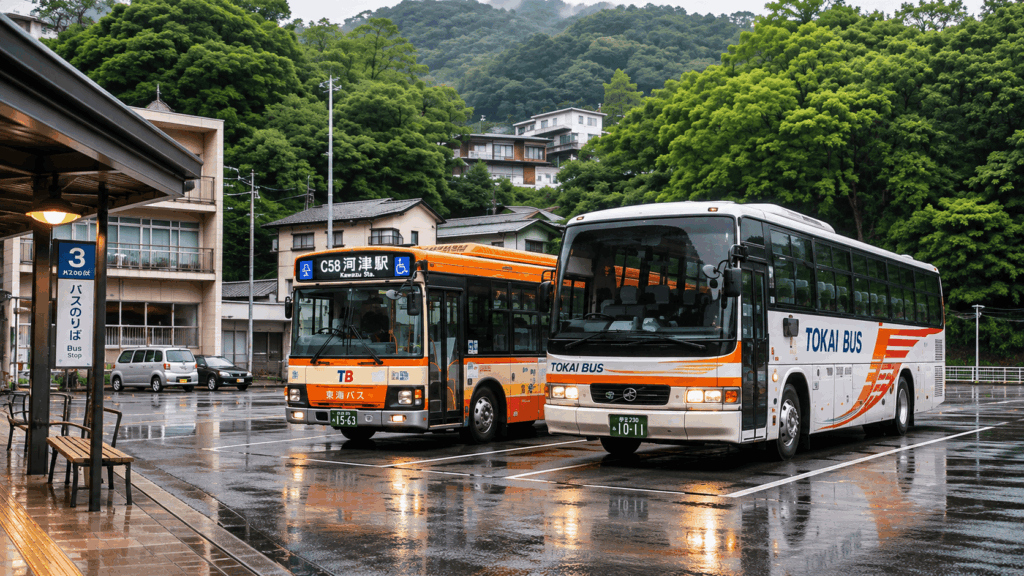
The bus works well if you are staying in Shuzenji and treating the falls as a half-day outing. It works less well if you want to see the falls, Amagi, and Kawazu in the same day, because each leg is tied to a schedule you did not write.
By Car and Parking
Joren Falls sits directly on National Route 414, and the free car park holds around 100 cars, is open 24 hours, and needs no reservation. The approach from Shuzenji climbs through the Amagi mountains, which is why the falls fit so naturally into a north-south drive: you are already on the road that connects Shuzenji with Kawazu and Shimoda.
Two conditions are worth knowing. In winter, snow can make Route 414 hazardous and can close the lower path to the falls, though the car park, toilets, and upper deck usually remain usable. And during the Kawazu cherry blossom season, which runs from early February to early March, traffic on Route 414 through Kawazu and over the Amagi passes gets heavy, especially at weekends; the car park is large, but expect it to be busy around midday on peak spring days.
Best Time to Visit Joren Falls
Summer is the season when this stop makes the most sense. The gorge is shaded, the water is running, and the temperature difference between the road and the base of the falls is at its most welcome in July and August. Autumn brings color to the surrounding forest. Spring brings the crowds, because the falls sit on the route between Shuzenji and the Kawazu cherry blossoms.
One timing point catches people out: there is no lighting at the falls, and the visitor center asks people not to visit after dark. Average sunset is around 16:30 from November to January, 17:30 from February to April, 18:30 from August to October, and 19:00 from May to July. In winter, that means the visit belongs in the early afternoon, not at the end of a day of sightseeing.
Kai’s tip: After heavy rain the falls are at their most impressive — I have been at the base when the spray reached the bottom of the stairs — and the steps are at their most slippery. Those are one fact, not two. Go for the water, but take the handrail seriously and leave the smooth-soled shoes in the car. In winter, do the stairs first and the shopping afterward, so you are not descending into a gorge as the light goes.
Rain raises the volume and the drama, and it also brings down branches and makes the stone steps slick. If there is a weather warning in force, or the road is closed, follow the official guidance rather than the forecast you were hoping for. In snow, the lower path can be closed altogether; the falls remain visible from the upper deck, and the car park and toilets stay open. Conditions change quickly here, so check the visitor center’s latest update on the day.
Wasabi Soft Serve and the Shops
There are several small shops around the car park and at the foot of the falls, and they are part of the visit rather than an afterthought. The Joren Falls Kanko Center is the most reliable: wasabi soft serve, sit-down meals until mid-afternoon (shop 8:30 to 16:30, restaurant 10:30 to 15:00 with last order at 14:30), and it closes on Tuesdays, or on Wednesday when Tuesday is a public holiday. Maruiwa Ando Wasabi-ten, which has been selling wasabi for more than a century, keeps similar hours but closes on Tuesdays. Odoriko Chaya sells drinks and souvenirs with no set closing day; Takimi Chaya, right by the falls, specializes in its own wasabi pickles; and Shibukitei serves grilled sweetfish with a view of the water. Hours vary by shop and some close without notice, so treat any single shop as a bonus rather than a plan.
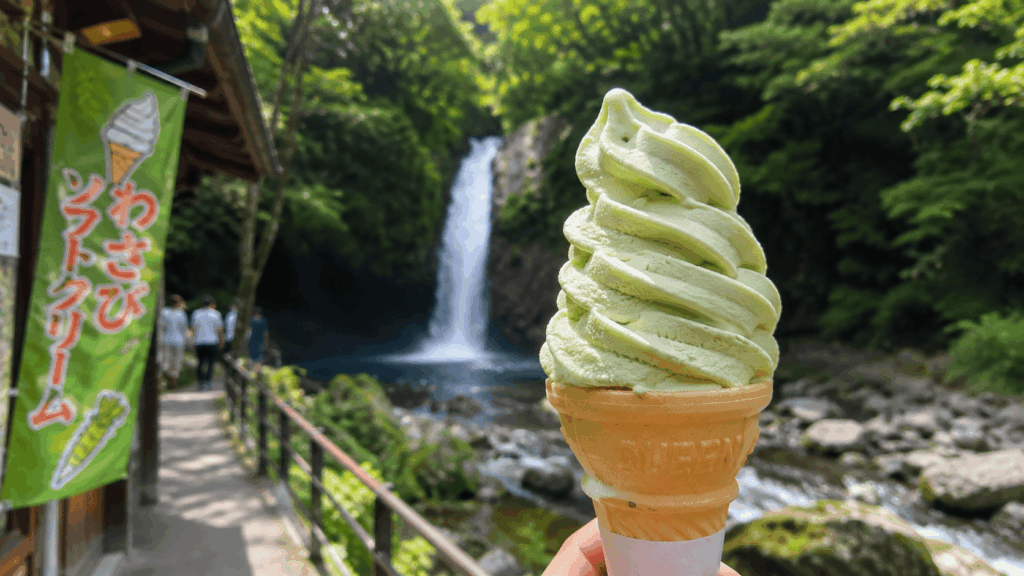
The soft serve is a sweet base with a green wasabi edge that arrives a second after the sugar, sharp rather than burning. If you dislike horseradish or wasabi heat, skip it — there is no milder version — and if you are curious, split one between two people. What I actually buy is usually the wasabi stems pickled in sanbaizu, a vinegary, mildly hot pickle that keeps well, and a fresh rhizome to grate at home. The soft serve is what I suggest to visitors who have never had wasabi in sweet form; the reactions split cleanly, with some finishing it before we reach the car and others handing it over after two bites.
Fitting Joren Falls Into Your Izu Itinerary
The natural place for Joren Falls is the north-south day: Shuzenji in the morning, over the Amagi range on Route 414, the falls around midday, then down to Kawazu or Shimoda for the afternoon. Driving times depend on traffic, weather, and how often you stop, so treat the falls as the midpoint of the day rather than scheduling it to the minute.
A Short Stop Between Shuzenji and Shimoda
Heading south, leave Shuzenji in the morning and you will reach the falls before lunch, which leaves the afternoon free for Kawazu and the coast. Heading north from Shimoda, the falls come later in the day — fine in summer, risky in winter when the light goes early. If you are doing the route in reverse during the shorter months, either start earlier or accept the upper deck and keep moving.
What the falls will not do is fill a day. Travelers who arrive expecting a trail network or a full afternoon often leave slightly deflated, not because the place is disappointing but because it is small. If a longer walk is what you are actually after, you might prefer the Jogasaki Coast Trail on the east side of the peninsula. Otherwise, pair the falls with something else on the same road: the Amagi Pass area, the Kawazu Seven Waterfalls further south, or Shuzenji’s temple and onsen before you set off.
Independent Visit or a Seasonal Tour?
Seasonal day tours from Tokyo run during the Kawazu cherry blossom window — the 2027 festival is scheduled for February 6 to March 7 — and bundle the falls with the blossoms and Shuzenji. They solve the transport problem completely, including the part where you would otherwise be standing at a bus stop doing arithmetic. What they do not do is give you a long stay at the falls; group itineraries move on, and the staircase takes time you may not have.
For a shared-group option during cherry blossom season, compare available dates and listed stops for the Kawazu cherry blossom, Joren Falls, and Shuzenji day tour. Check the time allowed at the waterfall, especially if you plan to walk down all 200 steps.
| Method | Advantages | Limitations | Best for |
|---|---|---|---|
| Car | Full control of timing; easy to combine with Amagi, Kawazu, and Shimoda; free parking at the falls | Mountain roads, winter snow, and blossom-season traffic | Travelers doing a multi-stop Izu route, especially with luggage or children |
| Public bus | No driving; direct from Shuzenji Station in about 35 minutes; cheaper than a tour | Roughly hourly and uneven; the return time dictates your visit | Travelers based in Shuzenji with half a day to spare |
| Seasonal day tour | Transport and logistics handled; several Izu sights in one day from Tokyo | Only runs in blossom season; limited free time at each stop | First-time visitors from Tokyo who would rather not plan the transfers |
If you are staying on the peninsula and have a car, there is no reason to join a tour for this stop. If you are coming from Tokyo for a single spring day and would rather not assemble three train and bus connections, the seasonal tour is the honest shortcut — just go in knowing that the falls will be one stop among several.
For travelers who want a more flexible Izu day rather than a fixed group itinerary, a private driver is the alternative worth comparing. It makes the most sense when several people are traveling together, want hotel pickup in Tokyo, and prefer to choose their own priorities along the route.
Why I’d book this one
- Private transport: Travel between Izu sights without coordinating multiple train and bus connections or waiting for the next scheduled departure.
- Flexible itinerary: Discuss your preferred stops and route in advance rather than following a fixed seasonal group itinerary.
- Tokyo hotel pickup: Avoid renting a car and handling the mountain roads yourself, especially when traveling as a family or small group.
This is a private driver service, not a guided sightseeing tour. Joren Falls is not guaranteed as a stop, so confirm that it can be included and ask whether the schedule allows enough time for the descent, photographs, and return climb. For an independent visit with your own car, the free parking and flexible timing will usually make more sense.
Check current availability, pickup details, and route options for the private Izu day trip before deciding whether the extra flexibility is worth the cost.
Frequently Asked Questions About Joren Falls
How many steps are there at Joren Falls?
Roughly 200 down to the lower viewing area, and the same 200 back up — there is no separate return route. The visitor center’s guidance is about 5 minutes down and about 10 minutes up, which is realistic for a fit adult and optimistic for anyone carrying a child or nursing a bad knee.
Can you see Joren Falls without taking the stairs?
Yes. The upper observation deck is a two- to three-minute walk from the free car park with no stairs, and it was built specifically so that visitors with limited mobility could see the falls. It gives you a view down onto the top of the falls through trees, with the sound of the water but not the spray; the full drop and the wasabi beds are only visible from the bottom.
Is Joren Falls free to visit?
Yes. There is no admission charge, no ticket, and the car park is free. You pay only for food, drinks, and anything you buy in the shops. The site is open at all hours, but there is no lighting, so arriving after dark is pointless and discouraged.
How long does it take to visit Joren Falls?
About 30 minutes for the standard visit, which is the visitor center’s own estimate. Allow 10 to 20 minutes for the upper deck alone and 45 to 60 minutes if you want to sit down and shop. If you are dependent on the bus, add the wait for your return connection rather than assuming the visit and the journey fit neatly together.
Can you go fishing at Joren Falls?
No. The trout fishing pond at the base of the falls closed in December 2025, and the operator has given no reopening date. Some older English-language guides and map listings still advertise fishing here; ignore them. Entering the river is prohibited in any case, as are swimming and drone flights over the falls.
Is Joren Falls wheelchair accessible?
Partly. The upper deck, the car park, and the toilets can be reached without stairs, and the deck was designed with wheelchair users in mind. The lower viewing path cannot be used with a wheelchair or stroller — it is a steep stone staircase of about 200 steps. The accessible experience here is the deck, not the base of the falls.
Can you visit Joren Falls at night?
You can drive there, but you will not see much. There is no illumination at the falls, and the visitor center asks people not to visit after dark. Sunset averages around 16:30 from November to January, so a winter visit needs to happen in the early afternoon.
Final Verdict: Who Should Go, and How Far Down
Joren Falls is a good stop and a poor destination. That distinction decides everything else: if it sits on the road you were already driving, go; if you were going to build a day around it, build the day around Izu instead and let the falls be one part of it.
Choose the lower path if you can manage 200 steps back up, you want the photograph taken from below, and you have 45 minutes rather than 15. That is the version of Joren Falls worth the detour, and the wasabi beds at the foot of the stairs are part of what you are paying for with the effort.
Choose the upper deck if you are traveling with someone whose knees, hips, or heart will not enjoy the climb, or if you have a bus to catch within the hour. The deck is not a failure state. It is a real view, reached in three minutes, and it leaves you time for the shops.
For first-time visitors to Izu, the cleanest plan is a car, an early start in Shuzenji, and the falls around midday on Route 414 before continuing to Kawazu or Shimoda. That order puts the stairs before the driving fatigue and the light before the afternoon. For families and older travelers, park, use the deck, buy a wasabi soft serve at the Kanko Center, and treat the visit as a 20-minute pause rather than an attraction.
For travelers on a tight schedule, check the return bus time before you descend, and if the gap is under 45 minutes, stay at the top — missing a bus here costs an hour, which is more than the falls themselves take. For anyone coming from Tokyo for a single day, be honest about the arithmetic: three hours or more of travel in each direction for a 30-minute stop. Either join a seasonal tour that combines the falls with the Kawazu blossoms and Shuzenji between early February and early March, or stay a night in Shuzenji and see the falls properly on the way south.
For repeat visitors and photographers, the falls are at their best in the hours after heavy rain, when the volume doubles and the spray reaches the stairs — and at their most crowded during the cherry blossom weeks. Go early, go wet, and go on a weekday if you can.

Hi, I’m Kai. I’m a Tokyo-based travel writer, tourism industry insider, and the author of a published guidebook for international visitors to Japan. With over 10 years of professional experience at a leading Japanese tourism company, my mission is to help you skip the tourist traps and navigate Japan’s best destinations like a local. I believe the perfect day trip is like a traditional kaiseki meal: a beautiful balance of precise planning and unforgettable seasonal discovery. When I’m not out conducting field research, you’ll usually find me drafting new itineraries with one of my favorite fountain pens!