

Planning an Amanohashidate sunset? Before you commit to a viewpoint, there are two things most visitors don’t realize. First, the sandbar stretches between two bays, so the sun drops behind the hills west of the Aso Sea — it does not sink into an open ocean horizon the way it does on the Sea of Japan coast. Second, and more important for your planning: in summer, both main viewpoints close well before the sun goes down, while in late autumn and winter the timing can line up almost perfectly.
Coming from Kyoto or Osaka and want fewer moving parts? A private Amanohashidate and Ine day trip can handle the long-distance transfer and local sightseeing in one itinerary. See current pickup options, start times, and recent traveler reviews for the private Amanohashidate & Ine trip before assuming the schedule will line up with sunset.
Quick Answer: Where to Watch the Sunset in Amanohashidate
Here’s the short version before the details:
- Best for staying late: Kasamatsu Park — the cable car runs until around 18:00 from March to October, making it the more realistic viewpoint for evening light.
- Best panoramic view: View Land — the classic panorama from Mt. Monju, but it usually closes before sunset from spring through early autumn.
- Best quiet golden hour: The Sandbar itself — free, open 24/7, and at its most atmospheric after the viewpoint crowds have gone.
- Best ocean-horizon sunset: Hamazume Yuhigaura Beach — a real sun-into-the-sea sunset about 45–60 minutes away by car, at its best in spring and summer.
On any given day, the practical answer depends on the season: summer means the sandbar, winter can mean the viewpoints, and shoulder seasons come down to your exact dates. Take your visit date, look up the sunset time, and compare it with the last downhill departure — the tables below show you how that works out across the year.
Is Amanohashidate Actually Good for Sunset?
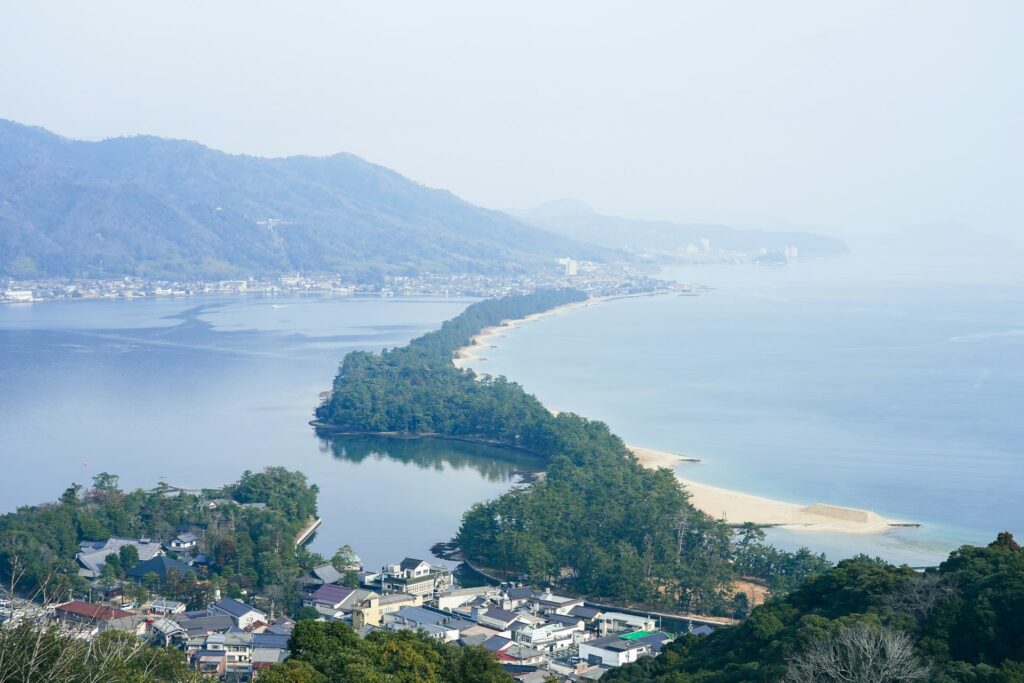
Yes — but for a specific kind of sunset. Amanohashidate is a 3.6-kilometer sandbar of pine forest running between the Aso Sea on the west and Miyazu Bay on the east. The sun sets to the west, which means the evening show happens over the Aso Sea side and the hills beyond it. What you get is warm orange light spilling across the water, the sandbar’s silhouette cutting through the bay, and a sun that disappears behind the ridge on the far shore. What you don’t get — unless you drive about 45–60 minutes to the coast — is a sun dropping straight into the open sea.
Travelers consistently give the two viewpoints high marks for the daytime panorama, and the same reviews sometimes note that the sun vanishes behind the hills before it reaches the water. That is geography rather than a letdown, but it’s worth knowing before you pick your spot. If your mental image of an Amanohashidate sunset is a red ball sinking into a flat ocean, you will be happier at Yuhigaura; if you want the sandbar and the bay bathed in evening light, you are in the right place.
The Best Sunset Spots in Amanohashidate
The four options below fall into three categories: panoramic viewpoints, a water-level golden hour, and a true ocean horizon. Here is how they compare:
| Spot | Best for | What the sunset looks like | Access & cost | Closing risk | Who it suits |
|---|---|---|---|---|---|
| Amanohashidate View Land | Convenient panoramic view from Mt. Monju | Full sandbar panorama; sun sets toward the hills west of the Aso Sea | Chairlift or monorail; ¥1,000 round trip (adult) | High in summer; closes before sunset from spring to early autumn | First-timers, families, anyone short on time |
| Kasamatsu Park | The classic “bridge to heaven” view from the north side | Similar panorama from the opposite bank; also sets behind the hills | Cable car or lift; ¥800 round trip (adult) | Lower than View Land — cable car runs until ~18:00 (Mar–Oct) | Travelers who want the classic view and a later ride down |
| The Amanohashidate Sandbar | A quiet, slow golden hour at water level | Orange light over the Aso Sea, pine shadows on the sand, sun dropping behind the far ridge | Free; walk the 3.6 km path or rent a bicycle | None — always open; bring a light after dark | Couples, photographers, anyone who wants peace after the viewpoint crowds |
| Hamazume Yuhigaura Beach | A real ocean-horizon sunset over the Sea of Japan | The sun sinks into open water (at its best in spring and summer) | About 45–60 minutes by car from Amanohashidate; free | None — but it is a separate destination, not a quick detour | Rental-car travelers who prioritize the sun hitting the water |
Amanohashidate View Land — Best for a Convenient Panoramic View
View Land sits on Mt. Monju at the southern end of the sandbar, close to the Monju temple district and the Amanohashidate Station side. You ride up by chairlift (about 6 minutes one way, single-rider) or monorail (about 7 minutes), and the round-trip ticket is ¥1,000 for adults, covering both rides and park entry. From the top you get the classic dragon-rising-to-the-sky panorama of the sandbar.
The request I hear most often from travelers planning an evening here is “we want to watch the sunset from View Land.” In summer, it rarely works out — the park’s hours and the last downhill rides finish well before the sun is down. In winter the opposite is true: the last monorail and chairlift leave around 16:50, which lands almost exactly on the sunset. The operating calendar shifts by season and by year, so treat the times below as a starting point and check the official schedule for your date.
View Land seasonal hours (as of August 2026, verify before your trip):
- Feb 16 – Jun 30: last downhill monorail 17:10 / chairlift 17:20
- Jul 1 – Jul 15: last downhill 17:50
- Jul 16 – Sep 15: last downhill monorail 18:10 / chairlift 18:20
- Sep 16 – Sep 30: last downhill 17:50
- Oct 1 – Nov 15: last downhill monorail 17:10 / chairlift 17:20
- Nov 16 – Feb 15: last downhill 16:50
Recent visitors give the view itself high marks, and note that the ride down is a highlight in its own right. On busy holiday dates you can expect a queue for the lift, so allow extra time if you are chasing a specific light.
Kasamatsu Park — Often the Better Viewpoint to Check for Sunset
Kasamatsu Park sits on the north side of the sandbar at 130 meters above sea level, reached by cable car (departing at :00, :15, :30 and :45 past the hour, about 4 minutes) or by chairlift (about 6 minutes). The round-trip ticket is ¥800 for adults and covers both. This is where you do the famous “Matanozoki” — viewing the sandbar upside down from between your legs — and there is a restaurant at the top with a view.
For sunset planning, Kasamatsu has one practical advantage over View Land: the cable car usually runs later. From March to October it operates until about 18:00, and even in December and January it runs until 17:00. One common confusion is the chairlift, which finishes much earlier (around 16:00 for most of the year) — plan your return on the cable car, not the lift.
This makes Kasamatsu the better bet for evening light in spring and autumn, when View Land has already closed but the cable car is still running. In midsummer even 18:00 is too early for a 19:15 sunset, and in midwinter the 17:00 last departure sits right on the sunset. As with View Land, the exact dates and any special summer schedules change every year, so verify the timetable for your visit.
The Amanohashidate Sandbar — My Pick for a Quiet Evening
If I had to choose one place to be as the light drops, it would be the sandbar itself. The path runs 3.6 kilometers through thousands of pine trees, with the Aso Sea lapping at the west side and Miyazu Bay on the east, and you can walk as much or as little of it as you like. It is free, there is no closing time, and there are sandy stretches along the way where you can step off the path and stand at the water’s edge.
What surprises most visitors is how quickly the sandbar empties after mid-afternoon. The viewpoint crowds come early, and by around 3 pm you often have long stretches of path and beach to yourself. On a late afternoon the light turns the pine trunks orange, the Aso Sea side glows while Miyazu Bay already sits in shadow, and the pine shadows stretch across the sand — exactly the kind of quiet golden hour that is hard to find at a busy viewpoint. The sea breeze picks up noticeably as the sun drops, so by the end of the walk you will be glad for a light layer even in mild weather.
After dark the path has little lighting, so if you stay past sunset, carry a phone flashlight or a small torch and walk back toward the Monju side or the north entrance rather than deep into the middle of the spit.
Can You Watch the Actual Sunset from View Land or Kasamatsu Park?

Sometimes — but not reliably year-round. The whole question comes down to two numbers: the sunset time on your date and the last downhill departure at the viewpoint you choose. Here is how those numbers line up through the year. Times are approximate and change with the date and the year, so treat the table as a planning aid, not a timetable.
| Season | Typical sunset (Miyazu) | View Land last downhill | Kasamatsu last cable car | Can you stay for the actual sunset up top? |
|---|---|---|---|---|
| Winter (Dec–Feb) | ~16:50–17:30 | ~16:50 | 17:00–17:30 | Sometimes — the viewpoints close right around sunset, leaving a short window. Bring layers; it gets cold fast after dark. |
| Spring (Mar–Apr) | ~17:55–18:20 | ~17:10–17:20 | 18:00 | View Land: no. Kasamatsu: possible from late March into April on some dates. |
| Late spring – early summer (May–Jun) | ~18:45–19:10 | ~17:10–17:20 | 18:00 | No — the sun sets one to one-and-a-half hours after the last ride down. |
| Summer (Jul–Aug) | ~19:05–19:20 | ~17:50–18:20 | 18:00 | No. Plan the golden hour at water level on the sandbar instead. |
| Autumn (Sep–Nov) | ~17:05–18:30 | ~16:50–17:20 | 17:30–18:00 | Sometimes from mid-October onward, when sunset and closing times converge. Check your exact date. |
Kai’s tip: The number I compare is not the sunset time — it is the last downhill departure. Travelers regularly ask me about watching the sunset from View Land, and in summer the answer is almost always “you will be riding back down before the sun dips.” Take your visit date, look up the sunset time for Miyazu, and check it against the final chairlift or cable-car down. If the viewpoint closes more than about 30 minutes before sunset, plan the golden hour at water level instead and save the viewpoint for the daytime panorama.
Summer Sunset — Usually Too Late for the Viewpoints
From late May through August, sunset in Miyazu falls between roughly 19:00 and 19:20. View Land’s last downhill runs from about 17:10 in late spring to 18:20 at the height of summer, and Kasamatsu’s cable car stops at 18:00 — which means the sun is still well above the hills when the last ride leaves. You can still catch the last of the daylight from the top in early summer, but the actual sunset belongs to the sandbar. This is the one season where the water-level plan is not a compromise; it is the better plan.
Autumn and Winter — Some Dates Work, Others Do Not
From mid-October the sun sets earlier and earlier, and the math flips. By late November, sunset is around 16:50–17:00, View Land’s final downhill is 16:50, and Kasamatsu’s cable car runs until 17:00–17:30. On a clear late-autumn or winter evening you can genuinely ride up, watch the sun drop over the Aso Sea hills, and take the last ride down in twilight. The trade-offs are real: the days are short, the viewpoints close almost immediately after sunset, and the temperature drops sharply once the sun is gone. But if a viewpoint sunset is what you want, winter is the season where the timing actually cooperates — and the viewpoints are at their quietest.
My Recommended Late-Afternoon Amanohashidate Plan

If your priority is a relaxed evening rather than squeezing in every sight, this is the order I would suggest. It works for both day-trippers and overnight guests — the difference is how late you can stay. The times below assume a visit between spring and autumn; in winter, shift everything about an hour earlier, and in midsummer you can push the water-level part later since the sun lingers until around 19:15.
If coordinating the long ride from Kyoto or Osaka, the viewpoint, the sandbar and Ine feels like too many moving parts for one day, a private trip is the cleaner alternative.
Why I’d book this one
- Private transport removes the train-and-local-bus juggling between Kyoto or Osaka, Amanohashidate and Ine.
- Recent travelers consistently mention helpful driver-guide support and useful stops along the route.
- Flexible booking conditions make it easier to check the day’s timing before committing.
See live availability, start times, pickup details, and recent traveler reviews for this private Amanohashidate & Ine trip. Because this is a same-day tour, check the available schedule rather than assuming it includes the actual sunset.
- Arrive by early afternoon (13:30–15:00). Start at the Monju side near Amanohashidate Station, where the temple district, shops and the View Land entrance sit close together.
- Do the viewpoint first, while the light is still high. Choose View Land for the classic panorama (or Kasamatsu if you prefer the north side). Riding down before the last departure takes away the biggest source of sunset stress.
- Buy souvenirs and snacks before you go up — or before 16:00. Shop hours vary, but the small stores around the sandbar and Monju tend to wind down in the late afternoon rather than staying open into the evening. What you leave until after sunset, you will likely not find open.
- Walk onto the sandbar for the golden hour (from about one hour before sunset). Head out along the path with the Aso Sea on your right, find a stretch of sand, and settle in as the light turns orange. This is the part of the day I would not trade for a viewpoint.
- Watch the sun drop, then walk back in twilight. The path back to the Monju side is straightforward; carry a phone flashlight once it darkens.
- Finish with dinner and a walk back to your hotel or the station. If you are staying overnight, the evening is when Amanohashidate feels most like a small seaside town. If you are not, you have checked the last train or bus before the sun went down.
Kai’s tip: Get your souvenirs before you take the chairlift or cable car up. Travelers routinely plan to “buy something on the way back down,” and then discover the shops around the sandbar have closed or are locking up by the time they finish the golden hour. The little stores along the Monju approach and the sandbar’s southern end close shop earlier than most people expect — I always do the shopping first, then carry it onto the sandbar, and it solves the problem completely.
Don’t Plan a Sunset Bike Ride Without Checking the Return Time

Cycling the 3.6-kilometer sandbar at golden hour is one of the most pleasant ways to spend a late afternoon here — but the rental rules are where a sunset plan quietly falls apart. The ordinary rental bicycles around the sandbar need to be back well before dark, and if you assume you can return them after sunset, you may find yourself walking the final stretch carrying your own bags.
The two rental options work very differently:
- Standard rentals (Amanohashidate Tourism Association, at the Michi-no-Eki Umi no Kyoto Miyazu roadside station): available roughly 9:00–17:00, with return expected by 17:00. That places a hard cap on how late you can be out on the sandbar — fine for an afternoon ride, not fine for a sunset that falls after 18:00.
- PAS E-BIKE electric-assist bicycles (also from the Tourism Association): Yamaha e-bikes aimed at riders roughly 140–160 cm tall, from ¥1,500 for 3 hours, ¥2,500 for a day, or ¥4,500 for an overnight rental returned by 17:00 the next day (plus a cash deposit). If the standard bikes must be back by 17:00, the overnight e-bike option is the practical way to keep wheels until the next morning — and note that the association does not run rentals in heavy rain or when the sandbar path is muddy.
There is also a separate, smaller rental service run by Tango Kairiku Kotsu at the Amanohashidate Boat Dock and Ichinomiya Boat Dock — about ¥500 for two hours with no advance reservation, and one-way use is allowed — but the same rule applies: it is a daytime service, not a sunset service. Check the return time of whatever you rent, and if sunset falls after 17:00, treat a standard bicycle as a day-use item only. If you plan to ride into the evening, book the overnight e-bike ahead of time and confirm the current conditions when you collect it.
Amanohashidate vs Yuhigaura — Which Is Better for Sunset?
If the sun hitting open water is the whole point of your evening, the honest answer is that you need to leave the Amanohashidate area. Hamazume Yuhigaura Beach (夕日ヶ浦, “sunset beach”) on the Sea of Japan coast is about 45–60 minutes away by car from Amanohashidate — roughly 50 minutes on a typical run, more with traffic — and it is the option I suggest to travelers who tell me they specifically want a horizon sunset. The two places are not interchangeable, so here is the honest comparison:
| Amanohashidate | Hamazume Yuhigaura Beach | |
|---|---|---|
| Sunset type | Sun drops behind the hills west of the Aso Sea — a bay-and-sandbar panorama | Sun sinks into the open Sea of Japan horizon — the classic “sun into the sea” |
| Best season | All year, with the viewpoints most likely to work in late autumn and winter | Spring and summer, when the sun sets further north over open water |
| Getting there | Train or bus to Amanohashidate Station, or drive | Car essential for a realistic sunset plan; about 45–60 minutes from Amanohashidate |
| What you do there | Viewpoint panorama, sandbar walk, temple district, evening dinner | Beach walk, the Yuhi no Michi promenade with benches, the beach swing Yurari at Tsuneyo Beach |
| Evening atmosphere | Small seaside town; restaurants around the Monju side | Quiet coastal resorts and ryokan along the beach; fewer walk-in restaurants |
| If you stay overnight | Hotels and ryokan around Miyazu and the sandbar | Beachfront ryokan, many with sunset-facing rooms — a different, slower evening |
In practice, I tell rental-car travelers: if the image you have in your head is a red sun meeting the water, drive to Yuhigaura and make that your sunset — it is a real coastal sunset and the spring-to-summer timing is on your side. If what you actually want is the sandbar, the pine forest and the bay glowing at dusk — the scene that makes Amanohashidate look like Amanohashidate — then stay here, and pick the water-level golden hour on the sandbar over the viewpoint if the season does not cooperate. Trying to do both in one evening means choosing one sunset and watching the other from the car, which is rarely worth it.
Practical Tips for Staying Until Sunset
- Do your souvenir shopping before the late afternoon. The small shops around the sandbar and the Monju approach wind down well before dinner, so buy first and enjoy the evening without errands.
- Compare the last downhill departure, not just the sunset time. For View Land and Kasamatsu, the final chairlift or cable car is the number that decides whether you can watch from the top. If the gap is more than about 30 minutes, stay at water level.
- Know your return transport before the sun goes down. Last trains and buses from Amanohashidate (especially trains back to Kyoto) can leave earlier than you expect, and evening options are limited. Check the timetable in the afternoon, not after dark.
- Treat standard bicycle rentals as daytime only. Most return by 17:00. If you want wheels for the evening, book the overnight e-bike instead.
- Bring a layer, even in mild weather. The sea breeze over the sandbar picks up sharply as the light drops, and the temperature falls quickly once the sun is gone. In winter, dress for temperatures several degrees colder than the daytime forecast.
- Carry a small light for the walk back. The sandbar path has little lighting after dark. A phone flashlight is fine — just make sure the phone has charge left for the walk and the train.
- Check the cloud forecast. A clear evening gives you the full show; heavy cloud can swallow the sunset entirely, especially in the shoulder seasons. If the sky looks doubtful, decide in the afternoon whether the viewpoint or the sandbar deserves your time.
- Expect crowds only on busy dates. Weekends and holidays bring day-trip crowds to the viewpoints, and the lift queues push your schedule later. On ordinary weekdays, the late afternoon is noticeably quieter.
Kai’s tip: What catches people out here is the cold. The day can be warm and pleasant at the station, and then the light starts to drop, the wind comes straight off the sea, and within twenty minutes you are shivering on a beach that was comfortable at noon. I always carry a layer even on a mild day, and in the colder months I treat the sunset plan as an evening outing, not an afternoon one — gloves, a warm jacket, and a plan to be back inside shortly after the sun goes down.
If staying until sunset means you are watching the clock for the last train instead of watching the sky, that is the moment to think about a night in Miyazu or along the sandbar. An overnight stay converts the evening from a rushed transit to the best part of the trip — the shops closing, the town settling down, and the sandbar quiet under the evening sky.
FAQ — Amanohashidate Sunset
What time is sunset in Amanohashidate?
Sunset in the Miyazu area runs from roughly 16:50 in early winter to about 19:20 in late June and early July. For exact times on your visit date, search “sunset time Miyazu [your month]” or check a sunrise/sunset calculator for the date — the times shift noticeably week to week in spring and autumn, so a monthly average is not precise enough for planning a viewpoint visit.
Can you watch the sunset from View Land?
Only in some seasons. View Land’s last downhill ride runs from about 16:50 in winter to 18:20 in midsummer, so it works mainly in late autumn and winter, when the sun sets early enough to catch it from the top. In spring and summer the park closes well before the sun goes down, so the sunset itself happens after you have already ridden back down.
Can you watch the sunset from Kasamatsu Park?
Sometimes — and more often than from View Land. The Kasamatsu cable car runs until about 18:00 from March to October (17:00 in midwinter), which lines up with sunset in late autumn and winter and on some spring dates. In midsummer, a 19:15 sunset is still more than an hour after the last cable car, so the actual sunset belongs to the sandbar. Note that the chairlift finishes much earlier (around 16:00 for most of the year) — plan the return on the cable car.
Where is the best place to watch the sunset in Amanohashidate?
It depends on the season and the kind of sunset you want. For a panoramic view with the sandbar in frame, try Kasamatsu Park in late autumn and winter. For a quiet golden hour with no closing time, walk onto the sandbar itself — the free, always-open option that works in every season, and my pick for summer. For a true sun-into-the-sea horizon, drive about 45–60 minutes to Hamazume Yuhigaura Beach on the Japan Sea coast, best in spring and summer.
Is Yuhigaura better than Amanohashidate for sunset?
For an ocean-horizon sunset, yes — Yuhigaura’s sun sinks into open water, which Amanohashidate cannot offer, since its sun drops behind the hills west of the Aso Sea. But Yuhigaura needs a car and is a separate destination about 45–60 minutes away. If the sandbar-and-bay scene is what you came for, stay in Amanohashidate and plan the water-level golden hour; if a red sun meeting the sea is the goal, make Yuhigaura your sunset stop.
Final Verdict: Choose by Traveler Type
For first-time visitors who want the classic view: Do the viewpoint early in the day, ride down before the last departure, then walk the sandbar for the golden hour. Which viewpoint? View Land if you are short on time and want the panorama from the Monju side; Kasamatsu if you want the north-side view and a cable car that runs later. In summer, skip the viewpoint-sunset idea entirely — the sandbar is the plan.
For couples and photography-focused travelers: The sandbar in the late afternoon is the strongest choice — the light on the pine trunks, the shadows on the sand, and the Aso Sea glowing while the bay goes dark. From mid-October through winter, Kasamatsu Park adds a viewpoint option that actually works for sunset. If the image you want is the sun meeting the horizon, drive to Hamazume Yuhigaura Beach and watch from the Yuhi no Michi promenade or the sand near Yurari swing instead.
For day-trippers from Kyoto or Osaka: Check two numbers before you go — the sunset time and the last train or bus back. With a standard bicycle rental you must also be back by 17:00, which quietly caps an evening plan. If the numbers line up (late autumn and winter often work), a viewpoint sunset plus a walk back in twilight is a beautiful end to a day trip. If they do not, accept the sandbar golden hour and be at the station before dark.
For rental-car travelers: You have the freedom to choose your sunset. Stay in Amanohashidate for the sandbar-and-bay evening, or drive the 45–60 minutes to Yuhigaura for a true ocean horizon — just pick one so you are actually watching the show instead of driving through it. If you want both, stay overnight near one of them and see the other in the morning.
For overnight guests: This is the way to experience the evening properly. With no last train to catch, you can do the viewpoint early, shop before the stores close, walk the sandbar into twilight, and finish with a quiet dinner in the Monju area. The town settles down noticeably after sunset, and the sandbar — empty and lit only by the last light — is the memory most people keep.
Staying overnight and doing Amanohashidate and Ine independently? The 2-day sightseeing pass is the lower-commitment option to compare for local transport and sightseeing over two consecutive days. Check what the Amanohashidate–Ine 2-day pass currently includes.

Hi, I’m Kai. I’m a Tokyo-based travel writer, tourism industry insider, and the author of a published guidebook for international visitors to Japan. With over 10 years of professional experience at a leading Japanese tourism company, my mission is to help you skip the tourist traps and navigate Japan’s best destinations like a local. I believe the perfect day trip is like a traditional kaiseki meal: a beautiful balance of precise planning and unforgettable seasonal discovery. When I’m not out conducting field research, you’ll usually find me drafting new itineraries with one of my favorite fountain pens!