
Amanohashidate is worth visiting in winter if you want the pine-covered sandbar, coastal views and seasonal food, with snow as a possible bonus. January and February are cold, but a white landscape is never guaranteed. Check Miyazu’s weather, viewpoint closures and your return transport before leaving Kyoto.
Visiting Amanohashidate and Ine with your own group?
A private vehicle with agreed Kyoto or Osaka pickup can simplify the winter connections. Compare the total for your party; meals and sightseeing tickets are extra.
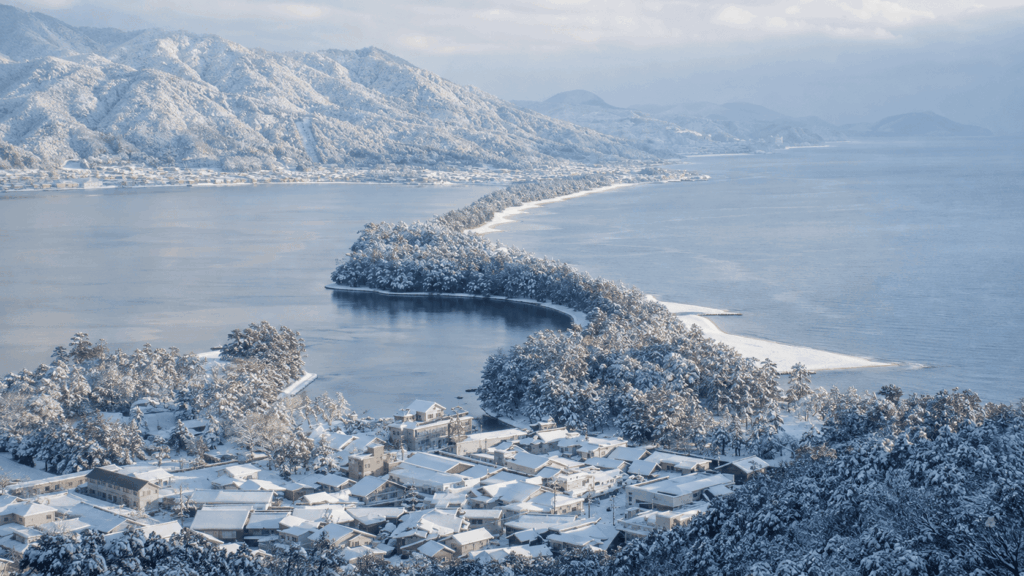
Is Amanohashidate Worth Visiting in Winter?
Yes, if the destination appeals to you with or without snow. Amanohashidate is a roughly 3.6-kilometer pine-covered sandbar separating Miyazu Bay from the inner Aso Sea, on the northern coast of Kyoto Prefecture. It is a different outing from visiting temples in Kyoto city: allow around two hours or more each way by train, depending on the service and connections.
The reward is a coastal landscape that changes with the light, quieter stretches of pine forest, warm seafood meals and the possibility of snow on the mountains and trees. The compromises are wind, wet weather and a limited sightseeing window. Winter does not mean that the whole area shuts down, but individual attractions have maintenance dates and weather interruptions.
| What works in winter | What to plan around |
|---|---|
| Quieter walks away from the busiest station-side spots | Snow cover changes from day to day |
| Snow-dusted pines or mountains when conditions align | Rain, cloud and sea wind are also normal possibilities |
| Winter yellowtail dishes and a warm ryokan meal | Special meals need their own reservation and time allowance |
| A manageable day focused on one viewpoint and the sandbar | Adding Ine takes time from the same short daylight window |
| Accommodation choices if you want a slower visit | Crab-season meals, weekends and holidays can be expensive |
Do not assume winter is automatically the cheapest season for a ryokan: food plans and travel dates matter. For the broader decision, including the long journey from Kyoto, see whether Amanohashidate is worth the trip. This guide focuses on what changes in winter and how to make the day work.
Does It Snow in Amanohashidate?
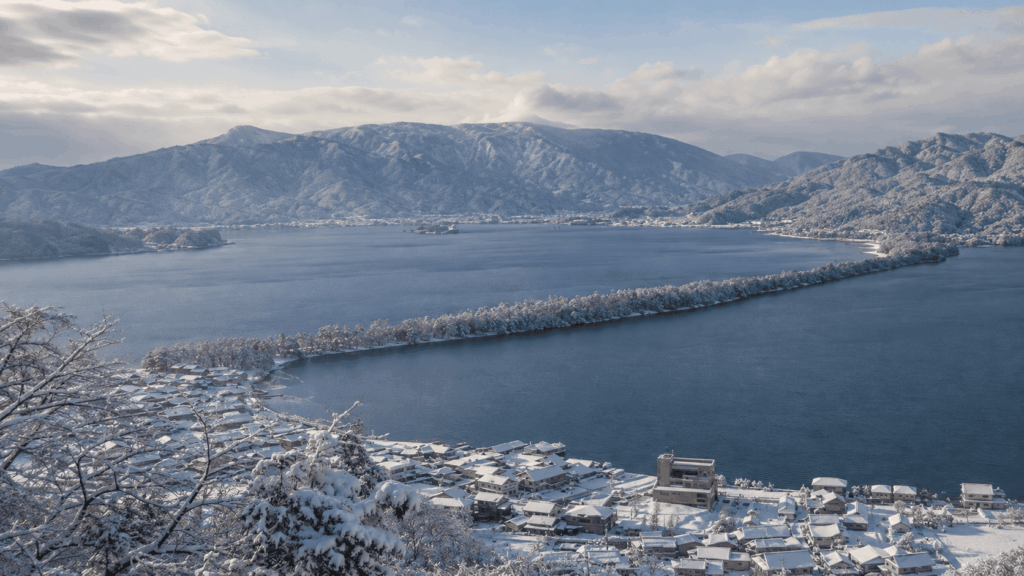
Yes, Amanohashidate can receive snow, including snow that settles on the sandbar. Northern Kyoto has a different winter weather pattern from Kyoto city. However, being on the Sea of Japan side does not mean that every December, January or February day comes with a white landscape.
Separate three things when looking at photographs: snow falling now, snow remaining on the ground, and snow on the pine branches. They do not always happen together. Recent precipitation, temperature, rain, sunshine and the condition of the ground all affect what you see. Snow may remain in the surrounding hills after the waterfront has thawed.
January and February are sensible months to consider for a snow-focused visit, but there is no reliable calendar date to book for a guaranteed snow scene. A cold, wet winter day can bring rain near the water, and a forecast for snow is not a promise that the sandbar will still be white when you arrive.
For a last look before departure, use the live camera on View Land’s official website. Look at the image time as well as the picture, and check whether it actually shows the sandbar. Check the ride status separately before heading uphill.
When to Look for Snow on the Pine Trees
Fresh snow on the branches can be much more fleeting than snow on the hills. View Land calls its rare white-pine panorama gensetsu no hiryukan, describing cold mornings when new snow coats the frozen pine needles and disappears as the day warms.
If that photograph is your priority, an overnight stay gives you the option of trying the viewpoint around its 9:00 AM opening after a suitable snowfall. Travel only once conditions and transport allow it. A day trip arriving in late morning can still be rewarding, but it gives you less control over this short-lived scene.
Why Amanohashidate Weather Can Be So Different From Kyoto City
Kyoto Prefecture spans different climate regions. The Japan Meteorological Agency describes a contrast between the northern Sea of Japan climate and the southern part of the prefecture. In winter, a clear morning in Kyoto city is therefore a poor substitute for checking the northern coast.
On one of my winter visits, Kyoto city was clear and dry when I boarded the train north, and Miyazu was in the middle of a full snow squall when I stepped off. By early afternoon the sky had cleared and I finally saw the sandbar under a light dusting of snow. The lesson I would pass on to anyone planning the trip: the Kyoto forecast tells you almost nothing about Amanohashidate. Check Miyazu directly.
For the day’s plan, use the JMA forecast and warnings let you select the Miyazu area. Look at precipitation, wind and warnings together: the temperature alone does not tell you how comfortable a waterfront walk will be.
December, January or February: When Is Best for Winter Scenery?
Choose a month around the kind of trip you want, then use the actual forecast to decide the day’s activities. December is generally milder than midwinter; February gives you more daylight as the month progresses. Neither point guarantees that a viewpoint will be clear.
The figures below are Miyazu’s 1991–2020 climate normals from the Japan Meteorological Agency. Highs and lows are averages of daily readings. The precipitation includes rain and melted snow, so pack for wet weather as well as cold.
| Month | Mean temperature | Average daily high / low | Monthly precipitation | Planning implication |
|---|---|---|---|---|
| December | 6.6°C / 44°F | 10.8°C / 51°F; 3.1°C / 38°F | 188.5 mm | Snow is possible, but rain and bare ground are also plausible. Check the published December maintenance dates. |
| January | 4.1°C / 39°F | 7.9°C / 46°F; 0.9°C / 34°F | 202.9 mm | A cold month for a snow-oriented trip; keep the walking route flexible and expect New Year variations at individual businesses. |
| February | 4.3°C / 40°F | 8.6°C / 47°F; 0.6°C / 33°F | 150.4 mm | Still cold, with a longer sightseeing window toward month-end. Ice and wet surfaces can remain an issue. |
These figures come from JMA’s Miyazu climate table. Use the local forecast to choose your layers and footwear, including protection for outdoor waits.
For flexible dates, prioritize a clear enough view and manageable wind. For fixed dates, keep a short walk and a warm meal in the plan so that the day still works without snow.
Check the Weather Before You Leave Kyoto

Before leaving Kyoto, settle these five points. Save the return booking and local timetables on your phone so you can use them while out.
- Read Miyazu’s forecast. Include wind, rain or snow, visibility and any active warnings. Use Ine’s local conditions as well if you are continuing up the coast.
- Look at the sandbar camera. Check the timestamp and whether the view is clear enough to justify making the panorama your first stop.
- Check the entire transport chain. A train journey can involve JR West and Kyoto Tango Railway; the highway bus and local buses are separate services. A normal train status does not confirm that the boat or your next bus is running.
- Check your chosen viewpoint’s calendar. Distinguish a chairlift-only inspection from a full closure. View Land and Kasamatsu Park are separate businesses with separate calendars.
- Choose the return you can realistically catch. Keep time for lunch, warm breaks and walking back to the station. If conditions or operations undermine the plan, shorten it or choose another day.
Kai’s tip: Kyoto city can be clear and dry while Miyazu is in a full snow squall — I have watched it happen on the train ride north. Check the forecast for Miyazu itself (not Kyoto) and glance at the View Land live camera before you leave; it takes two minutes and changes how you pack, dress and plan your order of sights.
Getting There Without a Car
A limited-express train or a reserved highway bus is a practical starting point from Kyoto. Allow around two hours or more for the train, depending on the departure and connections. The current Tankai highway-bus timetable includes Kyoto Station 8:20 AM → Amanohashidate Station 10:25 AM, with a useful return at 4:20 PM → Kyoto 6:30 PM. The Kyoto stop is C2 on the station’s Karasuma side, rather than a shared tour’s meeting point.
Adult highway-bus fares are ¥3,400–¥3,900 each way under the October 1, 2026 revision, depending on the travel date. Reserve both directions through the operator’s booking link. The timetable also lists later returns at 5:10 PM and 6:00 PM, but changing to one depends on seats and booking rules. For rail routes, passes and other starting points, use the Kyoto to Amanohashidate transport guide.
The official highway-bus timetable and fare calendar show the current departures. Winter traffic can delay a road journey, so leave room after your return to Kyoto.
Self-Guided or Tour in Winter?
The useful choice is between an independent Amanohashidate day, a shared sightseeing bus, and a private vehicle for your party. All can work. Which is worth paying for depends on whether you want Ine as well, how much walking everyone can comfortably do, and how much control you need over the day.
| Decision | Independent travel | Shared day tour | Private trip |
|---|---|---|---|
| Strongest fit | One destination, your own lunch and pace | Both places on a set group schedule | A family or small group wanting fewer connections |
| Transfers | You arrange trains or highway buses and local transport | The operator links the sightseeing stops | An agreed pickup and vehicle replace the public-transport connections |
| Walking and breaks | You choose a shorter route or a longer meal | Fit them into the group’s stop durations | Discuss priorities and realistic stop lengths in advance |
| Weather changes | You can change your own sightseeing plan | The operator may adjust the itinerary | Discuss an alternative route, within the booked service |
| Cost comparison | Return transport, local rides, tickets and food | Price for each traveler plus excluded activities | Your party’s vehicle quote plus excluded activities |
For an independent day, compare the actual return train or highway-bus fare with the activities you intend to use. A local sightseeing pass does not replace your journey from Kyoto. For a private trip, divide a group quote only by the people who will actually travel, and check the selected vehicle’s passenger and luggage limits.
Private transport is especially worth comparing when moving children, older relatives or several people between connections would be the hard part. It can also make a two-stop day more practical without requiring anyone in your party to drive. It does not make a closed viewpoint open or remove the effect of snow on the roads.
For families or friends combining both coastal stops
- One vehicle: travel between Amanohashidate and Ine with your own party.
- Agreed pickup: start within the selected Kyoto or Osaka service area.
- Basic English support: selected smaller-vehicle options include an English-speaking driver-guide.
Viewpoint rides, boat tickets and meals are extra. Driver-guide support is basic assistance rather than licensed guiding.
The smaller-vehicle English driver-guide options are listed as ten hours; larger driver-only options are listed as eight hours. Select the vehicle for both passengers and luggage, and send pickup details and requests at least 24 hours before departure. Confirm any child seat or custom route in advance; a request needs the operator’s agreement. Extra time or out-of-area pickup can cost more. Leave room after returning before an evening commitment.
If a Shared Bus Fits Your Budget Better
For a solo traveler or couple happy with a set schedule, the shared Kyoto–Amanohashidate–Ine outing is a separate option. Its listing describes a ten-hour shared trip with English, Japanese and Traditional Chinese guiding and designated meeting points. The boat and viewpoint ride are optional extras, and food is not included. Select the correct departure city and meeting point rather than expecting hotel pickup.
Check shared-bus dates & optional activity costs
If you only want the sandbar and a quiet lunch, independent travel remains a good fit. Paying for a second destination you do not really want is not the same as saving time.
What to Do in Amanohashidate on a Winter Day
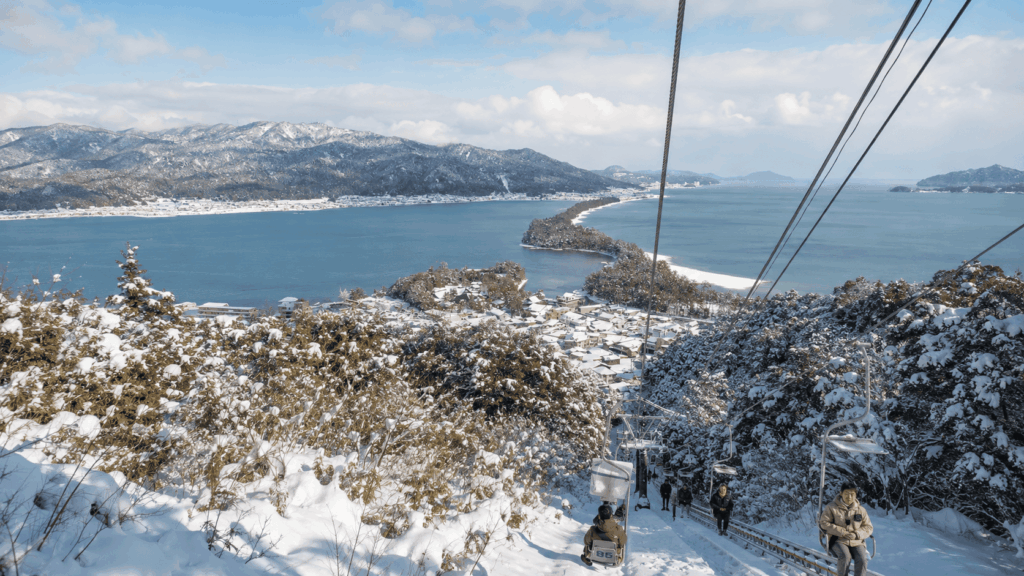
Make one good view, a comfortable walk and a warm meal the core of the day. Treat the other viewpoint, a full crossing or Ine as additions to assess once you know your transport and conditions. Winter rewards a clear priority more than a long checklist.
Use visibility to choose the order. If the panorama is clear on arrival, take advantage of it. If the hill is in cloud, consider lunch, the temple area or a short sheltered section of the sandbar, then reassess. Waiting for better visibility is a choice, not a promise that the afternoon will clear.
Start With the View When the Sky Clears
The two main viewpoints look at the same landscape from opposite ends. View Land is on the southern, station side; Kasamatsu Park is on the northern, Fuchu side. Their tickets and rides are different. The famous upside-down matanozoki view is not a reason to assume that one admission covers both.
| Viewpoint | When it fits | Winter details |
|---|---|---|
| Amanohashidate View Land | You arrive at Amanohashidate Station and want a straightforward first panorama | Adult return ride/admission is ¥1,000; elementary-school children pay ¥500. From November 16 to February 15, ticket sales run 9:00 AM–4:30 PM and the park closes at 5:00 PM. Final uphill monorail: 4:20 PM; chairlift: 4:30 PM. Both have a 4:50 PM final descent. |
| Kasamatsu Park | Your route already takes you to the northern shore by boat, bus or a sandbar crossing | Adult cable-car/lift return fare is ¥800; children pay ¥400. Cable-car hours are normally 9:00 AM–5:00 PM in December–January and until 5:30 PM in February. The chairlift has a shorter schedule. |
For a sheltered ascent, use View Land’s monorail or Kasamatsu’s cable car instead of an open chairlift. The View Land monorail normally leaves uphill at :00, :20 and :40, with a capacity of 40 people boarding in arrival order. At Kasamatsu, the winter chairlift runs 10:00 AM–4:00 PM from December 1 to January 5, then only on weekends and public holidays through the end of February. The cable car is the usual weekday choice.
Important for winter 2026–27: View Land has announced a full closure on December 15–17, 2026. Its chairlift is also closed all day on December 14 and 18, when the monorail is the alternative, subject to operation. Separately, Kasamatsu Park is closed on December 18, 2026, including its cable car, lift and associated facilities.
During View Land’s full closure, consider the north-shore route if Kasamatsu is operating. On December 18, allow extra waiting at View Land’s monorail. The date-specific notices are on View Land’s ride and maintenance information and Kasamatsu’s official operating information for your date, including later January or February inspections.
For 2027, View Land’s published chairlift checks interrupt service after 3:00 PM on January 20 and February 17, and until 11:00 AM on January 21 and February 18. These are partial chairlift suspensions, with the monorail as the normal alternative, subject to operation. Allow for its departures and queues.
Kai’s tip: If the forecast shows snow or rain for the morning, do the viewpoint first and the sandbar walk after lunch — that is the order that has saved my winter days more than once. A squall can clear completely by early afternoon, and the sandbar is far more pleasant to walk when the wind has dropped and the sun is out.
Take the viewpoint first when visibility is usable. If cloud hides the sandbar, pause for a warm meal and try later, provided you can still make the descent and return connection.
Walk the Sandbar When Conditions Improve
The pine-lined sandbar is a worthwhile experience at ground level as well as from above. Walk far enough to leave the busiest entrance area, listen to the water and look at the contrast between the trees, shoreline and hills. You do not need to cross the entire length to appreciate it.
For the full 3.6-kilometer crossing, allow roughly 50–60 minutes one way in good walking conditions, with extra time for photographs, snow or slippery patches. A return walk is twice the distance, not a short add-on. Families can choose a smaller out-and-back section and keep lunch close to the station.
Walking one way and returning by the Amanohashidate Sightseeing Boat can form a useful loop. The normal direct crossing between Amanohashidate and Ichinomiya piers takes about 12 minutes; some scheduled services have a different route. The published adult fare is ¥800 one way or ¥1,300 return.
For November–February, the published timetable’s last regular southbound boat is Ichinomiya 4:45 PM → Amanohashidate 4:57 PM; the previous departure is 4:15 PM. The last northbound boat leaves Amanohashidate at 4:00 PM. The later sailings marked for March–October or April–September do not run in winter. Use the boat’s timetable and operating notices for your date. Aim for an earlier boat if you have a booked train or bus to catch.
If the boat stops running, use a confirmed local bus from the north shore or allow another 50–60 minutes or more to walk back. Make that decision before you cross, especially in snow. A park staying open until 5:00 PM does not give you time to catch a 4:45 PM boat afterward.
Cycling Can Be Great — But Only in Suitable Conditions
A bicycle can cover the sandbar in roughly 15–20 minutes, but winter conditions determine whether it is a pleasant option. Use it on a dry, calm day with a clear surface. On snow, ice or in strong wind, choose a shorter walk or a different activity.
Tankai’s published rental rate is ¥500 for two hours, with ¥300 per additional hour. Bikes are available at the Amanohashidate and Ichinomiya piers, and the operator permits returns on the opposite shore. Confirm the arrangement and the day’s return deadline when you collect the bike.
Rain can affect lending, and the operator has no children’s bicycles. Riders must be able to put their feet on the ground. Free helmets are available, and you cannot reserve these bikes. Check the rental operator’s current terms rather than relying on a photograph of people cycling in another season.
A Warm Break Near the Station
Chie-no-yu, beside Amanohashidate Station, is a useful bath stop when the cold has caught up with you. The current admission is ¥800 for adults and ¥400 for elementary-school children. It opens at noon, closes at 8:00 PM and asks visitors to enter by 6:30 PM. Its regular closed days are Tuesday, Wednesday and Thursday, with date-specific changes on the official Chie-no-yu page.
Allow roughly an hour for changing, bathing and getting ready to leave, and bring a small towel. The bath does not admit guests with tattoos or accept carry-on suitcases, and the former outdoor footbath service has ended. On a closed day, use the time for a longer meal or a café break instead.
What to Wear in Amanohashidate in Winter
Prioritize staying dry and blocking wind. A temperature that sounds manageable can feel much less comfortable while you are waiting for a ride or standing at an exposed viewpoint. Plan for pauses as well as walking, with layers you can adjust inside restaurants and vehicles.
- Outer layer: a windproof, water-resistant or waterproof jacket. Choose protection suitable for the expected rain or snow, rather than relying on thickness alone.
- Insulation: a fleece, sweater or light insulated jacket that fits under the outer layer. You should be able to add or remove it without unpacking your whole bag.
- Base layer: a thermal top, and thermal bottoms if you feel the cold or expect prolonged outdoor time.
- Footwear: waterproof shoes with a grippy sole for a dry or wet day; insulated winter boots are more useful when snow or freezing conditions are expected. Allow extra walking time when surfaces are slippery.
- Hands and head: warm gloves, a hat or ear protection, and a neck warmer or scarf. Keep these accessible for viewpoints and outdoor waits.
- Small extras: a compact daypack, spare socks when wet weather is likely, and protection for your phone or camera. Keep the bag small enough to manage comfortably on the ride you choose.
Kai’s tip: Prioritize windproof and waterproof over sheer thickness — a waterproof shell plus a mid-layer beats a huge padded coat that the sea wind cuts straight through. I would also bring proper snow boots only when the forecast for Miyazu actually shows snow or freezing conditions; on a dry, cold day, waterproof shoes with grip are enough and far easier to travel with.
For children or anyone who tires quickly in the cold, alternate outdoor sections with warm breaks. A shorter walk with dry feet is usually a better afternoon than completing the whole sandbar in wet shoes.
A Simple Winter Itinerary for Amanohashidate
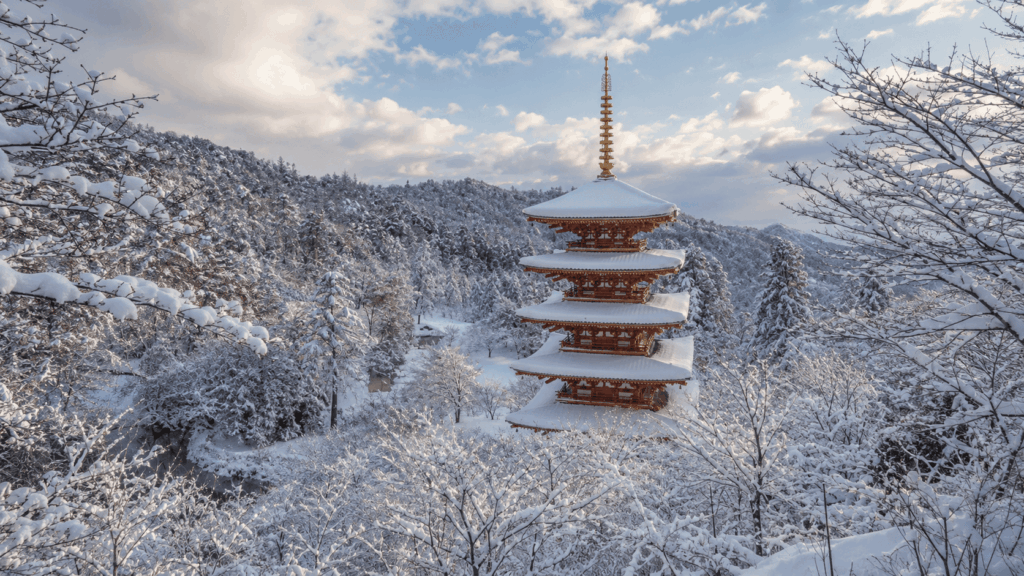
For a first winter visit, choose View Land, lunch and a partial sandbar walk. This version gives you time to warm up without arranging a return from the north shore. The Amanohashidate day-trip plan has broader sightseeing choices; the example below keeps the winter day deliberately manageable.
The highway-bus departures are from the timetable effective October 1, 2026. The sightseeing blocks are suggested allowances, not booked activities. Reserve the transport first, then adapt the stops to your date’s weather and closures.
| Time | Plan | Time included |
|---|---|---|
| Before 8:20 AM | Reach Kyoto Station C2 with your main luggage already stored | Allow time to locate the stop and board |
| 8:20–10:25 AM | Reserved highway bus to Amanohashidate Station | Published journey; road delays are possible |
| 10:25–10:45 AM | Toilets, orient yourself and walk to View Land’s lower station | 20 minutes for arrival and getting to the ride |
| 10:45 AM–noon | Ascent, panorama and descent | 75 minutes for the queue, rides and viewing |
| Noon–1:00 PM | A station-side lunch | One hour for a straightforward meal |
| 1:00–2:00 PM | Chionji area and a short out-and-back sandbar walk | Turn around in time to return within the hour |
| 2:00–3:15 PM | Walk back and use Chie-no-yu if open | 15 minutes to reach the bath, then about one hour inside |
| 3:15–3:55 PM | A warm drink, souvenirs or extra weather margin | 40 minutes, including any local bag collection |
| 3:55–4:20 PM | Return to the station stop, use the toilets and prepare to board | A 25-minute departure margin |
| 4:20–6:30 PM | Reserved highway bus back to Kyoto | Leave further time for luggage collection and onward travel |
If you arrive late or the view stays clouded: shorten the walk or drop the bath. If View Land is fully closed, choose a confirmed north-shore route instead of waiting at its lower station. Chie-no-yu is closed Tuesday–Thursday, so that hour can become a warm meal or café stop. A long reserved buri-shabu course also needs time taken from another activity.
For the alternative Kasamatsu route: use a boat-based loop and skip View Land. A boat out at 11:00 AM, time for Kasamatsu and lunch, then an Ichinomiya return at 1:45 PM leaves the afternoon for a short station-side walk. The 11:00 AM outward sailing is normally 12 minutes on weekdays and a 22-minute special route on weekends and holidays when that route operates. Allow time between the pier and cable-car station, and for ride queues. If you miss the 1:45 PM return, the scheduled 2:15 PM service is the next option when operating.
For a full sandbar crossing plus Kasamatsu, use the walking and return-boat times above and remove the bath or other sightseeing. December loses daylight much earlier than late February. For late light, use the Amanohashidate sunset guide alongside the descent and return timetables.
From Osaka, plan the full route from your accommodation. A transfer through Kyoto, a route via Fukuchiyama and a road tour have different departure arrangements. Staying locally is the easier option if you want an early snow-view attempt or a slower meal.
How Much to Budget for a Winter Day
These are adult, per-person examples from Kyoto, using the current highway-bus range and a ¥1,500 lunch allowance. The food figure is a planning assumption, not a restaurant quote. Accommodation, travel to Kyoto Station, storage, snacks and extra activities are separate.
| Your day | Cost calculation | Example total |
|---|---|---|
| View Land, short walk and simple lunch | Return bus ¥6,800–¥7,800 + View Land ¥1,000 + lunch ¥1,500 | ¥9,300–¥10,300 |
| The same day with Chie-no-yu | The above + bath admission ¥800 | ¥10,100–¥11,100 |
| Kasamatsu and a return sightseeing boat instead of View Land | Return bus ¥6,800–¥7,800 + ¥2,000 sightseeing ticket + lunch ¥1,500 | ¥10,300–¥11,300 |
| Ine village and View Land, without either cruise | Return Kyoto bus ¥6,800–¥7,800 + return regular local bus ¥800 + View Land ¥1,000 + lunch ¥1,500 | ¥10,100–¥11,100 |
Buying the return boat and Kasamatsu separately costs ¥1,300 + ¥800 = ¥2,100. The ¥2,000 combined ticket’s coverage is explained in the local-pass section below.
For two adults, the basic View Land day is ¥18,600–¥20,600 in total. Use the party total when comparing it with a private-vehicle quote, then add meals and attraction tickets on the private side too. A reserved seasonal fish or crab course will raise the lunch budget considerably.
Warm Up With Buri Shabu
Winter yellowtail, or buri, is one reason the coast can be enjoyable even without snow. For buri shabu, thin slices of fish are briefly swished through hot broth. The meal gives you a warm pause between outdoor visits and makes a food-focused winter day worthwhile in its own right.
Toriki is a cooking ryokan about three minutes on foot from Amanohashidate Station, known for its winter buri-shabu offering. November–March is the usual seasonal window. For a day-visit meal, call +81 772-22-0010 and ask for the serving time, current course price and whether your date is available. Reserve the meal separately from your transport.
I have eaten my share of this dish around the Tango coast, and Toriki’s version is the one I would send a friend to in winter: the fish is rich and sweet from the cold-season fat, and the broth lets it speak for itself. It is a splurge rather than a budget meal, but on a cold day it is exactly the right way to finish a trip to the sandbar.
Allow more time than the sample itinerary’s one-hour simple lunch for a reserved course, using the duration the property gives you. If the course is your priority, drop the bath or shorten the walking. For a smaller budget or an unavailable date, choose a simpler seafood lunch and keep the warm break.
For an overnight plan, compare the location and meal arrangements in the Amanohashidate onsen and ryokan guide. A dinner-and-breakfast stay can suit someone who would rather enjoy the food and scenery slowly than return to Kyoto the same evening.
Should You Add Ine in Winter?
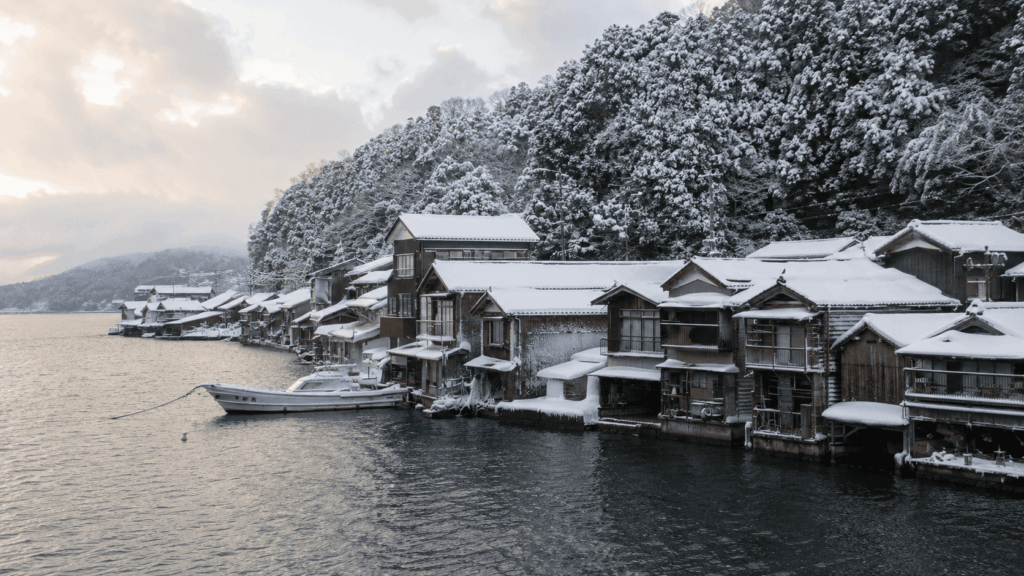
Yes, if you start early and keep the Amanohashidate stop short. For an independent first visit, choose either the fuller sandbar day above or a day built around both places. Ine’s waterfront boathouses deserve more than a hurried stop added after a full crossing, two viewpoints and a long lunch.
The regular Tankai bus takes roughly an hour from Amanohashidate Station to the village. Its route via the hospital and northern shore is different from the limited-time sightseeing express. The operator gives ¥400 one way as the regular fare from Amanohashidate Station to the Ine Bay cruise stop, across two fare areas.
A Winter Combination Using the Regular Bus
The following services appear in both the current weekday and holiday timetables. They are a useful starting point for January or February planning, subject to any later revision or winter disruption.
| Time | Plan | What to leave out |
|---|---|---|
| 7:20–9:25 AM | Reserved Kyoto highway bus to Amanohashidate | Store main luggage before the early departure |
| 9:25–10:00 AM | Toilets, find the local stop and wait for the Ine bus | No viewpoint visit in this 35-minute connection |
| 10:00–10:59 AM | Regular bus from Amanohashidate Station to Ine | Stay on beyond the separate cruise stop if your aim is the village walk |
| 10:59 AM–1:05 PM | A short village walk and a simple lunch, returning to the stop by about 12:50 PM | Skip the cruise and a lengthy full-course meal in this version |
| 1:05–2:05 PM | Regular bus from Ine back to Amanohashidate Station | Use the return-direction stop |
| 2:05–3:55 PM | Walk to View Land, one viewpoint visit, then a brief Chionji or sandbar look if time remains | No Kasamatsu, full sandbar crossing or bath |
| 3:55–4:20 PM | Station stop, toilets and boarding margin | Keep this time for departure |
| 4:20–6:30 PM | Reserved highway bus back to Kyoto | A later onward commitment needs additional margin |
At Ine, the 126-minute stop can accommodate roughly 45–50 minutes of walking, 50–60 minutes for a simple lunch, and the remaining time for toilets, returning to the stop and waiting. It is a compact visit. If lunch queues grow, shorten the walk rather than aim for the last minute at the stop.
If you miss the 1:05 PM return, the current timetable also lists 1:33 PM → 2:33 PM. Shorten the Amanohashidate sightseeing accordingly, dropping the viewpoint if its queue would eat into your boarding margin. A much later 4:00 PM → 5:00 PM bus leaves only ten minutes before the 5:10 PM Kyoto coach, which is too little margin for a winter plan. A later Kyoto seat must be available and booked before you rely on it.
Use the regular bus timetable and select the correct day type: December 30–January 3 uses the holiday timetable. On regular buses, board at the rear, take a numbered ticket if paying cash, and pay at the front when leaving. Contactless bank-card payment is offered on equipped buses; ICOCA and other transport IC cards are not accepted. Keep small cash as a backup.
For visits through December 20, 2026: the separate sightseeing express is advertised at ¥1,200 one way and takes about 43 minutes between Amanohashidate Station and Ine. It has different stops and boarding/payment arrangements. Its published period ends December 20; use the regular bus plan above for later dates unless a new operating period is announced.
The cruise boarding point at Hide and the village’s Ine stop are different places. Add the travel between them if you want a cruise. If fresh snow on the sandbar is your main goal, keep Amanohashidate first and give Ine another day, rather than spending the morning bus time away from the view.
The Local Pass and the Two Different Boat Rides
Match the ticket to the rides you will actually use. Tankai’s official ticket list includes a ¥2,000 adult / ¥1,000 child Amanohashidate–Kasamatsu sightseeing ticket, valid for two days. It covers a return Amanohashidate–Ichinomiya boat trip, Kasamatsu return rides and the Nariaiji mountain bus; temple admission is separate.
The broader ¥3,500 adult / ¥1,750 child two-day Tankai ticket covers specified local buses, the Amanohashidate sightseeing boat, Ine Bay cruise, Kasamatsu rides and the Nariaiji mountain bus. Community buses and Nariaiji admission are excluded. Neither of these tickets includes View Land or your journey from Kyoto. For just View Land, a short walk and lunch, individual tickets are the simpler choice. A two-day pass can spread the covered rides across a stay instead of squeezing them into one winter afternoon.

The Amanohashidate Sightseeing Boat links the shores beside the sandbar. The Ine Bay cruise is a separate excursion from Hide around the boathouses; taking either one does not transport you between the two destinations. Give Ine more time if it is a priority, using the Ine winter guide for village-specific planning.
Driving From Kyoto: When a Rental Car Makes Sense
A rental car is an alternative for independent travelers who already have the required documents and are comfortable with winter driving. It can help on a wider northern-Kyoto itinerary or when several people want their own timetable. Compare it with the train, shared bus and private vehicle rather than treating it as a necessary extra.
If you are starting in Kyoto, compare Kyoto pickup locations and the actual rental terms. Ask the supplier about winter tires and any other equipment for the expected route before reserving. A standard vehicle listing does not establish that suitable winter equipment is included.
Add fuel, expressway tolls, parking and the rental return deadline to the comparison. View Land’s lower-station parking is currently ¥700 per car for the day, paid in cash; spaces are limited. Park on the side where your sightseeing begins, rather than expecting to drive across the sandbar. Check road conditions before departure. If you do not want responsibility for snow or ice, public transport or an operated trip is the better fit.
What to Do With Luggage on a Winter Day Trip
A small daypack makes lifts, boats and a wet-weather walk easier. If you are returning to the same Kyoto accommodation, ask it about keeping your main suitcase. On a checkout day, hotel storage or a station locker may still be the simplest arrangement.
For a reservable alternative, search Bounce around your Kyoto departure and return area. An 8:20 AM bus requires storage that opens before then, while the sample return reaches Kyoto at 6:30 PM. Choose hours that cover both ends, with time to walk between storage and the station. A 9:00 AM opening cannot serve the morning departure.
The link opens a general search, so enter the area that fits your route. Do not assume it books storage at Amanohashidate Station. If you are continuing onward rather than returning to Kyoto, arrange storage or luggage space that works with that onward journey instead.
When I Would Skip Amanohashidate in Winter
A cloudy day can still be worthwhile. The more useful reasons to change the plan concern actual operations, uncomfortable conditions and what you wanted from the trip.
- Serious weather or transport disruption affects the route. Read the relevant warnings and operator notices before traveling. A sightseeing booking does not override them.
- The main experience you want is unavailable. A full viewpoint closure matters more to a panorama-focused visitor than to someone coming for lunch and a short walk.
- Snow scenery is the only reason you would travel. If the camera shows bare ground and no useful snow is expected, consider another day rather than relying on a calendar promise.
- A delay would undermine a flight, long-distance train or essential evening plan. Give the trip a day with room for uncertainty.
Conversely, no snow is not the same as no reason to go. A clear view, a shorter sandbar walk and a warm seasonal meal can make a good winter day. Match the version of the trip to the weather and your party rather than measuring it against one perfect photograph.
FAQ: Amanohashidate in Winter
Does it snow in Amanohashidate?
Yes, and snow can settle on the sandbar and pine branches. It also rains, and snow cover changes quickly. Check Miyazu’s forecast and the current sandbar camera before a snow-focused visit.
What is the best month to see snow at Amanohashidate?
January and February are the main midwinter months to consider. December is generally milder. For the white-pine scene, recent snowfall and the day’s conditions matter more than a fixed date.
Is Amanohashidate worth visiting in winter even if there is no snow?
Yes, if you want the coastal view, pine forest and seasonal food. A clear, snowless day can be excellent for a short walk. Keep another day in reserve if snow is your only reason to travel.
What should I wear to Amanohashidate in winter?
Wear adjustable warm layers under a windproof, rain-resistant outer layer, with waterproof shoes, grip, gloves and head protection. Bring winter boots when snow or freezing surfaces are expected.
Can I visit Amanohashidate and Ine in one day in winter?
Yes, with an early start and a reduced sightseeing plan. The regular-bus example above allows a village walk, simple lunch and one Amanohashidate viewpoint. It leaves out both cruises, a full sandbar crossing and the bath.
Are the viewpoints open throughout winter?
Normally, with maintenance and weather exceptions. View Land is fully closed December 15–17, 2026; Kasamatsu is closed December 18. Chairlift-only inspections are separate from full park closures. Snow clearance can also delay opening.
Does a tour include the boat, viewpoint tickets and lunch?
The linked private trip excludes meals, boat rides and attraction tickets. The shared-bus alternative also excludes food and lists boat and viewpoint rides as optional extras. Compare the full cost for your selected option.
Do I need a car for Amanohashidate in winter?
No. Trains and reserved highway buses reach the station area, with local buses and sightseeing boats for other stops. Rent a car only when you want to drive and are prepared for winter roads.
Final Verdict: Who Should Visit Amanohashidate in Winter?
For a first visit, one viewpoint, a comfortable walk and a warm meal make a good winter day. Choose View Land for the station-side route, or Kasamatsu when you are already planning the northern shore. Snow adds something special, but the trip should still appeal to you without it.
Families can shorten the exposed walking and make warm breaks part of the schedule. Compare a private vehicle when moving everyone between connections is the main difficulty, and confirm child seats, luggage space and ride arrangements.
Travelers with limited time should focus on Amanohashidate or start early for the checked Ine combination. Repeat visitors can make seasonal food, changing coastal light and quieter walking the reason to return. An overnight stay makes more sense if you want an early snow-view attempt and an unhurried dinner.
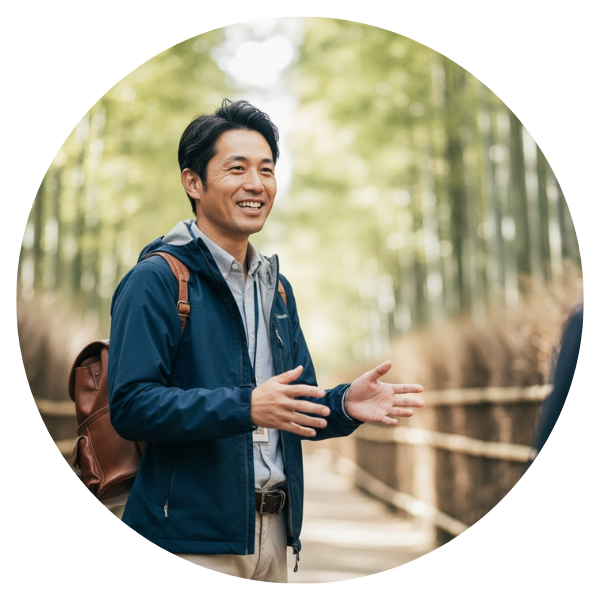
Hi, I’m Kai. I’m a Tokyo-based travel writer, tourism industry insider, and the author of a published guidebook for international visitors to Japan. With over 10 years of professional experience at a leading Japanese tourism company, my mission is to help you skip the tourist traps and navigate Japan’s best destinations like a local. I believe the perfect day trip is like a traditional kaiseki meal: a beautiful balance of precise planning and unforgettable seasonal discovery. When I’m not out conducting field research, you’ll usually find me drafting new itineraries with one of my favorite fountain pens!