
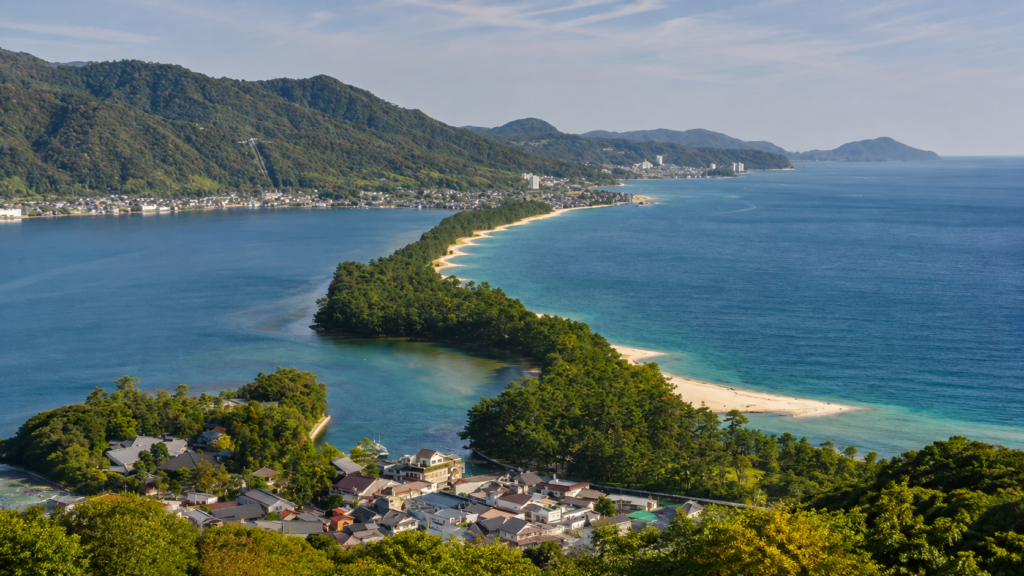
Planning an Amanohashidate day trip usually starts with the same question: is it worth two hours of train each way? From Kyoto, my honest answer after guiding foreign visitors through this corner of northern Kyoto is yes — if you keep the day focused. From Osaka, it is still possible, but the longer travel time leaves less room for delays, and every small wait at a lift or boat dock quietly eats into your day. Plan for one viewpoint, an efficient crossing of the 3.6 km sandbar, and one or two ground-level stops, and you will leave with the view that made this one of Japan’s Three Scenic Views. If Ine is on your list, budget for a guided tour rather than building the day around local bus connections.
If Ine is non-negotiable: a guided Kyoto/Osaka day tour removes the local-bus connection from the equation. Check departure points, current inclusions, and recent traveler reviews for this Amanohashidate & Ine day tour before building the day around public transport.
Quick Answer: Is Amanohashidate Worth a Day Trip?
- From Kyoto: yes, very workable. The JR Limited Express Hashidate runs direct from Kyoto Station to Amanohashidate Station in around 2 hours each way.
- From Osaka: possible but tighter. Expect around 3 hours door to door by train (change at Kyoto or Fukuchiyama), or a direct highway bus of about 2 h 50 min — but that bus has only a few departures a day and needs advance booking.
- Don’t try to see everything. One viewpoint plus an efficient sandbar crossing is the realistic base for a one-day visit. Two viewpoints, a full walk across the sandbar, and Ine in the same day is a recipe for missed return trains.
- Adding Ine the same day is possible but rushed; for most travelers, that is the point where a guided day tour starts to make more sense than the local bus.
- The itinerary below includes what to cut if your day starts running late — not just what to see.
Is Amanohashidate Worth a Day Trip?

Short answer: yes from Kyoto, and yes from Osaka if you accept a long but focused day. What decides it is not the scenery — it is how you spend the limited hours on the ground.
The math for a Kyoto-based traveler: around 2 hours each way by limited express, which leaves roughly 5–6 hours in the area with an early start. From Osaka, the journey stretches to around 3 hours each way, leaving roughly 3–4 hours on the ground — enough for one viewpoint and one crossing, but not much more.
The mistake I see first-time day-trippers make is trying to combine both viewpoints, the full sandbar walk, and Ine in a single day. Each of those sounds small on paper; together they add up to missed boats, skipped lunches, and a stressful race to the last train. The travelers who enjoy this trip most are the ones who commit to a focused plan and treat everything else as optional.
Best for: scenery lovers, travelers who want a quieter contrast to Kyoto or Osaka, and anyone comfortable spending several hours on transport for a genuinely different day.
Not ideal for: travelers with only half a day, people who dislike long transport days, anyone with a same-day flight or tight evening plans, and families with very young children who will not enjoy two hours of train each way.
Kyoto vs Osaka: Which Is Better for an Amanohashidate Day Trip?
Kyoto is the easier base by a clear margin. The difference is not just the extra hour on the train — from Osaka, every delay (a long lift queue, a missed boat, a slow lunch) matters more, because your return options are fewer.
| Starting city | Typical one-way travel time | Day-trip comfort | Time margin | Best for | Main drawback |
|---|---|---|---|---|---|
| Kyoto | Around 2 hours (direct JR Limited Express Hashidate) | High — one direct train, no transfers in the morning | Comfortable: roughly 5–6 hours on the ground with an early start | Travelers who want a relaxed day with room for a boat or bike ride | Still a 4-hour round trip |
| Osaka | Around 3 hours (change at Kyoto or Fukuchiyama, or direct highway bus of about 2 h 50 min) | Lower — transfers and fewer departures | Tight: roughly 3–4 hours on the ground, little buffer for delays | Osaka-based travelers who accept a long but doable day | Fewer return options; every queue or missed boat matters more |
From Kyoto: take the JR Limited Express Hashidate from Kyoto Station directly to Amanohashidate Station. Journey time is around 2 hours; fares are roughly 4,800–5,400 yen one way depending on the day, with limited express seats booked in advance. For more details on the journey, see our dedicated guide to visiting Amanohashidate from Kyoto.
From Osaka: you have two train options. The most comfortable is Osaka → Kyoto (about 30 minutes by rapid train) followed by the Hashidate limited express — around 2 h 50 min door to door, roughly 5,800 yen one way. The other is Osaka → Fukuchiyama on the Konotori limited express (about 90 minutes), then the Kyoto Tango Railway onward — around 3 h 10 min and roughly 5,200 yen. A direct highway bus from Hankyu Umeda takes about 2 h 50 min from around 3,200 yen, but it runs only a few times a day, is all-reserved, and needs advance booking.
Times and fares above are examples and change with the timetable and season — check the latest schedule before you travel.
A Realistic Amanohashidate One-Day Itinerary

This is not the “see everything” itinerary you often find online. It is built around what actually fits in a day from Kyoto, with a version for Osaka travelers at the end. The base shape: one viewpoint → one sandbar crossing → one or two ground-level stops → a return train you have already checked.
Morning — Arrive and Go to Your Main Viewpoint First
Go to the viewpoint before anything else. The view across the sandbar is the reason you came, and in the morning the lift lines are usually shorter and the light is better for photos.
Choose one of the two observatories — Amanohashidate View Land (south side, near the station) or Kasamatsu Park (north side, across the sandbar). Both are covered in detail later in this guide. For a Kyoto-based day trip, View Land is the easier first stop because it sits on the Monju side, a short walk from Amanohashidate Station.
What surprises most first-time visitors is how much of the day the viewpoint itself takes: the walk from the station, the queue, the ride, and the photo stop. Budget an hour at the viewpoint, not twenty minutes. At View Land, the round-trip lift/monorail ticket (which includes park entry) is around 1,000 yen for adults, and one ticket is valid for both the chairlift and the monorail, so you can mix the two.
Midday — Cross the Sandbar Without Losing Too Much Time
The sandbar is 3.6 km long, and how you cross it is the single biggest time decision of the day. Walking is the classic choice but not automatically the best one: at 45–50 minutes one way, a full walk-and-walk-back eats close to two hours. If the walk itself appeals to you, take it; if your goal is the viewpoint at the far end, use the bike or the boat.
| Option | Approx. time | Effort | Best for | What you miss / trade-off |
|---|---|---|---|---|
| Walk the sandbar | 45–50 min each way | Moderate; flat and mostly shaded by pines | Travelers who enjoy a quiet, slow stroll | Uses ~1.5–2 hours round trip including photo stops |
| Rental bicycle | 15–20 min each way | Easy; standard 20-inch bikes, no electric assist | Time-savers who still want the sandbar feeling | Pick-up and drop-off at the boat docks; around 500 yen per 2 hours, one-way use allowed |
| Sightseeing boat | About 12 min | None | Photographers and families; see the sandbar from the water | Around 800 yen one way / 1,300 yen round trip; check last departure time |
| Bike one way + boat back | Combined | Easy | The best time-value combo for most day-trippers | Set plan around 1,200 yen for adults; may not be sold during Golden Week and Obon holidays |
Rental bicycles are available at the Amanohashidate boat dock and the Ichinomiya boat dock on the opposite shore, and one-way use (returning the bike at the other dock) is allowed. The boats run between the Monju side and the Ichinomiya side in about 12 minutes, passing through Kaisen Bridge, the rotating bridge that swings open to let them through.
A note on the walk, from watching guests make the call: travelers split evenly on the sandbar. Some find the pine-lined path the most peaceful part of the trip; others find it repetitive and wish they had kept the time for the viewpoint. If you are unsure which type you are, treat the walk as optional and decide after you see the sandbar from above.
Afternoon — Add One More Stop, Not Three
With the viewpoint and the crossing done, pick one more thing and then protect your return journey. Good candidates: Motoise Kono Shrine at the south end of the sandbar, Chion-ji Temple on the Monju side, a second ride on the sightseeing boat just for the water views, or a day-use onsen near the station.
Before you wander, check the return train or bus time and work backwards. This is where most day trips go wrong — not on the train, but in the afternoon, when the last 45 minutes quietly disappear into a souvenir shop or a second viewpoint. Keep the late afternoon deliberately light.
Sample timeline from Kyoto (adjust to the actual timetable):
- 07:30–08:00 — Depart Kyoto Station on the Hashidate limited express
- Around 09:30 — Arrive at Amanohashidate Station
- 09:30–10:30 — Main viewpoint (choose one: View Land or Kasamatsu Park)
- 10:45–12:00 — Cross the sandbar (bike or boat for time-savers; walk if it appeals to you)
- 12:00–13:00 — Lunch on the Monju side or near Ichinomiya
- 13:00–14:00 — One ground-level stop: shrine, temple, or a boat ride
- 14:00–15:00 — Souvenir time and a second coffee while it is still early
- 16:00–17:00 — Return train toward Kyoto (confirm the departure time first thing in the morning)
For Osaka-based travelers, the same shape works but with the morning viewpoint as the only “must”: arrive, see the view, cross the sandbar by boat or bike, and aim for an early afternoon return. Adding Ine on top of an Osaka day trip is not realistic by public transport — more on that below.
Amanohashidate View Land or Kasamatsu Park: Do You Need Both?
For a one-day trip, the honest answer is usually no — pick one viewpoint and give it your full attention. The two observatories sit on opposite sides of the sandbar, and visiting both means crossing it twice or adding a long loop you do not need. Unless you have a specific reason to see the view from both directions, spend the saved time on the sandbar, the boat, or a slower lunch instead.
Both viewpoints show the same famous sight — the pine-covered sandbar curling across the bay — but they differ in practical ways that matter on a day trip:
- Amanohashidate View Land is on the Monju (south) side, a short walk from Amanohashidate Station, which makes it the easiest first stop if you arrived by train. It uses a chairlift and a monorail; the round-trip ticket, around 1,000 yen for adults, covers both and includes park entry.
- Kasamatsu Park is on the Ichinomiya (north) side, across the sandbar. It uses a cable car and a chairlift — around 800 yen for adults — and the same ticket works for both. At the top you will find AmaTerrace (a viewpoint restaurant and shop) and the matanozoki spot, where you bend forward and view the sandbar upside down between your legs.
Choose View Land if you want the fastest route from the station to the view, or if you arrived on the Monju side and plan to cross the sandbar afterward. Choose Kasamatsu Park if your day is built around crossing the sandbar first, if you are heading toward Ine in the afternoon (check whether the Ine bus stops on the Ichinomiya side on your travel date), or if you want the cable car and the matanozoki ritual in one stop.
A word on matanozoki, since it is the moment most people photograph: treat it as a fun ritual rather than expecting an optical illusion to literally look like a dragon. I have watched guests laugh at how ordinary the view looks upside down — and enjoy it anyway, because the joke is part of the experience. It is a five-minute stop, not a reason to pick one park over the other.
If you are tempted to do both “just in case”: remember that two viewpoints, one sandbar crossing, lunch, and a return train rarely all fit comfortably. On a day trip, one viewpoint plus the crossing is the stronger plan.
The Small Timing Decisions That Can Save Your Day Trip

In my experience guiding day-trippers here, the trips that go well are rarely decided by the big itinerary. They are decided by small timing calls — which lift to take, whether to walk the sandbar, when to buy souvenirs. A few minutes saved at each step is what keeps your return train relaxed instead of a race. The three calls below are the ones that matter most.
If the Chairlift Line Is Long, Switch
At Kasamatsu Park, the round-trip ticket is valid for both the cable car and the chairlift, which means you do not have to ride the same way up and down. The chairlift is the more open, wind-in-your-face option; the cable car carries more people and clears a long queue faster.
Kai’s tip: On a guided visit in July 2026, I took the chairlift up in the morning while the line was short. By mid-afternoon a queue had built up at the chairlift station, so for the way down we simply walked over to the cable car — same ticket, no extra cost, and we were back at the dock with time to spare. Treat the return ride as a choice, not a given: if the chairlift line looks long, check the cable car before automatically waiting. The same logic applies at View Land, where one ticket covers both the chairlift and the monorail.
One caveat: in strong wind or heavy rain, either ride can stop without notice. If the weather looks unstable, check the operating status at the ticket office before committing to a plan that depends on riding down.
Do Not Automatically Walk All 3.6 km
Walking the sandbar is free, it is the classic thing to do, and it is not automatically the right choice. The full crossing takes roughly 45–50 minutes each way — close to two hours round trip once you add photo stops. On a day trip, that is real time you could spend on the viewpoint or the boat.
Decide based on what you actually want. If your goal is the slow, quiet experience of walking through a pine forest with the sea on both sides, the walk is the best 45 minutes of your day. If your goal is the postcard view from the top, the walk is mostly a long approach to it.
Kai’s tip: I have had guests tell me afterward that the crossing felt like “just walking through pine trees” — lovely if that is the experience you came for, anticlimactic if you came for the viewpoint. If you are already behind schedule, the full sandbar walk is one of the easiest things to shorten: take the rental bicycle (around 500 yen for two hours, one-way use allowed between the two boat docks) or the sightseeing boat (about 12 minutes each way) and spend the saved hour at the top instead. Save the walk for a trip where you can afford to enjoy it slowly.
Buy Souvenirs Earlier Than You Think
Rural sightseeing areas are not like a city shopping street: shops close, and they close earlier than most travelers expect. If you know you want souvenirs, check the opening hours of the places you plan to visit and do not leave the purchase for the very end of the day.
Kai’s tip: I learned this the hard way — on an earlier visit, I came down from the viewpoint on one of the last rides of the day and found the shops near the station already closing, with nothing left to buy. Now I tell people: if you know you want souvenirs, buy them before heading up, or while the shops are clearly open, and carry them on the boat or bike. A small bag of local snacks is a much better memory than a missed shop.
I would not generalize that everything closes at 5 p.m. — hours vary by shop and season. The reliable habit is simply to check, and to treat “buy it now” as the default when you see something you like.
A day trip has to absorb small surprises like these — a longer queue, a slower lunch, a missed boat. That is the part of the planning most guides skip, and it is also the part that decides whether you leave relaxed or sprinting for the platform.
Should You Add Ine to an Amanohashidate Day Trip?
Ine is the postcard fishing village of funaya houses lining the bay, and it is the most common add-on to this trip. It is possible in the same day, but it changes the day from relaxed to scheduled, and it is one of the most frequently asked questions about this area for good reason: the connections look simple on paper and tighten up quickly on the ground.
By public transport, Ine is about an hour by local bus (Tango Kairiku Kotsu’s Ine line, around 400 yen one way) from the Amanohashidate area, with roughly hourly departures that vary by season. Once there, most visitors take the short Ine Bay sightseeing boat (about 25 minutes) or walk along the waterfront. From Kyoto, an early start and checked connections make it workable — but you will likely drop to one viewpoint and skip a relaxed lunch.
From Osaka by public transport alone, I would think twice. With roughly three hours each way just to reach Amanohashidate, adding Ine on top leaves almost no buffer for the delays that are normal on a day like this. The schedule pressure is the real issue here, not the distance: it is a day that works if every connection cooperates, and feels fragile if any of them slips.
What I would not recommend: slowly walking the full sandbar, visiting both viewpoints, and then adding Ine. That plan is built to miss trains. If Ine is a must, drop the second viewpoint and the full walk before you add it.
If Ine is a must, this is where a guided day tour starts to make more sense than piecing together local connections — more on that below.
Self-Guided or Amanohashidate Day Tour?
Amanohashidate on its own is genuinely easy to do without a tour: one direct limited express from Kyoto, a viewpoint, a crossing, and a return train. The case for a tour is not the scenery — it is what a tour removes from your day, namely connection planning, especially if Ine is on your list.
| Factor | Self-guided | Day tour |
|---|---|---|
| Flexibility | Full control of pace and stops | Fixed schedule; less room to linger |
| Planning effort | You manage trains, buses, and boat or bike times | Operator handles transport and timing |
| Amanohashidate only | Easy and usually cheaper | Possible, but you pay for structure you may not need |
| Adding Ine | Doable from Kyoto with an early start and tight connections | Much simpler; this is where tours earn their value |
| Cost structure | Transport plus separate ride and food costs | One upfront price; check what is included (lunch, cable car, boat) |
| Risk of missed connections | Higher if you are new to local timetables | Lower, but check the meeting point and start time |
| Best traveler type | Confident planners visiting Amanohashidate alone | Anyone adding Ine, travelers short on planning time, Osaka-based visitors |
I have not taken these day tours myself, so I will not recommend one from personal experience. What the review patterns do show, consistently, is that the value people feel depends on the same thing I see with self-guided guests: how much timetable management you want to do yourself. If the idea of watching local bus and train connections all day sounds like work, a tour removes exactly that.
If you are leaning toward a tour, focus on what is actually included — entrance and ride fees, lunch, the boat — rather than the headline price. Prices and inclusions change, so compare current options before you book.
If you want both Amanohashidate and Ine in one day but do not want to spend the trip watching train and local-bus connections, this is the tour option that fits the problem this itinerary is trying to solve.
Why I’d book this one
- Recent travelers consistently mention helpful English-speaking guides and a smoothly managed day.
- It combines Amanohashidate and Ine without making you coordinate the rural bus connection yourself.
- Flexible booking terms are listed on GetYourGuide; check the conditions for your date before confirming.
Practical Tips Before You Go
- Check the return transport first, not last. Look up the final limited express, local train, and bus departures the evening before, and work your day backwards from the one you must not miss. Local services (Kyoto Tango Railway, Tango Kairiku Kotsu buses) are less frequent than in Kyoto or Osaka city, and the last useful departures come earlier than visitors expect.
- Reconfirm operating hours the day before. View Land, Kasamatsu Park’s cable car and chairlift, and the sightseeing boat all run seasonal or maintenance-adjusted hours, and the chairlift can be closed on weekdays in winter. The sightseeing boat’s last departure is mid-to-late afternoon, depending on the season.
- Watch the weather forecast. The view is the whole point, and both viewpoint rides can stop in strong wind or heavy rain. On an overcast day the sandbar still looks good from above; on a storm day, the whole trip loses its reason.
- Carry some cash. Rental bicycles and several smaller shops and ticket windows are cash-first, even though the main viewpoints accept cards. A few thousand yen in coins and notes avoids an awkward stop.
- Leave a buffer in the afternoon. Every plan I have seen fail here failed in the last hour — a souvenir shop, a second viewpoint, a slow coffee — not on the morning train. Keep the late afternoon deliberately light and treat any time left over as a gift, not a problem.
- Book limited express seats in advance. The JR Limited Express Hashidate and the Konotori from Osaka both allow seat reservations, which is worth it on weekends and holidays.
FAQ
Can you visit Amanohashidate as a day trip from Kyoto?
Yes — this is the most workable version of the trip. The JR Limited Express Hashidate runs direct from Kyoto Station to Amanohashidate Station in around 2 hours. With an early start you get roughly 5–6 hours on the ground, which comfortably fits one viewpoint, an efficient sandbar crossing, and one or two ground-level stops. Confirm the return train time first thing in the morning, and you have a relaxed day.
Can you do an Amanohashidate day trip from Osaka?
Possible, but noticeably tighter. Expect around 3 hours door to door by train (change at Kyoto, or at Fukuchiyama onto the Kyoto Tango Railway), or a direct highway bus of about 2 h 50 min — though that bus runs only a few times a day and needs advance booking. On the ground you will have roughly 3–4 hours, so commit to one viewpoint, cross the sandbar by bike or boat rather than walking, and aim for an early afternoon return. Adding Ine on top of an Osaka-based public-transport day is not realistic.
How many hours do you need in Amanohashidate?
Plan for about 4–6 hours on the ground if you want the full base itinerary: one viewpoint, a sandbar crossing, lunch, and one extra stop such as Motoise Kono Shrine or Chion-ji Temple. Less than 4 hours still works if you limit yourself to the viewpoint and a quick crossing, but the day starts to feel rushed. From Kyoto this fits easily with a morning departure; from Osaka it is the realistic maximum.
Can you visit Amanohashidate and Ine in one day?
From Kyoto, yes — but only with an early start, checked connections, and a deliberately reduced Amanohashidate plan: one viewpoint, no full sandbar walk, and a tight afternoon. Ine is about an hour away by local bus from the Amanohashidate area, and the return journey needs the same care. From Osaka by public transport alone, it is not a plan I would rely on, because the buffer for delays disappears. For most travelers, this is the day where a guided tour simplifies things the most.
Is it better to walk, cycle, or take the boat across Amanohashidate?
It depends on what you want from the crossing. Walk if the slow, pine-shaded stroll is the experience you came for — it takes roughly 45–50 minutes each way. Cycle if you want the sandbar feeling without spending close to two hours — rental bicycles take 15–20 minutes and one-way use is allowed between the two boat docks. Take the boat (about 12 minutes) if you want the sandbar from the water and to save energy for the viewpoint. For most day-trippers, the bicycle one way plus the boat back is the best time-value combination.
Final Verdict: Is an Amanohashidate Day Trip Right for You?
Choose this plan if you are based in Kyoto (or can accept a long day from Osaka) and you are comfortable with one viewpoint, an efficient sandbar crossing, and one or two ground-level stops as the definition of a great day. Choose another option if you are short on travel tolerance, have a same-day flight or tight evening plans, or are determined to see both viewpoints, walk the full sandbar, and add Ine — that combination does not fit comfortably in one day by public transport.
- For first-time visitors: make View Land your one viewpoint — it is the shortest walk from Amanohashidate Station — then cross the sandbar by bike or boat, and keep the afternoon light with one stop such as Motoise Kono Shrine. Treat matanozoki as a fun ritual, not the reason to pick a park.
- For families: the sightseeing boat is the easiest crossing for little legs, and the cable car at Kasamatsu Park is calmer for young children than an open chairlift. Build in the 2-hour train each way when deciding whether the day is worth it.
- For travelers on a tight schedule: protect the viewpoint and the return train above all. Skip the full sandbar walk, buy souvenirs before the late afternoon, and if the chairlift line is long, switch to the cable car rather than waiting.
- For repeat visitors: choose Kasamatsu Park this time (cable car, AmaTerrace, matanozoki), take the walking pace across the sandbar you skipped last visit, and consider adding Ine on a day when you can afford the schedule pressure.
The best version of Amanohashidate is not the one where you see everything — it is the one where you see the view, cross the bay without racing, and still catch your train with time for a souvenir. That is what a realistic one-day plan is for.

Hi, I’m Kai. I’m a Tokyo-based travel writer, tourism industry insider, and the author of a published guidebook for international visitors to Japan. With over 10 years of professional experience at a leading Japanese tourism company, my mission is to help you skip the tourist traps and navigate Japan’s best destinations like a local. I believe the perfect day trip is like a traditional kaiseki meal: a beautiful balance of precise planning and unforgettable seasonal discovery. When I’m not out conducting field research, you’ll usually find me drafting new itineraries with one of my favorite fountain pens!