
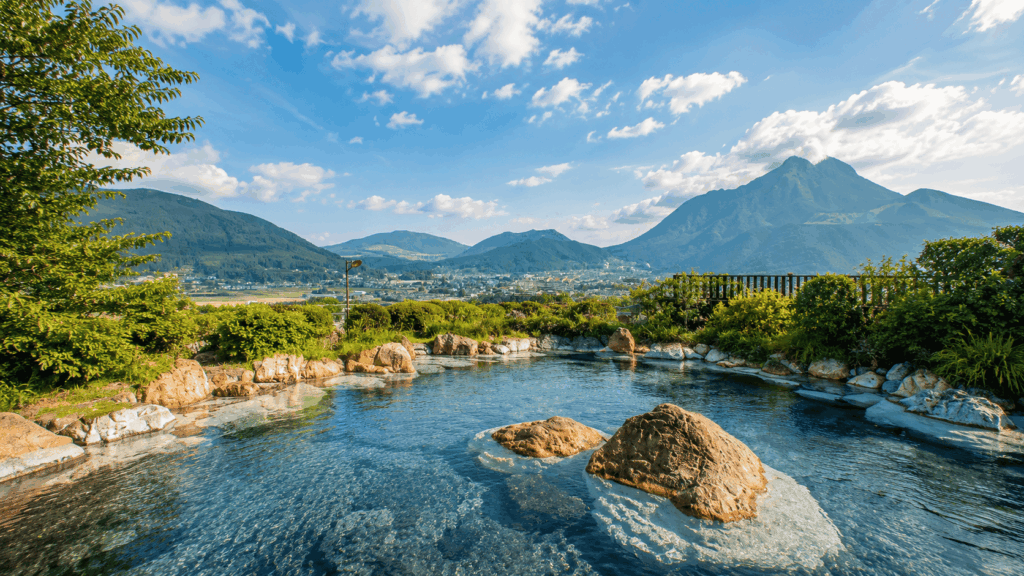
Is Yufuin Worth It? An Honest Take
Let’s address the question most travellers are quietly searching for before they even look at a map: Is Yufuin too touristy to bother with?
The short answer is yes, it’s touristy — and no, you shouldn’t skip it.
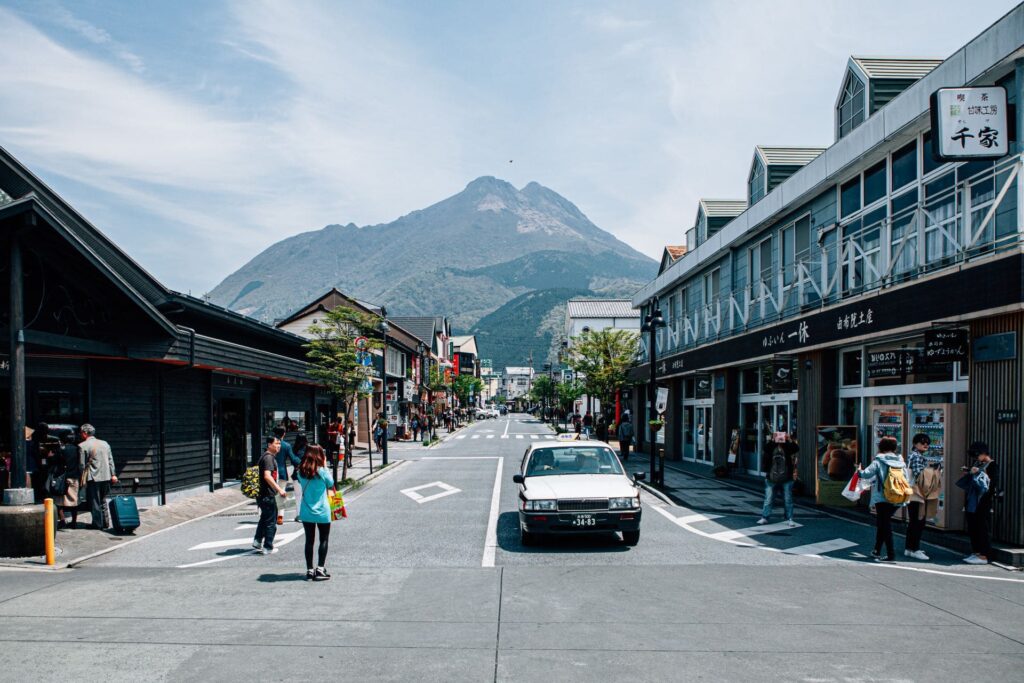
Yufuin has become one of Kyushu’s most visited day-trip destinations, and on a busy midday, Yunotsubo Street can feel like a festival crowd. But here’s what the highlight reels don’t show you: the town is designed around a single 1.5-kilometre walking route bookended by a train station and a lake. The “crowded” part is roughly 300 metres of that route. Step into a side lane, a museum, or arrive before 10 a.m., and you’ll find a completely different Yufuin — one with mist rising from rice paddies, quiet temple paths, and the kind of calm that made this onsen town famous in the first place.
Visit Yufuin if you enjoy leisurely food walks, onsen culture, and charming craft shops in a mountain setting. Skip it if you’re short on time and prefer raw nature over curated sightseeing (in that case, Kurokawa Onsen or the Kuju mountain range may suit you better).
Kai’s tip: The mistake I see first-time visitors make is arriving at noon, heading straight down Yunotsubo Street during peak bus-tour hours, and leaving disappointed by the crowds. Come early — the 9:17 a.m. Yufuin no Mori from Hakata puts you on the street by 11:30, just ahead of the lunch rush — or use midday to duck into a museum. The street is at its best in the quiet morning hours.
If you already know you want Yufuin without juggling train reservations, highway buses, and a possible Beppu add-on, compare the live start times and recent reviews for this Fukuoka-based Yufuin and Beppu day trip before locking in your transport.
How Much Time Do You Really Need?
This depends on what you want to do. Here’s how the three main visit styles compare:
| Visit Style | Time Needed | What You Can Do | Best For |
|---|---|---|---|
| Half-Day Express | 3–4 hours | Yunotsubo Street snacks + Lake Kinrin walk + station foot bath | Travellers on a tight Fukuoka day-trip schedule |
| Full-Day Relaxed | 6–8 hours | Above + a sit-down lunch (kamameshi) + one museum + onsen visit | First-time visitors who want the full experience without rushing |
| Overnight | 1 night + next morning | Everything above + morning mist at Lake Kinrin + ryokan kaiseki dinner + Mount Yufu hike | Onsen enthusiasts and photographers |
Most travellers from Fukuoka do Yufuin as a day trip. With the Yufuin no Mori’s schedule, you can comfortably manage a 5–6 hour window on the ground — enough for a full-day relaxed pace if you plan your priorities.
How to Get to Yufuin from Fukuoka
Yufuin is about two hours from Hakata Station in Fukuoka. You have three main options, each with different trade-offs. If you are arriving from elsewhere, check out our complete guide on how to get to Yufuin.
| Option | Time | Cost (One Way) | Reservation | Best For |
|---|---|---|---|---|
| Yufuin no Mori (Limited Express) | ~2h 15min | ~¥4,680 (covered by JR Pass; online reservation fee ¥1,000) | Mandatory — book early, sells out especially on weekends | Scenery lovers; JR Pass holders; first-timers who want the full experience |
| Limited Express Yufu | ~2h 30min | ~¥4,000–4,500 (covered by JR Pass) | Free seating sections available; less crowded | Backup option when Yufuin no Mori is full; budget travellers without a JR Pass |
| Highway Bus | ~2h | ~¥3,250 | Reservation recommended (via Willer Express or Japan Bus Online) | Travellers without a JR Pass; direct connection from Fukuoka Airport |
Yufuin no Mori (Scenic Limited Express)
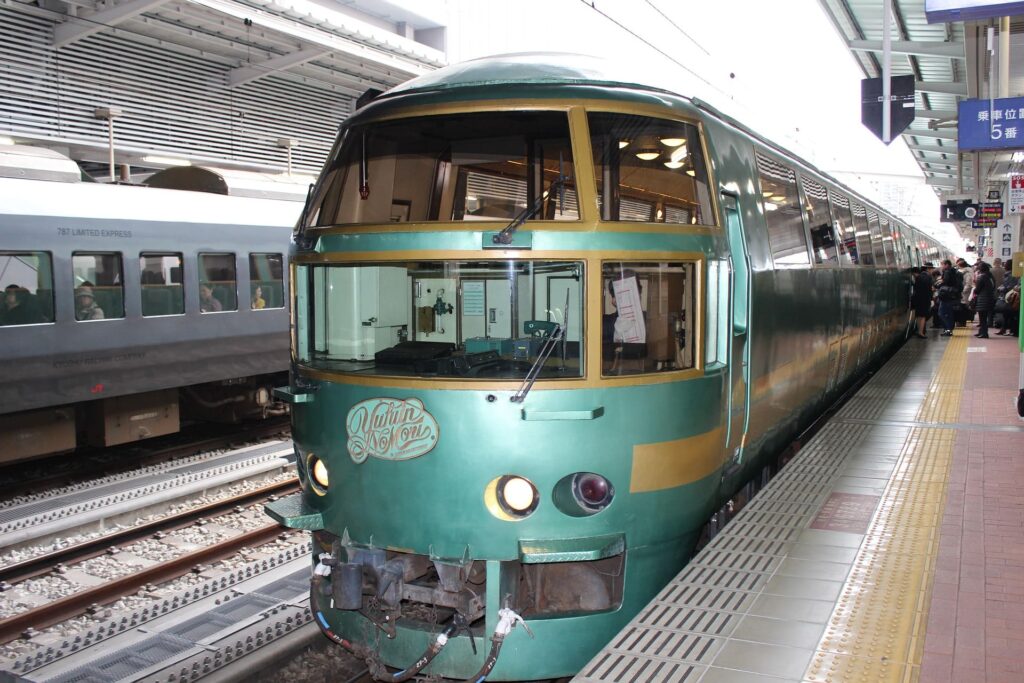
This deep-green train with wooden interiors is an attraction in itself. Large windows frame the Kyushu countryside as it winds inland from Hakata through the mountains. There are three outbound services from Hakata per day and two return services from Yufuin, so check the timetable and build your day around those windows.
Reservation tips: All seats are reserved — there are no non-reserved cars. JR Pass holders can book seats for free at any JR ticket office (Midori no Madoguchi) in Japan. Online booking via the JR Kyushu Rail Pass Online system is also available but carries a ¥1,000-per-person fee. During peak seasons (cherry blossom, autumn leaves, Golden Week, New Year), seats can sell out days in advance. Book as soon as your itinerary is confirmed.
Limited Express Yufu (The Backup Option)
The Yufu makes more stops than the Yufuin no Mori and takes about 15 minutes longer, but it’s a reliable alternative — especially when the scenic train is fully booked. Some services have non-reserved cars, making it a more flexible fallback.
Highway Bus (The Budget Alternative)
Direct highway buses from Hakata Bus Terminal and Fukuoka Airport run roughly once per hour. The journey takes about two hours and costs around ¥3,250 one way. Buses are comfortable with reclining seats, but you’ll miss the scenic train experience. This is a solid option if you’re without a JR Pass or if train seats are sold out.
If you fall into that camp — you want Yufuin, but the train reservations, bus timing, and possible Beppu add-on feel like too many moving parts — this is the one booking I’d push you toward.
Why I’d book this one
- It solves the Fukuoka logistics problem: round-trip bus transport removes the need to chase Yufuin no Mori seats or coordinate separate train and bus times.
- It adds Beppu without rebuilding your day: the route combines Yufuin highlights with Beppu’s hells, which is exactly where many first-time Kyushu visitors hesitate between DIY and a tour.
- Recent travelers often praise the guides and timing: reviews tend to mention friendly guides, comfortable transport, and a schedule that covers a lot without making the day feel impossible.
Before deciding, check the live availability, start times, inclusions, and recent traveler reviews for the Fukuoka to Yufuin and Beppu day trip on GetYourGuide.
Yunotsubo Street: Yufuin’s Main Eating & Shopping Strip
Yunotsubo Kaido (湯の坪街道) is a roughly 1.5-kilometre pedestrian-friendly street running from near Yufuin Station down to Lake Kinrin. Almost everything you’ll want to eat, see, and buy is on or just off this single road. Plan to spend 1.5–2 hours walking and grazing, not counting museum stops or a sit-down lunch.
Must-Try Snacks on Yunotsubo Street
These are the five food stops worth queuing for — and yes, you will queue at most of them by late morning. For even more options and reviews, see our more detailed guide to Yufuin street food.
Kinsho Croquette (金賞コロッケ)
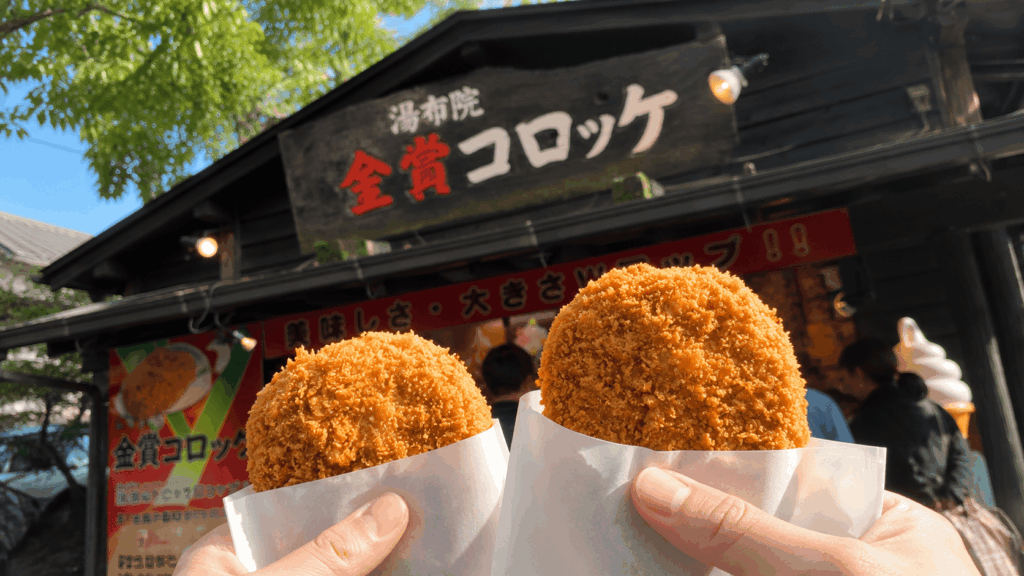
Yufuin’s most famous snack is a deep-fried croquette made with locally sourced potatoes and Bungo beef. Find it at the shop with the long queue about 10 minutes from the station side of the street. Flavours include original, cheese, curry, crab cream, and menchi (a minced-meat patty version). Prices range from around ¥160 to ¥250 depending on the variety. They’re fried fresh to order, which is why the line moves slowly — but the wait is part of the experience.
Milch
A German-style bakery that serves its signature Käse Kuchen — a warm, half-baked cheesecake served in a small ceramic dish. It’s creamy, slightly wobbly, and best eaten immediately at the standing table outside. Prices start around ¥240. They also sell a rich milk pudding (¥380) that travels better if you’re eating on the move.
B-Speak
This is the shop that brings the longest queue on Yunotsubo Street — and for good reason. B-Speak is run by Sansou Murata, a nearby luxury ryokan, and their signature P-Roll (cream roll cake) is legendary. A whole roll costs around ¥1,420–¥1,500. The catch? It frequently sells out by early afternoon. Popular flavours (plain cream, chocolate, and seasonal varieties) can disappear as early as 11 a.m. on busy days.
Kai’s tip: If you have your heart set on B-Speak’s roll cake, don’t leave it for later. Stop by first when you arrive, and ask if you can use their reservation service — they can hold a whole roll for you to pick up on your way back to the station. For Milch’s Käse Kuchen, the queue tends to peak around 11 a.m.–1 p.m., so aim for a mid-afternoon visit instead. These small timing adjustments can save you 20–30 minutes of waiting.
Yufuin Green Tea Factory
For something cold and quick, grab a matcha soft cream (matcha soft-serve ice cream) here. It’s creamy with a balanced bitterness — not overly sweet. Around ¥400–500.
Snoopy Chaya
A Snoopy-themed tea house and gift shop that’s as much about the photo opp as the food. They serve Snoopy-shaped buns, lattes with character art, and light snacks. Best for fans of the character or travellers with children.
Sit-Down Lunch: Bungo Beef Kamameshi
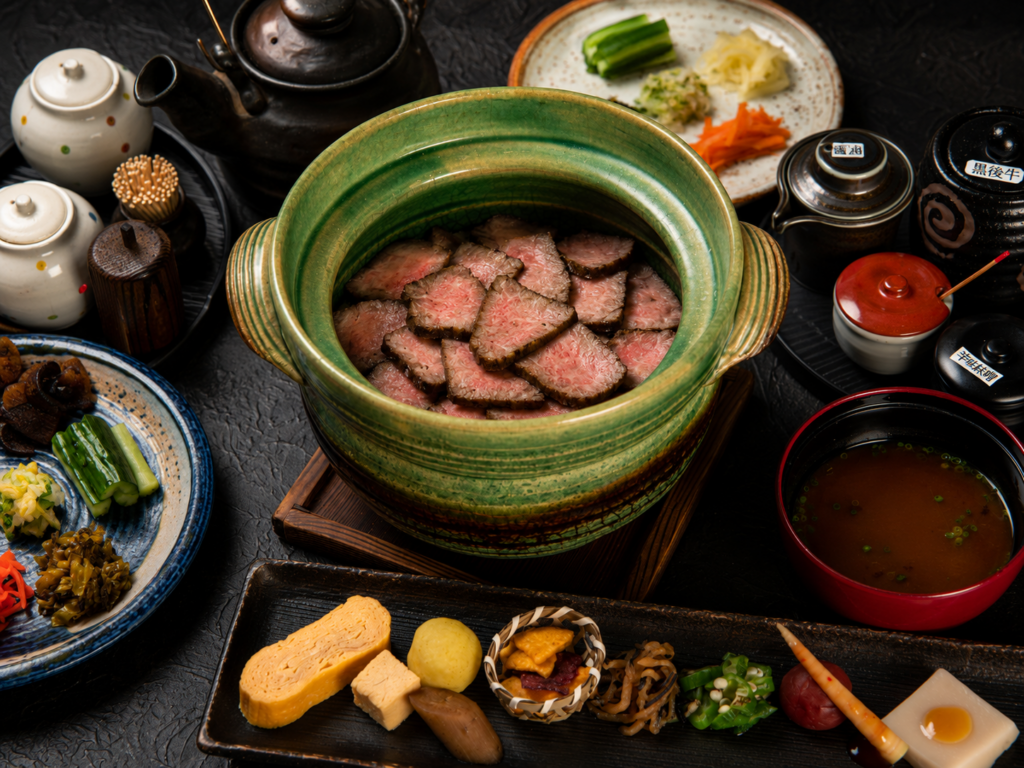
For a proper meal, the local specialty is Bungo beef kamameshi — seasoned rice topped with premium local beef, cooked in a personal iron pot. The gold-standard address for this is Yufumabushi Shin (由布まぶし心), which has two locations in town:
- Station Square (駅前店): Open 11:00–16:00 (last order 15:00), with evening sessions 17:30–21:00. Closer to the station, convenient if you’re arriving by train.
- Lake Kinrin (金鱗湖本店): Open 10:30–17:30 (last order 16:30). On the lake end of Yunotsubo Street — more scenic but also more likely to have a wait.
A Bungo beef kamameshi set costs around ¥2,000. Expect a 20–40 minute wait at peak hours (11:30–13:30). The station square location is generally less crowded than the lakeside one.
Lake Kinrin (Kinrin-ko): Scenic Walk & Morning Mist
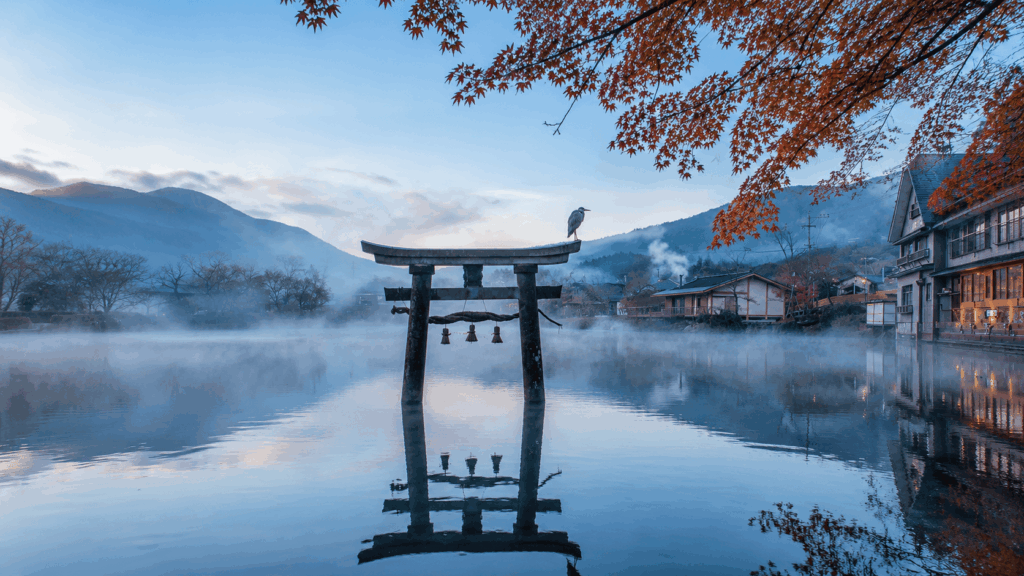
Lake Kinrin is the natural anchor point of Yufuin — literally the end of Yunotsubo Street. It’s a small volcanic lake fed by hot springs, which keeps its water temperature low at the surface and warm at the bottom, creating the famous morning mist on cold days.
What you need to know about the morning mist: The iconic photographs you’ve seen — the lake wrapped in a layer of fog with Mount Yufu in the background — are real, but they’re seasonal. This phenomenon occurs on cold autumn and winter mornings (roughly November through February) when the air temperature drops sharply overnight. You need to be there around sunrise (6:00–7:00 a.m.) on a clear, windless morning. Outside of winter, or later in the day, the lake is simply a pretty pond — beautiful, but not the ethereal scene you may expect.
Kai’s tip: “Smaller than expected” is the most common reaction I hear from first-time visitors to Lake Kinrin. Its circumference is only about 400 metres — a brisk 10-minute walk will take you all the way around. That’s not a disappointment; it’s a fact you can work with. The lake is best enjoyed as a slow 30-minute stroll: start at the Tenso Shrine (the small shrine with the lake-side torii gate, a fantastic photo spot at any hour), walk clockwise past the Cafe La Ruche for a coffee with a view, and loop back along the far bank for an unobstructed view of Mount Yufu. If you’re not there for the winter mist, come in the late afternoon when the low sun lights up the mountain behind the lake.
Other lake-adjacent spots:
- Tenso Shrine (天祖神社): A small shrine with a torii gate standing in the lake. Free, always open, and one of the most photogenic spots in Yufuin.
- Cafe La Ruche: A lakeside café serving coffee, tea, and light meals. Good for a rest stop after the walk. Expect around ¥500–700 for a drink.
Museums & Quirky Spots: What to Pick (And What to Skip)
Yufuin is surprisingly dense with small museums and themed attractions. Most are clustered on or just off Yunotsubo Street. The key is not to try to see them all — pick based on your interests.
| Spot | Entry Fee | Time Needed | Best For |
|---|---|---|---|
| Comico Art Museum | ¥1,700 (¥1,500 online) | 45–60 min | Contemporary art fans; Yoshitomo Nara fans |
| Yufuin Floral Village | Free | 20–30 min | Photo hunters; Ghibli fans (Donguri no Mori is inside) |
| Stained Glass Museum | ¥600–700 | 30–45 min | Rainy days; craft enthusiasts; families with kids (making workshop available) |
| Marc Chagall Yufuin Kinrin-ko Museum | ¥600–700 | 20–30 min | Chagall enthusiasts; quick culture fix |
| Yufuin Showa-kan | ¥500–1,000 | 30–60 min | Retro Japan nostalgia; rainy day activity; families |
| Artegio | Free (for guests) | 20 min | Chocolate shop + small gallery; part of Sansou Murata complex |
For Art Lovers: Comico Art Museum
Designed by Kengo Kuma (the architect behind the new National Stadium in Tokyo), this museum is worth visiting for the building alone. The permanent collection includes works by Yoshitomo Nara (his iconic “Your Dog” sculpture sits in the garden), Yayoi Kusama, Takashi Murakami, and Hiroshi Sugimoto.
Important: Advance online reservation is required. Same-day walk-ins are not accepted. Book at least a day ahead on the official website. Closed every other Wednesday. Photography is restricted in parts of the gallery.
For Photo Hunters: Floral Village + Donguri no Mori
Yufuin Floral Village is a recreated English countryside lane with thatched cottages, flower-lined paths, and small craft shops. It’s free to enter, highly Instagrammable, and takes about 20 minutes to wander. Inside the complex, Donguri no Mori (どんぐりの森) is a Studio Ghibli merchandise shop carrying Totoro, Kiki’s Delivery Service, and Spirited Away items — a magnet for Ghibli fans.
For Rainy Days: Showa-kan + Stained Glass Museum
The Yufuin Showa-kan is a nostalgic recreation of a 1950s–80s Japanese town, complete with retro candy shops, old phone booths, and vintage cars. It’s indoors, interactive, and surprisingly engaging for a 30–60 minute visit. The Stained Glass Museum offers a hands-on stained-glass making workshop (additional fee around ¥3,000–5,000) that’s popular with families.
Can You Visit an Onsen as a Day-Tripper?
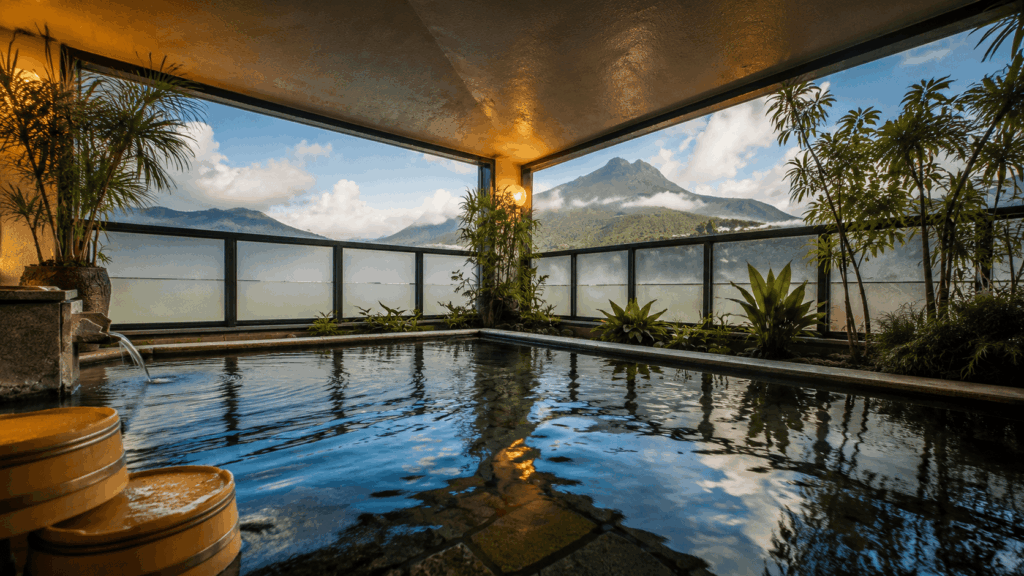
Yes — but you need to know your options. Yufuin’s ryokan (traditional inns) primarily cater to overnight guests, but several accept day-use bathers, and there’s a public bath by the lake. Here’s a realistic breakdown:
| Option | Cost | Type | Who It’s Best For |
|---|---|---|---|
| Shitanyu (下ん湯) | Around ¥200–300 | Public bath (konyoku / mixed-gender) by the lake | Budget travellers; those curious about a rustic, local onsen experience |
| Sansuikan (山粋館) | Around ¥800–1,500 | Ryokan day-use bath — near the station | Travellers who want a proper indoor onsen without staying overnight |
| Tsuka no Ma (塚の間) | ¥800 (indoor bath); private bath ¥2,700/hr | Ryokan day-use bath + private rental option | Couples or solo travellers who value privacy; those uncomfortable with communal bathing |
| Station Foot Bath (足湯) | Free or small fee | Foot bath at Yufuin Station square | Everyone; quick dip before the train; good intro to onsen culture |
Kai’s tip: Shitanyu is the most photogenic onsen in Yufuin — a semi-open-air bath right by the lake — but I want to be straightforward about what it actually is. It’s a mixed-gender bath (konyoku) with almost no changing area — just a small curtained space. Locals and experienced onsen-goers use it comfortably, but if you’re a first-time onsen visitor, travelling solo as a woman, or expecting private amenities, this isn’t the right choice. Head to Tsuka no Ma instead — the private bath rental (¥2,700 per hour) gives you a peaceful soak on a hillside with none of the awkwardness. And if you’re truly short on time, the station foot bath is free, takes five minutes, and counts as “I soaked in Yufuin.”
Beyond the Main Strip: Mount Yufu & Side Streets
If you have extra time (or want to escape the crowds), two options open up beyond the Yunotsubo–Kinrin corridor.
Mount Yufu (由布岳) Hike
The twin-peaked mountain that frames every photo of Yufuin is a proper hike, not a casual walk. The trail takes 3–4 hours round trip from the trailhead. Take a local bus from Yufuin Station to the trailhead (around ¥360 one way, 15 minutes). The trail is steep in sections and requires decent fitness and proper shoes. Best attempted on a clear day — the view from the saddle between the two peaks is spectacular. This is for travellers with a full day or an overnight stay; do not attempt it on a half-day schedule.
Side Streets & Quiet Lanes
The roads running parallel to Yunotsubo Street on either side — particularly towards the mountain side — are almost empty even at midday. They’re lined with small craft studios, pottery workshops, and quiet cafés that don’t appear on most maps. If the main street feels overwhelming, step sideways. You’ll find a more local Yufuin within two blocks.
Sample Itineraries
Here are a few ways to structure your time. For a full breakdown of timings and logistics, see our dedicated Yufuin itinerary guide.
Half-Day Express (3–4 hours)
- Arrive Yufuin Station → take the station foot bath (5 min)
- Walk Yunotsubo Street → grab a Kinsho Croquette on the way → pick up B-Speak roll cake (reserve ahead) → Milch Käse Kuchen
- Quick Lake Kinrin walk (20 min) → photo at Tenso Shrine
- Return to station → depart
Suitable for: Travellers on a tight day-trip who want the iconic snacks and a lake photo.
Full-Day Relaxed (6–8 hours)
- Arrive by 10:30 a.m. → B-Speak first (reserve or buy) → walk Yunotsubo Street slowly with snack stops
- 11:30 a.m. – Lunch at Yufumabushi Shin (station square location, less wait)
- 1:00 p.m. – One museum or attraction (Comico if you booked ahead, or Floral Village / Showa-kan)
- 2:30 p.m. – Lake Kinrin stroll + Café La Ruche break (30–40 min)
- 3:30 p.m. – Onsen: Tsuka no Ma (private bath) or Sansuikan (public bath)
- 5:00 p.m. – Pick up B-Speak order → stroll back to station
Suitable for: First-time visitors wanting a complete experience without rushing.
Overnight Option
If you decide to spend the night, check out our area-by-area guide on where to stay in Yufuin to find the best ryokan for your trip.
- Day 1: Arrive afternoon → check into ryokan → onsen → kaiseki dinner → evening lake stroll
- Day 2: Early morning Lake Kinrin for mist (winter only) → breakfast → Mount Yufu hike or second museum → depart
Suitable for: Onsen lovers; photographers wanting the morning mist shot; travellers who prefer slow travel.
FAQ
Is Yufuin worth visiting, or is it too touristy?
Yes, it’s worth visiting — if you go with the right expectations. Yufuin is undeniably touristy on Yunotsubo Street between 11 a.m. and 2 p.m., but the town is small enough that you can easily step away from the crowds. Visit early (before 10 a.m.), explore the side streets, or spend midday inside a museum, and you’ll find a genuinely pleasant onsen town. If you’re looking for a quiet, undeveloped hot-spring experience, Kurokawa Onsen is a better fit.
How much time do I need in Yufuin for a day trip from Fukuoka?
A half-day express visit (3–4 hours) covers the main food walk on Yunotsubo Street and a quick Lake Kinrin loop. A full-day relaxed visit (6–8 hours) adds a sit-down lunch, one museum, and a day-use onsen. Most Yufuin no Mori schedules from Hakata give you about 5–6 hours on the ground, which is enough for the full-day plan if you move efficiently.
Can I visit an onsen as a day-tripper in Yufuin?
Yes. Your options range from Shitanyu, a rustic public bath by Lake Kinrin (around ¥200–300, mixed-gender, minimal changing facilities), to day-use baths at ryokan such as Sansuikan (around ¥800–1,500) and Tsuka no Ma (¥800 for indoor bath, ¥2,700 per hour for a private bath). The station foot bath is free and always available.
Should I visit Yufuin or Beppu?
It depends on what you want. Yufuin is better for food walks, craft shopping, and a photogenic lake-and-mountain setting in a compact walkable area. Beppu is better for dramatic geothermal sights (hell ponds, steam vents), a wider variety of onsen (sand baths, mud baths), and a more “lived-in” city atmosphere. Many travellers combine both in a single day trip from Fukuoka, visiting Yufuin in the morning and Beppu in the afternoon, or vice versa.
Do I need to book the Yufuin no Mori train in advance?
Yes. All seats are reserved, and the train sells out regularly — especially on weekends, during cherry-blossom and autumn-leaf seasons, and around Japanese holidays. JR Pass holders can book free of charge at any JR ticket office. Online booking via the JR Kyushu system is also available but carries a ¥1,000-per-person fee. If the Yufuin no Mori is full, the Limited Express Yufu or direct highway buses are reliable alternatives.
What is the best time of day to visit Yufuin?
Early morning (arriving by 10 a.m.) is ideal for a quieter experience on Yunotsubo Street and the best chance at popular food items before they sell out. Late afternoon (after 3 p.m.) is also pleasant as the day-trip crowds thin out. Midday (11 a.m.–2 p.m.) is the busiest window — use this time for lunch or a museum visit rather than the main street.
Is Yufuin easy to walk?
Yes. The entire main area — from Yufuin Station to Lake Kinrin via Yunotsubo Street — is flat and walkable in about 20–30 minutes one way. Comfortable walking shoes are recommended. The street itself is pedestrian-friendly, though sections can be crowded. Side streets are quieter and also flat. The only significant incline is if you head up towards Mount Yufu or the hillside ryokan.
Final Verdict: Who Should Visit Yufuin — and Who Should Pass?
Choose Yufuin if:
- You’re a first-time visitor to Kyushu and want a classic day-trip experience from Fukuoka. The food walk, lake stroll, and onsen dip cover all the bases in a compact, low-effort package.
- You enjoy food-focused travel and want to try local specialties like Bungo beef kamameshi, fresh croquettes, and cream roll cake from shops with real names and reputations — not generic tourist traps.
- You’re looking for a short onsen experience without committing to an overnight stay. The day-use options at Tsuka no Ma or Sansuikan give you a proper soak on your own schedule.
- You’re travelling with children or a group — the flat, easy walk, the range of snack options, and the free-entry Floral Village make it a low-stress half-day excursion.
- You’re a photographer targeting the winter morning mist shot at Lake Kinrin. If you’re willing to stay overnight and wake up early, the payoff can be extraordinary.
Consider another destination if:
- You prefer raw nature over curated sightseeing. Kurokawa Onsen or the Kuju mountain range offers a more rustic, less commercial hot-spring experience.
- Dramatic geothermal landscapes excite you more than food streets. Beppu’s hell ponds, steam vents, and sand baths deliver spectacle that Yufuin can’t match.
- You’re on a very tight budget and don’t have a JR Pass. The transport costs from Fukuoka and the cumulative cost of snacks, lunch, museum entry, and onsen fees add up — a guided tour that bundles transport may save you money and logistics overhead.
- You’re visiting during a Japanese national holiday or peak foliage weekend. The crowds on those days can genuinely undermine the experience — visit on a weekday if possible, or skip it altogether if your schedule doesn’t allow flexibility.
What I’d tell a friend visiting for the first time: Yufuin is a pleasant onsen town with an excellent food street, a photogenic lake, and enough charm to fill a relaxed half-day. It’s not the hidden gem it once was, and yes, the middle of Yunotsubo Street at 1 p.m. feels like a fairground. But the real Yufuin — the one with mist on the lake at dawn, quiet back lanes with pottery workshops, and the satisfaction of biting into a hot croquette while Mount Yufu rises above the rooftops — is still there, if you know when and where to look. Go early, pick your priorities, and you’ll understand exactly why it’s still one of Kyushu’s most visited towns.

Hi, I’m Kai. I’m a Tokyo-based travel writer, tourism industry insider, and the author of a published guidebook for international visitors to Japan. With over 10 years of professional experience at a leading Japanese tourism company, my mission is to help you skip the tourist traps and navigate Japan’s best destinations like a local. I believe the perfect day trip is like a traditional kaiseki meal: a beautiful balance of precise planning and unforgettable seasonal discovery. When I’m not out conducting field research, you’ll usually find me drafting new itineraries with one of my favorite fountain pens!