
Quick Answer: Can You Take a Train to Takachiho Gorge?
No — there is no active passenger railway to Takachiho Gorge, and you cannot reach it by train alone. Every public-transport route requires a bus, taxi, rental car, or tour transport for the final leg into Takachiho.
- Easiest DIY route from Fukuoka: Take the Gokase-go highway bus to Takachiho Bus Center, then walk, taxi, or use local transport toward the gorge.
- Most train-like route: Take JR to Nobeoka Station, then continue by bus to Takachiho Bus Center.
- Most flexible option: Rent a car, especially if you want to combine Takachiho with Mt. Aso, Kurokawa Onsen, or other Kyushu stops.
- Lowest-stress no-driving option: Join a guided day tour from Fukuoka or another major city and check the current itinerary before booking.
- JR Pass note: The JR Pass may help with train sections to gateway stations, but it does not cover the final non-JR bus into Takachiho.
If you searched for “Takachiho Gorge train”, the key point is simple: you are not missing a secret rail route. The old railway is no longer a public transport line, and today’s Amaterasu Railway is a sightseeing attraction, not a way to reach the gorge from another city.
Why Do People Search for a “Takachiho Gorge Train”?
The confusion is understandable. Japan’s rail network is excellent, and many major sightseeing areas are easy to reach by train. Takachiho feels like the kind of place that should have a rail connection.
Takachiho also used to have a railway. The former Takachiho Railway connected the area with Nobeoka, but the line stopped operating after severe typhoon and flood damage in 2005. It was not restored as a normal passenger railway.
Today, you may see photos and videos of the Takachiho Amaterasu Railway. This tourist ride uses part of the former railway infrastructure and runs open-air sightseeing carts over a scenic section of track. It is fun if you already have time in Takachiho, but it does not connect Fukuoka, Kumamoto, Nobeoka, or the gorge as public transport.
- What it is: A local sightseeing ride on preserved railway tracks.
- What it is not: A train route to Takachiho Gorge.
- Best use: Add it if you are staying overnight or have extra time in town.
- Important: Operating hours, fares, closures, and weather suspensions can change, so check the official Amaterasu Railway information before going.
Does the JR Pass Cover the Trip to Takachiho Gorge?
Only partially. The JR Pass can be useful for getting to gateway stations such as Kumamoto, Miyazaki, or Nobeoka, depending on your wider Kyushu itinerary. However, there is no JR train into Takachiho itself.
The final leg requires a non-JR bus, taxi, rental car, or arranged tour transport. That means even JR Pass holders should budget for extra transport and check bus schedules carefully.
- JR Pass may help with: JR trains to Kumamoto, Miyazaki, Nobeoka, or other gateway stations.
- JR Pass does not solve: The final approach into Takachiho.
- Main planning issue: Bus frequency and timing matter more than rail coverage.
How to Get to Takachiho Gorge: Main Routes Compared
Once you stop looking for a direct train, the real choices become much clearer. Most visitors use one of these four approaches.
| Route | Starting Point | Best For | Transport Style | Main Caution |
|---|---|---|---|---|
| Gokase-go highway bus | Fukuoka / Hakata / Tenjin | Simplest DIY route from Fukuoka | Direct highway bus to Takachiho Bus Center | Limited departures and a long same-day return |
| Kumamoto / Aso route | Kumamoto or Aso | Travelers already in central Kyushu | Bus route with careful timing | Not as flexible as it looks on a map |
| Nobeoka route | Nobeoka / Miyazaki side | Travelers approaching from eastern Kyushu | JR train to Nobeoka, then bus to Takachiho | The bus leg is still mandatory |
| Rental car | Fukuoka, Kumamoto, Aso, Miyazaki, or Nobeoka | Maximum flexibility | Drive yourself | You need the correct driving documents and should be comfortable with mountain roads |
Route 1: From Fukuoka by Gokase-go Highway Bus
For many independent travelers based in Fukuoka, the Gokase-go highway bus is the most straightforward DIY route. It avoids unnecessary train changes and stops at Takachiho Bus Center.
- Main departure areas: Hakata Bus Terminal, Nishitetsu Tenjin Expressway Bus Terminal, and Fukuoka Airport International Terminal.
- Typical travel time: Around several hours one way, depending on your boarding point and road conditions.
- Reservation: The route is reserved-seat service, so book ahead rather than assuming you can simply walk on.
- Frequency: Limited daily departures, so your return timing matters.
- Fare: Fares vary by date and boarding point. Check the current fare calendar before booking.
Who this works for: Travelers staying in Fukuoka who want the simplest no-train DIY route to Takachiho.
What to watch out for: A same-day return can feel rushed. If you want lunch, the boat ride, Takachiho Shrine, or the Amaterasu Railway, consider whether an overnight stay would make the trip more enjoyable.
For a deeper breakdown of this route, see our guide to the Fukuoka–Takachiho bus.
Route 2: From Kumamoto or Aso by Bus
Kumamoto looks close to Takachiho on a map, but public transport is not always simple. In practice, this route works best for travelers who are already spending time in central Kyushu, especially around Kumamoto or Aso.
- Main idea: Use a bus route that connects the Kumamoto / Aso side with Takachiho.
- Best for: Slower Kyushu itineraries, not rushed one-day plans.
- Planning issue: Departures are limited, and missed connections can seriously reduce your time at the gorge.
Who this works for: Travelers already near Kumamoto or Aso who are comfortable planning around bus timetables.
What to watch out for: Do not assume “Kumamoto is close” means the public-transport day trip is easy. Check the actual bus schedule before building the rest of your day.
Route 3: From Nobeoka by JR Train and Bus
If you are approaching from the eastern side of Kyushu, Nobeoka is the clearest train-plus-bus gateway. You can take JR to Nobeoka Station, then continue by bus to Takachiho Bus Center.
- Rail portion: JR trains connect Miyazaki and other eastern Kyushu areas with Nobeoka.
- Bus portion: From Nobeoka Station, continue by bus toward Takachiho Bus Center.
- Typical bus time: Around 80–90 minutes, depending on the service and road conditions.
- JR Pass: It may cover the JR rail portion, but not the final non-JR bus.
Who this works for: Travelers already on the Miyazaki or eastern Kyushu side who want the most intuitive train-assisted route.
What to watch out for: This is still not a train route to the gorge. The bus from Nobeoka is the key final leg, and you still need to plan onward movement from Takachiho Bus Center.
Route 4: Rental Car
Renting a car gives you the most freedom. It is especially useful if you want to combine Takachiho with Mt. Aso, Kurokawa Onsen, Amano Iwato Shrine, or other rural Kyushu stops where public transport is limited.
- Best for: Travelers who want flexible timing and multiple stops in one day.
- Useful from: Kumamoto, Aso, Fukuoka, Miyazaki, or Nobeoka, depending on your wider route.
- Documents: Many visitors need an International Driving Permit or other valid driving documents prepared before arriving in Japan.
- Costs: Rental prices, tolls, fuel, parking, and insurance vary by date, vehicle type, and route.
- Driving caution: Expect rural roads, mountain sections, and limited parking near popular areas during busy periods.
Who this works for: Travelers who are confident driving in Japan and want to avoid being locked into bus schedules.
What to watch out for: Do not rent a car casually if you are uncomfortable with left-side driving, narrow roads, or rural navigation. Also check parking information before peak weekends and holidays.
DIY Public Transport vs Guided Tour vs Rental Car
The real question is not only “Is there a train?” It is “Which approach fits how I travel?” Here is the practical comparison.
| Decision Point | DIY Public Transport | Guided Day Tour | Rental Car |
|---|---|---|---|
| Planning effort | High — you manage schedules and transfers | Low — transport is arranged once the tour begins | Medium — you handle driving, parking, fuel, and timing |
| Flexibility | Low to medium | Medium, but the itinerary is fixed | Highest |
| Boat ride compatibility | Can be awkward if your arrival window is narrow | Depends on the tour itinerary and current conditions | Best if you arrive early and plan around the official reservation system |
| Risk of missing return transport | Higher with limited buses | Lower once your tour transport is arranged | You control the departure time |
| Mt. Aso combination | Difficult by public transport in one day | Often built into some day-tour itineraries | Practical if you plan the route carefully |
| Best for | Independent travelers with flexible expectations | Visitors who want a simpler no-driving option | Travelers who value freedom and have the right driving documents |
If you are leaning toward a tour, do not assume every tour includes the same stops or conditions. Check the current start time, meeting point, cancellation rules, lunch arrangements, boat access policy, and what happens if the boats are suspended.
Read our detailed breakdown of the Mt. Aso & Takachiho Gorge Day Tour before deciding whether it fits your route.
Prefer to avoid bus planning? Check the current availability, itinerary, inclusions, and cancellation rules before booking.
Check current tour availability and details
What to Know Before You Go
Takachiho Bus Center Is Not the Gorge
Arriving at Takachiho Bus Center does not mean you are already standing at the gorge. You still need to reach the gorge area itself.
- Walking: Possible for many travelers, but expect downhill walking to the gorge and a harder uphill return.
- Taxi: Useful if available, but do not assume one will appear instantly at the exact time you need it.
- Local transport: Local buses and shuttles may operate depending on the day or season, but frequency is limited compared with major cities.
- With luggage: Avoid dragging large bags to the gorge if possible. Store luggage before sightseeing or stay nearby.
Takachiho Gorge Boat Reservations
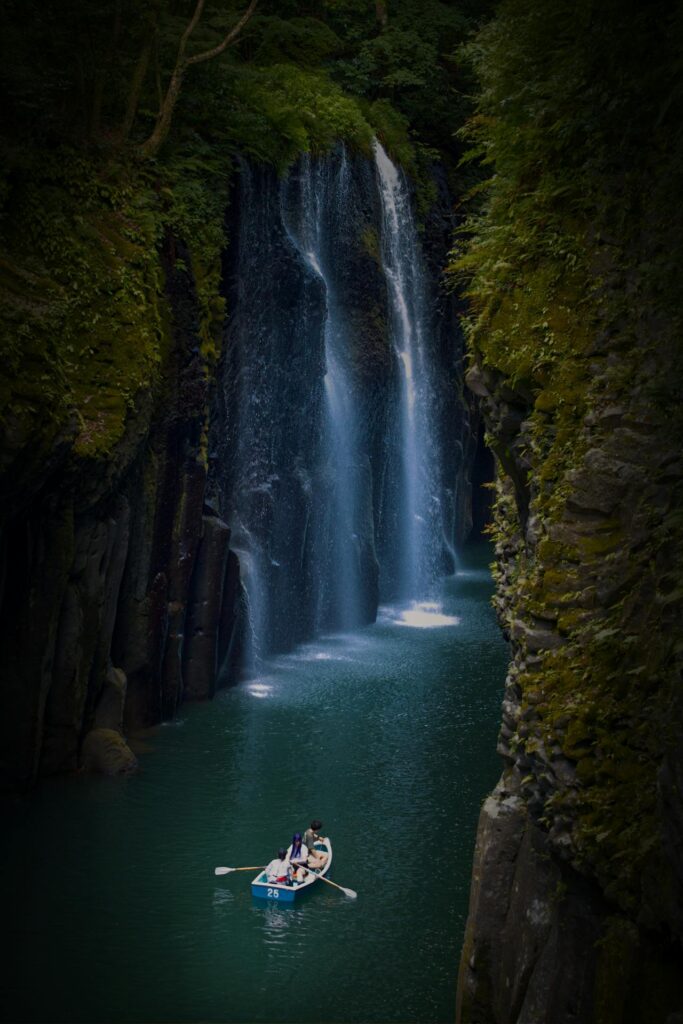
If the rowboats are one of your main reasons for visiting, plan this part carefully. Reaching Takachiho is only half the challenge. Your arrival time also needs to line up with boat availability.
- Price: Budget roughly ¥4,100–¥5,100 per boat for 30 minutes, but check the current official price before booking.
- Capacity: A boat usually holds up to 3 people, with limited exceptions for small children.
- Advance reservations: Online reservations usually open from 9:00 AM two weeks before the boarding date and close at 9:00 AM two days before the visit.
- Same-day tickets: Same-day tickets may be sold in the morning, but they are limited and cannot be relied on during busy periods.
- No phone booking: The official system does not accept phone reservations for the boats.
- Weather and safety: Even with a reservation, operations can be suspended because of rain, high water, inspections, or other safety conditions.
- Check the day-of status: The official tourism association updates the operating status, usually around the morning, so confirm before heading down to the boat area.
Bottom line: If the boat ride is a must-do, reserve in advance, arrive with time to spare, and keep a backup plan. A late arrival from Fukuoka or Kumamoto can leave you with little flexibility.
For a full explanation, read our Takachiho Gorge boat reservation guide.
Best Time to Visit Takachiho Gorge
There is no single perfect time, but your experience changes a lot depending on arrival time, weather, and season.
- Early morning: Usually better for photos, calmer paths, and boat planning if you are staying overnight or driving.
- Late morning to early afternoon: Often the busiest period, especially on weekends, holidays, and peak travel seasons.
- Late afternoon: Can feel calmer, but light may be limited in winter and boat timing may be less flexible.
- Rainy periods: Boat suspensions are more likely, and river conditions can change quickly.
- Autumn and holiday periods: Beautiful but busier. Build in more time than the map suggests.
Should You Stay Overnight?
If you are relying on public transport, an overnight stay can make Takachiho much easier and more enjoyable.
| Option | Best For | Flexibility | Main Trade-Off |
|---|---|---|---|
| DIY day trip | Travelers who mainly want to see the gorge | Low | Long travel time and limited buffer |
| Overnight stay | Travelers who want the boat ride, shrine area, and a slower pace | High | Requires accommodation planning |
| Guided day tour | No-driving travelers who want logistics handled | Medium | Fixed itinerary and conditions vary by tour |
| Rental car day | Travelers combining multiple Kyushu stops | High | Driving documents, parking, tolls, and mountain roads |
For many travelers, the mistake is not choosing DIY. The mistake is trying to force Takachiho into a rushed public-transport day trip with no room for delays, weather, lunch, or boat timing. With careful planning, it is still possible to make a Takachiho day trip worth the long ride.
Frequently Asked Questions
Can I use the JR Pass to get to Takachiho Gorge?
Only for part of the journey. The JR Pass may cover JR trains to gateway stations such as Kumamoto, Miyazaki, or Nobeoka, but the final bus into Takachiho is not covered by the JR Pass.
Is there any train at all in Takachiho?
Yes, but not as public transport to the gorge. The Takachiho Amaterasu Railway is a sightseeing attraction on part of the former railway line. It is not a train route from Fukuoka, Kumamoto, Nobeoka, or any other city to Takachiho Gorge.
What is the easiest public-transport route from Fukuoka?
For most travelers, the Gokase-go highway bus is the simplest DIY option because it goes directly from the Fukuoka area to Takachiho Bus Center. It is still a long journey, so check departure times, return options, and whether your plan leaves enough time at the gorge.
Can I visit Mt. Aso and Takachiho Gorge in one day without a car?
It is difficult on a self-planned public-transport day trip. A rental car or a guided itinerary designed to connect both areas is usually more realistic. Always check the current route, weather, and tour details before committing.
Do I need to reserve the Takachiho Gorge boat ride in advance?
Yes, if the boat ride is important to your visit. Same-day tickets may exist, but they are limited and can sell out. Advance online reservations are usually the safer option, but boat operations can still be suspended because of weather, water levels, inspections, or safety checks.
How much does the Takachiho Gorge boat ride cost?
As a rough guide, the official fee is usually around ¥4,100–¥5,100 per boat for 30 minutes. Prices and rules can change, so check the official booking page before planning your budget.
Is there parking at Takachiho Gorge?
Yes, but parking rules, fees, and availability can change by lot, season, and congestion level. If you drive, check the latest parking information before arrival and try to avoid reaching the gorge at the busiest time of day.
Final Verdict: What Is the Best Way to Visit Takachiho Gorge?
If you searched for “Takachiho Gorge train”, the most important takeaway is this: there is no direct train, and there is no train-only route to Takachiho Gorge.
- Choose DIY public transport if: You are already traveling through Kyushu slowly, you are comfortable with bus schedules, and you do not mind limited flexibility. From Fukuoka, the Gokase-go highway bus is usually the simplest DIY route.
- Choose a guided tour if: You want a no-driving option with less schedule stress, especially if you also want to combine Takachiho with Mt. Aso. Check the current itinerary, inclusions, meeting point, and cancellation policy before booking.
- Choose a rental car if: You have the correct driving documents and want to combine Takachiho with other rural Kyushu destinations on your own schedule.
- Choose an overnight stay if: You want time for the boat ride, Takachiho Shrine, the Amaterasu Railway, and a slower visit without constantly watching the bus timetable.
In other words, the best route depends less on trains and more on how much time, flexibility, and transport stress you are willing to accept.
➡️ If DIY logistics sound more complicated than you want, compare the current tour details before building the rest of your Kyushu itinerary.
Check current availability, prices, and tour details
Prices, opening hours, transport schedules, pass conditions, tour inclusions, payment methods, parking rules, boat operations, and seasonal services can change. Always check official sources and your selected booking page before finalizing your trip.

Hi, I’m Kai. I’m a Tokyo-based travel writer, tourism industry insider, and the author of a published guidebook for international visitors to Japan. With over 10 years of professional experience at a leading Japanese tourism company, my mission is to help you skip the tourist traps and navigate Japan’s best destinations like a local. I believe the perfect day trip is like a traditional kaiseki meal: a beautiful balance of precise planning and unforgettable seasonal discovery. When I’m not out conducting field research, you’ll usually find me drafting new itineraries with one of my favorite fountain pens!