
The Minoh Falls hike is beginner-friendly in the technical sense. The Takimichi Trail is paved, has no steps, and requires no hiking experience or special gear. What it is not is a flat stroll: from Hankyu Minoh Station, the path climbs more or less continuously for about 2.7 km before it reaches the waterfall.
That distinction is the whole story. When I guided international visitors along this trail, sneakers were perfectly adequate for the surface, but a guest who did not walk regularly was noticeably short of breath by the final stretch. The path was easy. The effort still added up.
Below, I’ve separated the two questions that matter: how hard the trail is technically, and how tiring it is in practice. After that come walking times, a realistic half-day plan from Osaka, and a comparison of the three ways to do this walk, including the taxi option and what it does and does not solve. If you want to combine the falls with Katsuoji Temple and an English-speaking guide, that option is covered in the route comparison further down.
Adding Katsuoji Temple to your hike? The waterfall alone is straightforward to visit independently, but combining both stops takes more planning. An Osaka-departure guided day tour is worth comparing if you want the transport connections and local context arranged for you. Walking is still required.
Minoh Falls Hike at a Glance
| Detail | What to expect |
|---|---|
| Trail type | Paved riverside walking path (Takimichi Trail) |
| Technical difficulty | Easy — no steps, no scrambling, no hiking experience needed |
| Physical effort | Steady uphill for most of the route, with one steeper section |
| Distance | About 2.7 km one way, roughly 5.4 km round trip |
| Walking time | About 40–50 minutes uphill at a steady pace |
| Round-trip walking | About 80–100 minutes, excluding stops |
| Realistic visit | 2–3 hours from Minoh Station, including breaks and photos |
| Entrance fee | Free |
| Starting point | Hankyu Minoh Station; Ichinohashi Bridge is about 5 minutes on foot |
| Footwear | Comfortable sneakers; hiking boots are not required |
| Main concern | Cumulative climbing, not the condition of the path |
| Current status | Full trail reopened on 7 August 2026 after the November 2025 fire near the falls; a temporary barrier narrows the path close to the waterfall |
The 2–3 hour figure is a planning estimate, not an official guaranteed time. Walkers who stop often, travel with small children, or visit during the autumn crowds should add buffer.
How Difficult Is the Minoh Falls Hike?
Difficulty here comes down to two separate questions: whether you can handle the surface, and whether you can handle the climb. The first is straightforward. The Takimichi Trail is paved, there are no steps, and you will not be picking your way over roots or rocks. The second depends entirely on you.
Visitor reviews tend to split along exactly that line. Many describe the walk as easy, well maintained and suitable for families. Others say the uphill felt longer and harder than the photos suggested. Both descriptions can be accurate, because they are answering different questions. The mistake I see most often is treating “paved” as a synonym for “flat.”
Is the Trail Steep or Mostly Gentle?
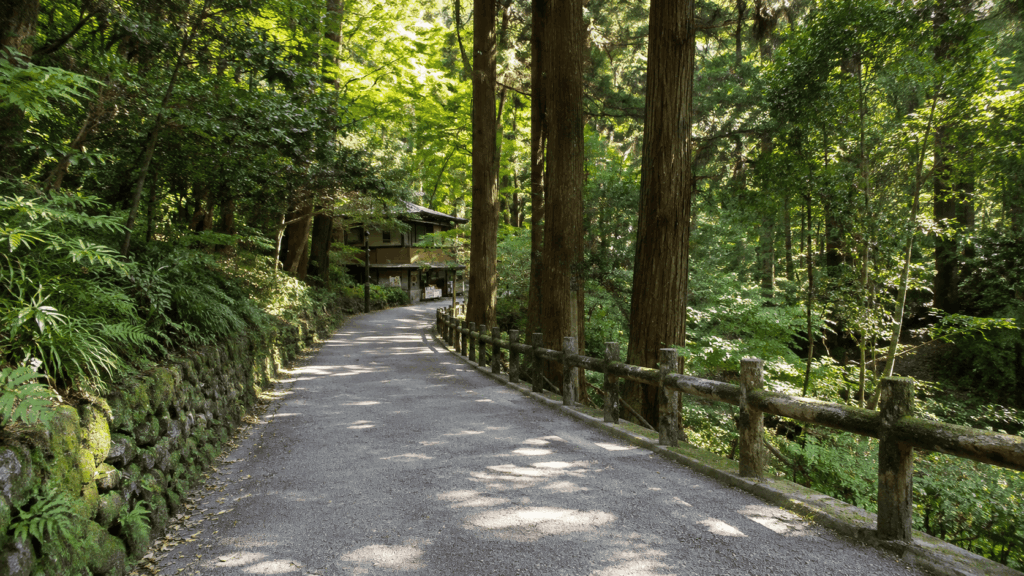
Mostly gentle, with one steep pitch. The park’s own guidance describes the trail as paved with no steps, and notes a single steep section along the way. There is no wall of a climb to haul yourself up. The difficulty is cumulative: a gentle gradient held for 2.7 km asks more of your legs and lungs than the same distance on level ground.
Two practical consequences follow. First, pacing matters more than footwear. Walkers who set off quickly at the station often slow down sharply in the second half. Second, the surface changes in wet weather. The paved path can be slick after rain, and the steep section is where you will notice it most.
Who Will Find It Easy? (And Who Should Think Twice)
| Walker type | Likely experience | Main concern | Suggested approach |
|---|---|---|---|
| Regular walkers | Comfortable; close to the official 40–50 minutes uphill | Very little | Walk at a normal pace and enjoy it |
| Occasional walkers | Manageable but noticeable | Underestimating the return leg | Allow 60–75 minutes uphill and take one proper break |
| Travelers not used to exercise | Genuinely tiring by the second half | Continuous incline with few flat stretches | Start early, rest at Shugyokoba, and keep the day otherwise light |
| Families with young children | Doable but slow | Total time, snacks, and toilet timing | Plan 3 hours or more and treat the falls as the only fixed goal |
| Older travelers | Varies widely; walking ability matters more than age | Knees on the descent, balance on the steep section | Test yourself on a 30–40 minute walk first; consider the route options below |
| Visitors with significant mobility limitations | Depends on the specific condition | The steep section and the final approach | Ask the park office about the assisted wheelchair loan before you go |
Age alone tells you very little. A fit 75-year-old who walks daily will usually find this easier than a 40-year-old who drives everywhere. If you are travelling with someone whose walking ability you are unsure about, the honest test is a 30–40 minute walk on consecutive days, not a guess based on age.
For visitors with more significant mobility limitations, Minoh Park lends one electric-assist wheelchair from the park office, which is about 15 minutes on foot from Minoh Station near the insect museum. It is a single unit, requires an assistant to accompany the user, and must be requested in person on the day. It is a genuine option, but not one to build a tight schedule around.
How Long Does the Minoh Falls Hike Take?
Budget 80–100 minutes of pure walking for the round trip. Add stops and the visit becomes a half-day: 2–3 hours from Minoh Station back to Minoh Station is realistic for most travellers. Families with small children, photographers, and anyone visiting during the autumn leaves should plan closer to 3 hours.
The return leg is faster than the climb, but not dramatically so. Most people take 30–40 minutes to walk back down, and tired legs on a paved surface still need attention.
Kai’s tip: Don’t judge the walk by the first ten minutes. The stretch out of Minoh Station is flat and lined with souvenir shops, which makes the route feel easier than it is. The grade becomes more noticeable after Ryuanji Temple, where the shops thin out and the trees close in. If you want to know how the climb will treat you, assess your pace at that point rather than at the start.
A Realistic Half-Day Plan from Osaka
This is a sequence rather than a timetable, so you can shift it to suit your start time.
- Take the Hankyu Takarazuka Line from Osaka-Umeda to Ishibashi Handai-mae, then change to the Minoh Line for Hankyu Minoh Station. The journey is roughly 25–30 minutes and around ¥280, though it is worth checking the current timetable.
- Walk about 5 minutes to Ichinohashi Bridge, the entrance to the park, then follow the Takimichi Trail upstream.
- Break the climb once. The insect museum and Ryuanji Temple are both on the way, and stopping for 15–20 minutes makes the second half easier.
- Spend 20–30 minutes at Minoh Falls. The viewing area is open and flat, which makes it a natural place to sit down.
- Walk back down and eat near the station or on the lower part of the trail, where the choice is wider than at the falls.
Starting before mid-morning is the single easiest improvement to this plan. The trail is narrower near the falls since the fire, and the viewing area fills up on weekends and during the autumn season.
If you are deciding between Minoh and other day trips from Osaka (like our guide to the Kurama to Kibune hike in neighboring Kyoto), compare how much walking each option involves before you commit a half day. Minoh is a poor fit for an itinerary that already includes a lot of standing and walking.
Which Route Should You Take to Minoh Falls?
For most travellers, the default is also the best answer: walk up from Minoh Station and walk back down. The alternatives exist for specific problems, not because the standard route is flawed.
| Option | Best for | Walking required | Main advantage | Main drawback | Key caution |
|---|---|---|---|---|---|
| Walk from Minoh Station and return | First-time visitors with reasonable walking fitness | About 5.4 km round trip, 80–100 minutes moving | Cheapest and most flexible; no booking needed | The return leg still requires legs | The climb is continuous rather than steep |
| Taxi to the upper parking area, walk down | Travellers who struggle with long uphill walks but can manage a steep descent | About 15 minutes steeply downhill to the falls, then either back up the same slope or 2.7 km downhill to the station | Removes most of the 2.7 km climb | Does not reach the falls; a sharp slope remains | Vehicles cannot enter the park; autumn restrictions affect taxis |
| Guided falls and Katsuoji tour | Travellers who want Katsuoji Temple and English commentary in one trip | Walking to the falls plus a climb out to the upper parking area | Transport, timing and context are handled for you | Costs more than a free walk | It is not a shortcut around walking |
Option 1 — Walk from Minoh Station and Back
From Hankyu Minoh Station, walk about 5 minutes to Ichinohashi Bridge and follow the Takimichi Trail upstream. The route is obvious, signposted, and lined with shops for the first stretch. You reach the falls in 40–50 minutes at a steady pace, then retrace your steps.
This is the version I would recommend to a friend visiting for the first time. It costs nothing beyond the train fare, you can stop wherever you like, and the walk itself is half the experience. The trade-off is simple: what you climb on the way up, you also descend on the way back, and then you still have a 5-minute walk to the station.
Option 2 — Taxi Up, Walk Down
A taxi from Minoh Station to the Times Otaki-ue Parking Lot area takes about 10–15 minutes and costs roughly ¥1,500–2,100 depending on traffic and the route taken. On the visit where I used one, the fare came to about ¥2,000. From the drop-off point, the falls are about 15 minutes away on a steep downhill path.
What this buys you is the removal of the long climb from the station. What it does not buy you is a flat approach. General vehicles are not allowed inside the park, and cars cannot enter the park from the upper road either, so a taxi cannot deliver you to the waterfall. The final descent is sharp, and if you plan to return the same way, you will climb it back up. Alternatively, you can walk down to the station from the upper area in about 50 minutes.
During the autumn season, taxis are also affected by the one-way uphill restriction on the Minoh Driveway, so allow extra time or avoid weekend afternoons. If your real priority is Katsuoji Temple rather than the falls, it is worth deciding that before you book anything, since the two sit on opposite sides of the valley.
Kai’s tip: If you take a taxi, decide before you set off how you are getting back. On the trip where I changed the plan for an older guest who was worried about the walk, we took the taxi up and walked down to the station, which worked well. The mistake would have been assuming the taxi solved the whole problem: the steep section near the top is still there, and it is harder on the knees going down than most people expect. If anyone in your group has knee or balance problems, treat this as a partial fix, not a solution.
Option 3 — Guided Waterfall and Katsuoji Tour
The guided version makes sense for one specific reason: Katsuoji Temple. Getting to the falls is easy on your own; linking the falls and Katsuoji without a car is the part that takes planning, because there is no direct public transport between them. If you want to do it independently, see our detailed guide on the Katsuoji to Minoh Falls routes.
The Minoh Waterfall Hiking & Katsuoji Temple Tour meets at Hankyu Minoh Station, runs 3.5–4.5 hours depending on the plan, and is offered in English. It includes a guide, momiji tempura, Katsuoji entrance, and transport during the tour, with prices listed from around ¥17,100 at the time of writing. Group size is small, with a maximum of seven.
Be clear about what you are buying. The tour walks to the falls, and the itinerary then climbs from the falls to the upper parking area before taking a taxi to Katsuoji. It is a well-organised day, not a way to skip the walking. If the waterfall is your only goal, you can do that for the price of a train ticket.
If you are comparing operators, or want to see whether a shorter or meal-included version suits you better, it is worth looking at the full range of Minoh Falls tours before choosing.
Another option is the Osaka-departure guided day tour, which visits Katsuoji first and then continues towards the falls. It follows a different route from the half-day tour described above, takes around 6.5 hours, and still involves moderate walking. If you want both destinations without coordinating the connections yourself, this is the tour worth a closer look.
Why I’d book this one
- English-speaking guidance: Recent travellers frequently praise the guides’ local knowledge, cultural explanations and willingness to accommodate the group’s pace.
- Less transport planning: The itinerary combines public transport and a taxi connection between Katsuoji and the waterfall area, removing much of the logistical work involved in visiting both destinations independently.
- Clearer booking conditions: Admission and public transport are listed among the inclusions, with flexible cancellation and payment options offered. Check the exact inclusions, cancellation deadline and payment conditions for your chosen date.
How to Get to Minoh Falls from Osaka
The route is simple once you know the transfer station, and it is the same route locals use.
- Start at Hankyu Osaka-Umeda Station and take the Hankyu Takarazuka Line.
- Change at Ishibashi Handai-mae Station to the Hankyu Minoh Line.
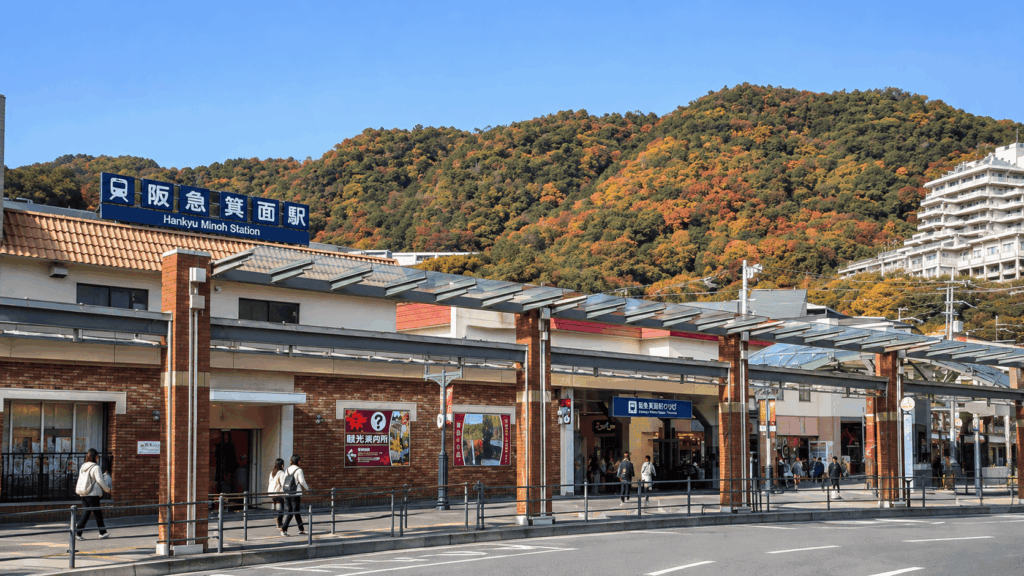
- Get off at Hankyu Minoh Station, the terminus.
- Walk about 5 minutes to Ichinohashi Bridge, then follow the Takimichi Trail to the falls.
The train journey takes roughly 25–30 minutes and costs around ¥280. An IC card works throughout, and you do not need a reserved ticket.
Driving is a poor choice. There is no parking inside the park or along the Takimichi Trail, general vehicles are prohibited inside the park, and the roads around Minoh become congested in autumn. If you park near Minoh Station, you will walk the same route; the Times Otaki-ue Parking Lot is another option, but it still leaves a steep walk of about 15 minutes down to the falls.
Minoh Station vs. Minoh-Kayano Station
These are two different stations, and the names are close enough to cause real confusion. Hankyu Minoh Station is the start of the walk and the correct destination for this hike. Minoh-Kayano Station is served by the Kita-Osaka Kyuko Line and connects to Hankyu Minoh Station by Hankyu Bus routes 21 and 36.
If you are coming from central Osaka on the Midosuji subway line, Minoh-Kayano may appear as a convenient option. It is a valid route, but it adds a bus ride and drops you at the same starting point. For the hike itself, Hankyu Minoh Station is the one you want.
What You’ll See Along the Takimichi Trail
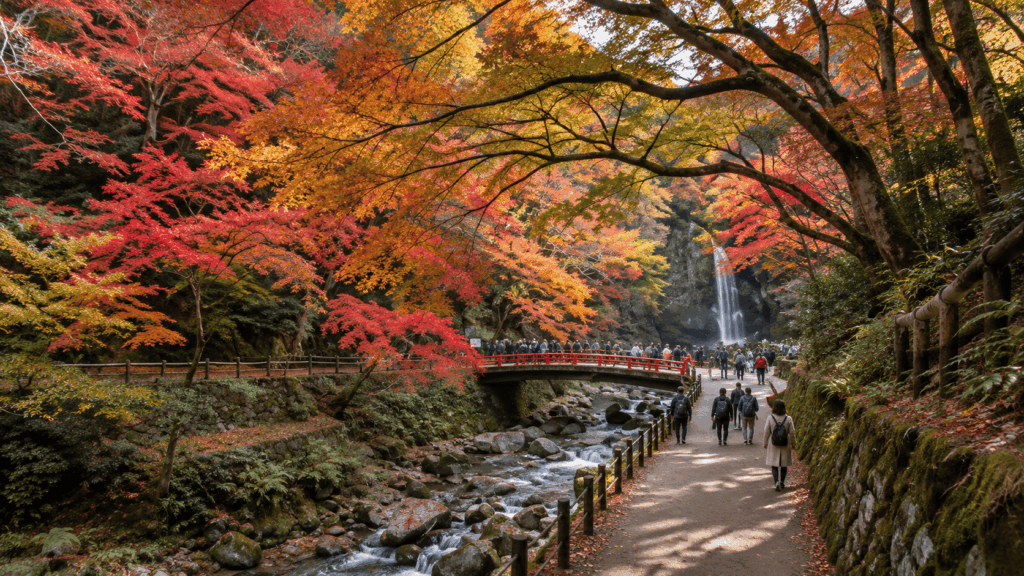
The walk is not just transport to the waterfall. The lower section passes Ichinohashi Bridge and a row of shops, then the Minoh Park Insect Museum, which makes a useful pause and a change of scene. Further up, Ryuanji Temple sits beside the path, and beyond it the buildings thin out and the valley becomes mostly trees and river.
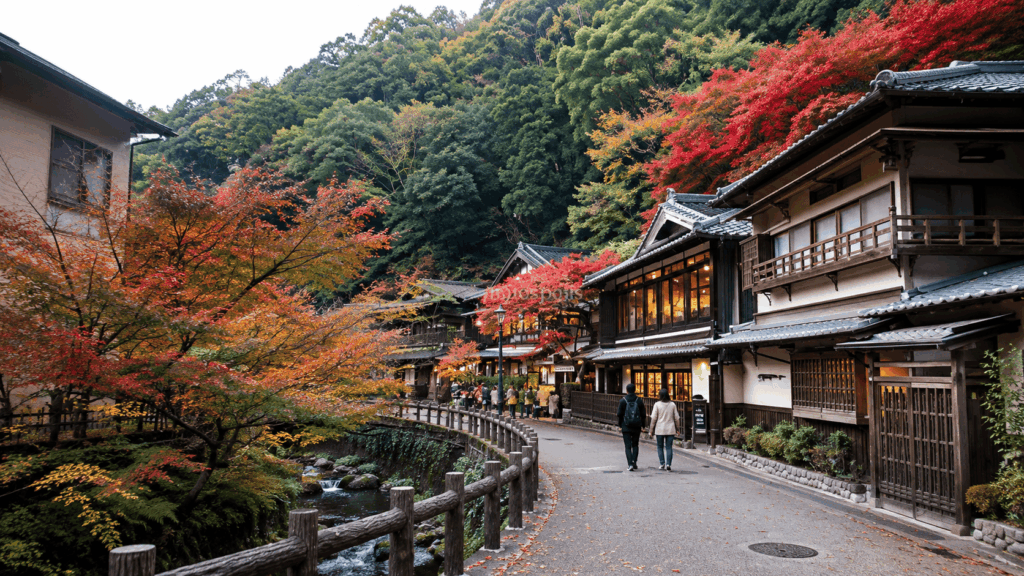
Shugyokoba Rest Area is the main rest stop on the climb, and a sensible place to pause if you are pacing yourself. From there, the path continues upstream through denser forest towards the falls.
Momiji Tempura — and Where to Eat It
Momiji tempura is the local snack you will see everywhere along the trail: real maple leaves dipped in a batter of wheat flour, white sesame and sugar, then fried in rapeseed oil. The result is crisp, lightly sweet, and unlike most fried food you will eat in Japan.
My own note on texture: it is firmer than the word “tempura” suggests, closer to a crisp biscuit than to the light, fluffy version served with noodles. I enjoyed it as a sweet snack rather than as a meal.
Shops sell it year-round, but many close irregularly and stock runs out during the autumn leaf season. If you want to try it, buy near the station or on the lower trail rather than assuming you will find it at the falls. Cobeni, about 3 minutes from Minoh Station, is one convenient option among several.
One practical rule: eat it where you buy it, or keep it sealed in your bag. The upper valley is monkey country.
What to Expect When You Reach Minoh Falls
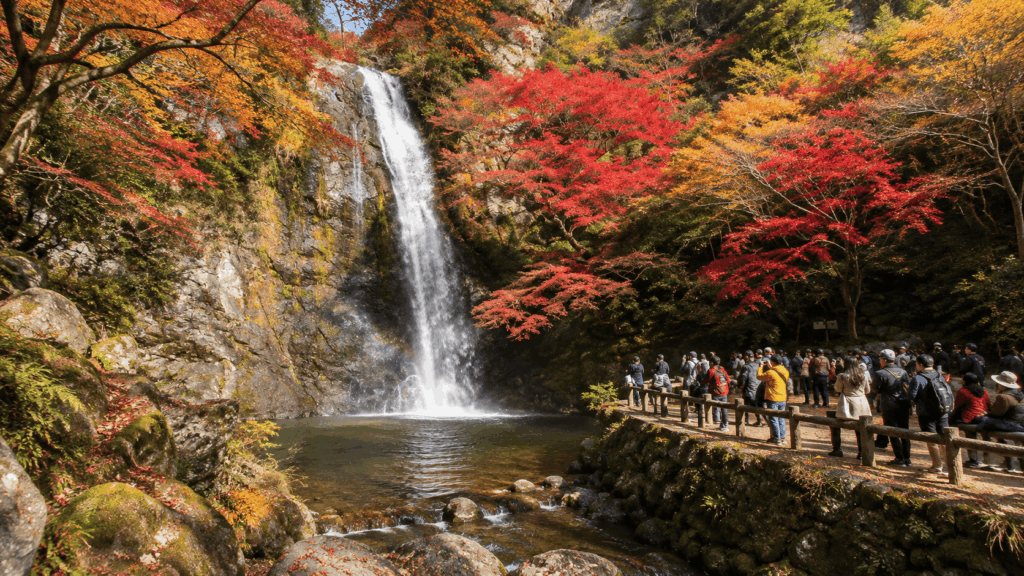
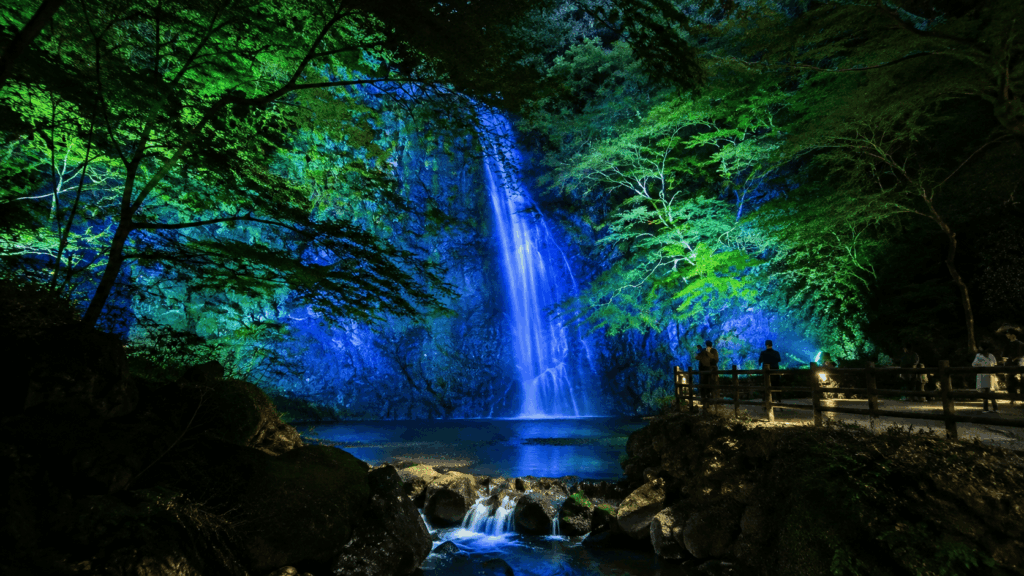
The waterfall drops 33 metres and is listed among Japan’s top 100 waterfalls. What surprised me on arrival was the space in front of it: the viewing area is open and flat, which makes a welcome change after the climb and gives you room to sit down rather than perch.
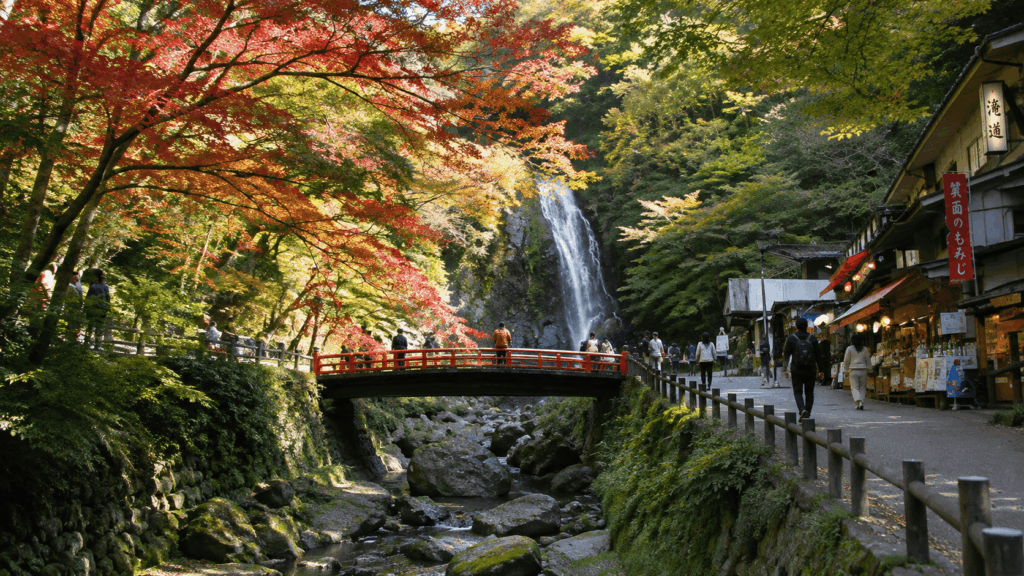
That openness also means it fills up. Weekends and the autumn season bring a steady stream of photographers, and the area around the best angles gets congested. If quiet matters to you, an early start is worth more than any other planning decision.
The trail near the falls is fully open again after the November 2025 fire at a shop in front of the waterfall, which closed this section until 7 August 2026. A temporary barrier now narrows the path close to the falls, and the second floor of the rest house remains closed because of fire damage. Further work on the slope behind the fire site is expected, so check the park’s latest notice before you travel.
Food and Facilities Around the Falls
Food options near the falls are limited and changeable. Some shops and restaurants operate in the area, but the fire disrupted the usual lineup, and I would not plan your day around a specific menu. Eat a proper meal near the station or on the lower trail, and treat anything at the falls as a bonus.
On an earlier visit, I ate cold yuzu noodles and grilled ayu near the waterfall and enjoyed both. That was some time ago, though, and I would not assume the same shops or dishes are available now. Carry a little cash as a backup, since payment methods vary from shop to shop.
Best Time to Hike Minoh Falls and What to Bring
Spring brings fresh green and comfortable temperatures. Summer is hot and humid, and the climb feels considerably harder in the afternoon heat. Autumn is the famous season, with colour typically peaking around mid-November to early December, and the falls area usually at its best from late November.
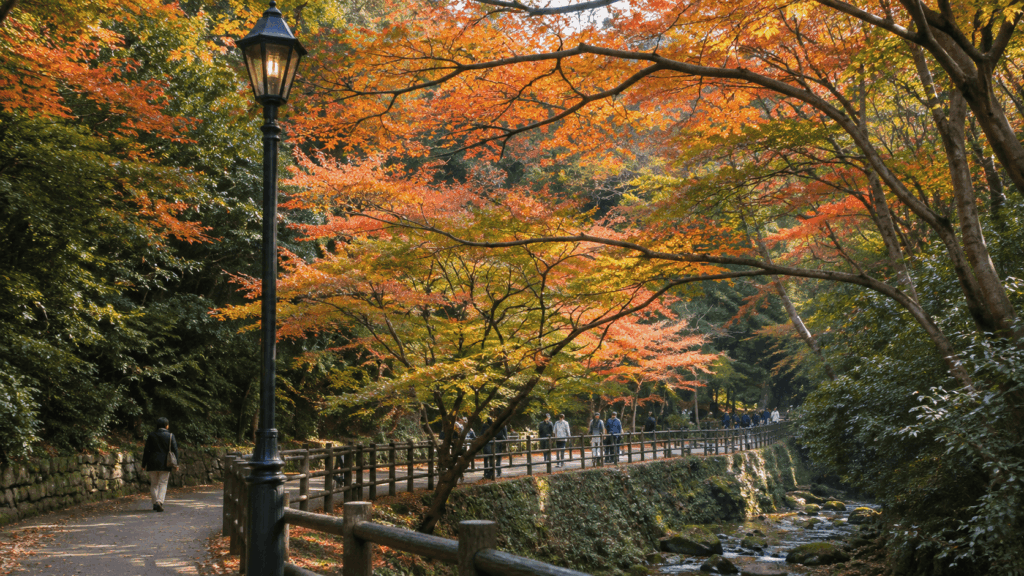
Autumn is also the busiest. In 2026, the Minoh Driveway has a one-way uphill restriction on weekends and holidays from 14 November to 6 December, between 9:00 and 18:00, and Katsuoji Temple requires parking reservations on those days. The dates change from year to year, so confirm them if you are travelling in late November.
Rain is not a reason to cancel, but it changes the walk. The paved surface is slick in places, the valley is dimmer, and the steep section needs more care. If you are visiting specifically for the leaves, it is worth checking the autumn colour report before committing a day.
What to Wear and Carry
For the standard Takimichi Trail, comfortable sneakers are enough. Hiking boots are unnecessary, and most visitors will be fine in what they already wear for a day of sightseeing. What matters more is what you carry:
- Water, especially from June to September
- A light rain shell or umbrella
- A small amount of cash
- A layer for the shade and the walk back
- A bag that closes properly, for reasons covered below
I walked this trail in ordinary sneakers and never wished for boots. I did wish I had a few coins and a ¥1,000 note on hand, which is a small thing that makes the snack stops easier.
Are There Monkeys on the Trail?
Minoh is home to wild Japanese macaques, and the area is a designated natural monument. They do occasionally appear along the trail and near the falls, but sightings are not guaranteed, and no guide or blog should promise you one.
The city’s rules are short and worth following exactly: do not show food, do not feed the monkeys, and do not approach them. Feeding is banned by local ordinance. A monkey that sees a plastic bag or a snack box may treat it as an invitation, and that is when problems start.
Kai’s tip: The simplest habit that prevents trouble is to keep snacks and momiji tempura inside a closed bag while you are in the upper valley, and to eat them at the shop or at the falls rather than while walking. When I have guided groups here, the issue was never aggressive monkeys; it was people carrying open food without thinking. If a monkey does approach, stop, keep your bag closed, and give it space rather than trying to photograph it up close.
FAQ
How hard is the Minoh Falls hike?
Technically it is easy. The Takimichi Trail is paved, has no steps, and needs no hiking experience. The effort comes from the climb: about 2.7 km of mostly continuous uphill from Hankyu Minoh Station, with one steeper section. Fit walkers usually find it comfortable; people who rarely walk may find the second half tiring.
How long does it take to walk to Minoh Falls?
Allow about 40–50 minutes uphill at a steady pace, and 80–100 minutes of walking for the round trip. With photo stops, a break at Shugyokoba Rest Area and time at the falls, most visitors spend 2–3 hours from Minoh Station back to Minoh Station. Families with young children should plan closer to 3 hours.
Do you need hiking boots for Minoh Falls?
No. Ordinary walking shoes or sneakers are fine on the main trail. The surface is paved and step-free, so boots add weight rather than safety. The exceptions are wet weather, when the paving can be slick, and the one steep section, where grip and care matter more than ankle support.
Can you take a taxi directly to Minoh Falls?
Not to the waterfall itself. General vehicles are not allowed inside the park, and cars cannot enter from the upper road either. A taxi can take you to the Times Otaki-ue Parking Lot area in about 10–15 minutes, but from there it is roughly 15 minutes of steep downhill walking to the falls, and a climb back up if you return the same way.
Is the Minoh Falls hike suitable for older visitors?
It depends on walking ability and knee stability, not age. Someone who walks regularly will usually manage it; someone who struggles on slopes may not enjoy it. The taxi option removes the long climb but leaves a sharp descent, so it is a partial solution. For significant mobility limitations, the park office lends one electric-assist wheelchair with an assistant, and the upper route is not suitable for it.
Is the Minoh Falls Hike Worth It?
Yes, for the right traveller, and the right traveller is easier to define than the internet usually admits. This is a genuinely easy trail with a real physical cost. If you have a free half-day in Osaka, enjoy walking, and want forest and water without leaving the city’s rail network, it is one of the best-value outings available. If your priority is covering Osaka’s major sights in two days, the round trip will eat time you will resent spending on a paved path.
For first-time visitors: Take Option 1 and start before mid-morning. Walk up, stop at Ryuanji Temple on the way, spend 20–30 minutes at the falls, and walk back down. That is the version most people picture when they plan this trip, and it delivers.
For families with young children: The main trail is stroller-friendly in principle, but the steep section and the crowds near the falls are the limiting factors. Plan three hours or more, bring snacks, and do not add Katsuoji Temple on the same half-day unless you are on a guided tour with transport arranged.
For travellers on a tight schedule: Skip it, or accept that Minoh is your one outdoor stop. The falls are free, but the round trip still costs you most of a half-day once you include trains, walking and a break.
For those travelling with older companions: Decide based on knees, not enthusiasm. Option 2 works if the descent is manageable, but the climb back to the road is not trivial. A shorter walk from the station to Ryuanji Temple and back is a legitimate compromise: you still get the valley, the shops and the temple without committing to the full 5.4 km.
For repeat visitors: Come in the autumn, arrive early, and combine the falls with Katsuoji Temple now that you have already seen the main route. The one-way traffic restrictions and crowds are the price of the best season.
If you want Katsuoji Temple in the same trip, the guided tour handles the transport and timing that make that combination awkward on your own. If the waterfall is the whole point, the walk from Hankyu Minoh Station is enough, and it costs little more than the train fare.
If Minoh is one of several day trips you are weighing from Osaka, compare the walking time and travel time of each before you commit a half-day. This one rewards people who like to walk and frustrates people who do not.

Hi, I’m Kai. I’m a Tokyo-based travel writer, tourism industry insider, and the author of a published guidebook for international visitors to Japan. With over 10 years of professional experience at a leading Japanese tourism company, my mission is to help you skip the tourist traps and navigate Japan’s best destinations like a local. I believe the perfect day trip is like a traditional kaiseki meal: a beautiful balance of precise planning and unforgettable seasonal discovery. When I’m not out conducting field research, you’ll usually find me drafting new itineraries with one of my favorite fountain pens!