
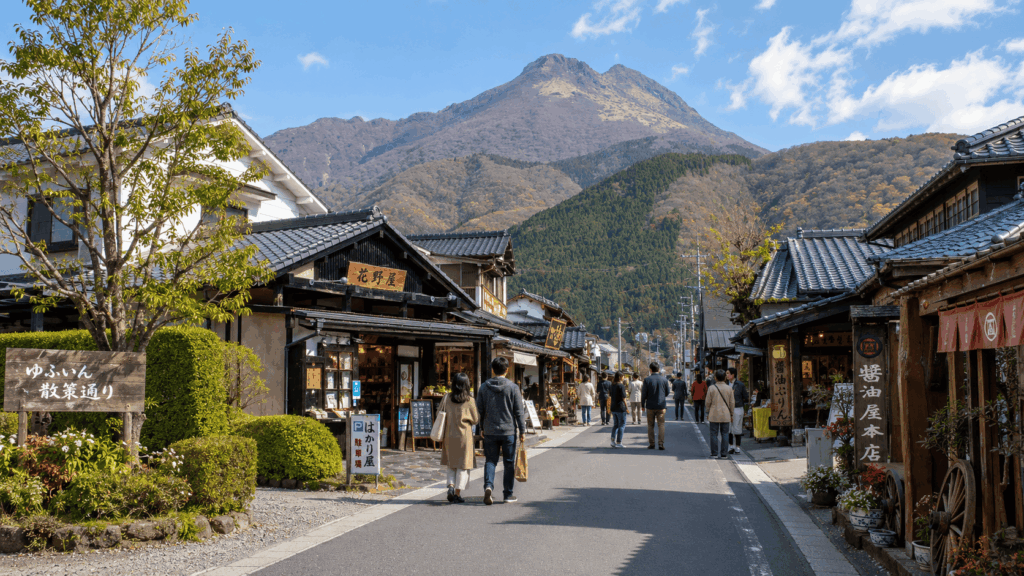
Yunotsubo Kaido — the main shopping street running from Yufuin Station toward Lake Kinrin — is packed with food stalls, each one promising something worth stopping for. But with a few hours at most and queues forming by mid-morning, you need a plan. Here’s exactly what to eat, in the right order, and what you can skip without regret.
Prefer not to plan every stop yourself? If you want Yunotsubo Kaido, Lake Kinrin, and a few local food picks explained in English as you walk, check live start times and inclusions for this Yufuin highlights walk before you lock in your day.
Yufuin Street Food at a Glance: The 5 Must-Eats
If you only have a half-day in Yufuin, these five items give you the best return on your time and appetite. I’ve ranked them by priority — what to grab first, what’s worth a queue, and what you can pick up whenever.
| Priority | Item | Shop | Price (approx.) | Queue Risk | Best Time to Buy |
|---|---|---|---|---|---|
| 1 | Gold-Award Croquette | Yufuin Kinsho Croquette | ¥200–300 | High (moves fast) | Mid-morning or try 2nd shop |
| 2 | Molten Cheesecake (hot + cold) | Milch | ~¥200 each | High (20–30 min wait) | Mid-morning on weekdays |
| 3 | P-Roll (roll cake) | B-speak | ~¥540/slice | Low (but sells out early) | Before noon — gone by 14:00 |
| 4 | Bungo Beef Mabushi rice bowl | Yufumabushi Shin (Ekimae) | ¥2,000–4,500 | High at lunch | Arrive by 10:45 or go to Kinrinko branch |
| 5 | Matcha gelato or Purindora | Telato / Hanakoji Kikuya | ¥173–600 | Low | Anytime — these don’t sell out |
The mistake I see most first-time visitors make? They start with whatever stall is closest to the station. That means they queue for a croquette while B-speak sells out 800 metres away. There’s a smarter order — and I’ll walk you through it step by step.
Yunotsubo Kaido: The Walking Route in 3 Minutes
Yunotsubo Kaido (湯の坪街道) is the spine of Yufuin’s food scene — an 800-metre to 1.2-kilometre shopping street running southeast from Yufuin Station toward Lake Kinrin. Most food stalls sit along this single stretch, which means you can cover the entire eating route without backtracking.
- Station to Yunotsubo Kaido entrance: about 5 minutes on foot
- Yunotsubo Kaido itself: roughly 1 km of continuous shops and stalls
- Yunotsubo Kaido end to Lake Kinrin: another 5–10 minutes
- Total walking time (non-stop): about 25–30 minutes
- With eating stops: budget 2–3 hours
Most stalls open between 9:30 and 10:00, and the street starts winding down around 16:30. By 17:00, many shops have closed their shutters. If you’re arriving on the Yufuin no Mori limited express from Hakata (which pulls in around noon), you lose the quiet morning window — but you can still hit everything if you move in the right sequence.
What surprises travelers who expect a theme-park food street? The pace here is genuinely relaxed. Even with queues, the atmosphere is unhurried, and shop owners will wait for you to finish eating before handing the next customer their order. That’s not inefficiency — it’s the local rhythm. Plan for it rather than fighting it.
The Gold-Award Croquette Everyone Lines Up For
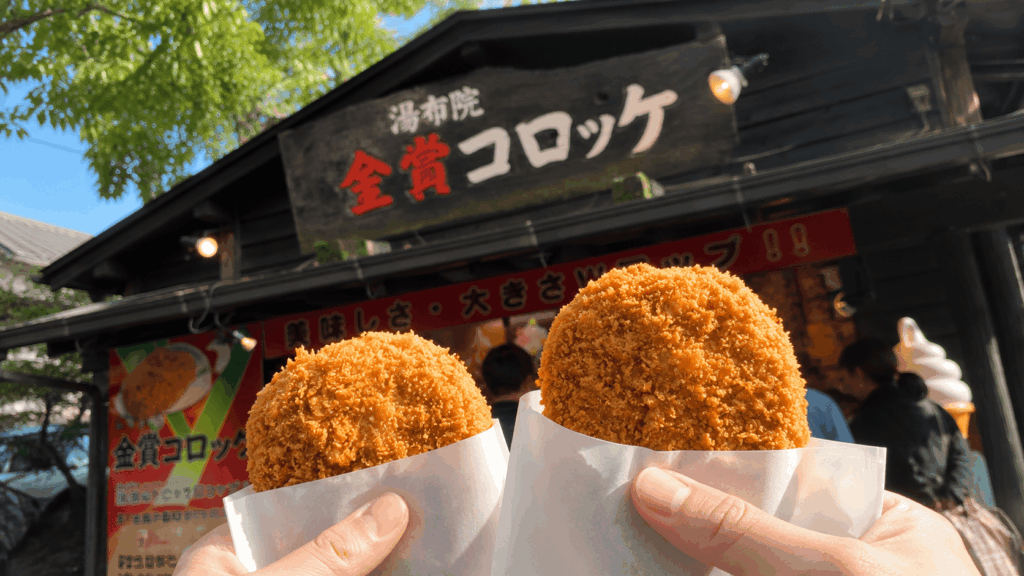
Yufuin Kinsho Croquette (金賞コロッケ) is the single most famous street snack in town — and for good reason. These are not the flimsy frozen croquettes you find at convenience stores. The potato filling is creamy and seasoned with minced Bungo beef, then breaded and fried fresh to order. The name “Kinsho” means “gold award” — the shop won first prize in an NHK-affiliated croquette competition, and the recognition has never faded.
- Price: around ¥200–300 per piece
- Main shop (Honten): directly on Yunotsubo Kaido, easy to spot by the queue
- Second shop (2-gouten): on a side street off the main strip, about a 3-minute detour
- Hours: 9:00–18:00 daily
Kai’s tip: If the main shop has a long line — and it often does by 11:00 — walk to the second shop instead. It’s less known among day-trippers and the queue is usually shorter or non-existent. The croquettes are identical, and you’ll get yours fresh from the fryer. On a cold morning, that first bite of a piping-hot, just-fried croquette is genuinely one of the best food moments in Yufuin. Don’t let the queue at the first shop discourage you — there’s always a faster option a few steps away.
Milch: Hot or Cold Cheesecake (Get Both)
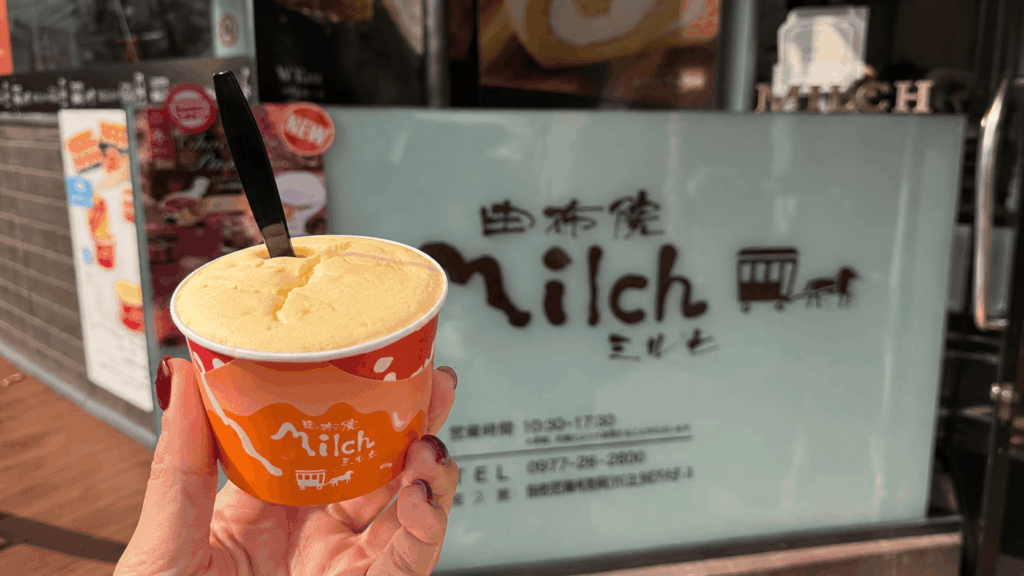
Milch (ミルヒ) is a small German-style patisserie on Yunotsubo Kaido, and its specialty is miniature baked cheesecakes served two ways. The hot version comes straight from the oven — the exterior is firm while the centre remains molten and rich. The cold version is the same cheesecake chilled, giving it a denser, creamier texture closer to a traditional New York-style cheesecake. Most visitors buy one of each, and that is the correct strategy.
- Price: approximately ¥200 per cup
- Hours: 9:30–17:30 (may vary seasonally)
- Queue: expect 15–30 minutes during peak hours (11:00–14:00)
- Payment: cash only
The shop also sells a milk pudding in a glass jar — smooth, lightly caramelised, and less sweet than the cheesecake. It’s a good alternative if the queue looks too long, though the cheesecake is the reason most people come.
A note on timing: the hot cheesecake is made in small batches, so even if the line moves, there can be a pause while the next tray bakes. If you’re short on time, buy one cold version first — it’s ready to go — and wait for the hot if you have another 5 minutes. The texture difference is noticeable enough that it’s worth the extra wait.
B-speak: The Roll Cake That Sells Out by Afternoon
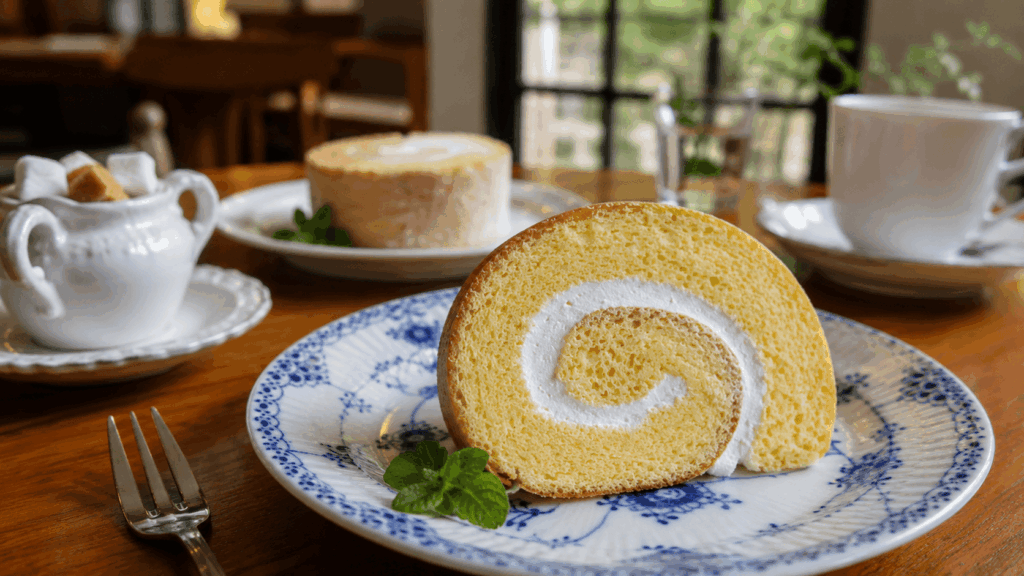
B-speak is a dedicated roll cake shop located a short walk from the main Yunotsubo Kaido strip (closer to the station end). Their signature product is the P-Roll — a light Swiss roll filled with fresh cream that is noticeably less sweet than standard Japanese convenience-store rolls. The cream has a clean dairy flavour, and the sponge is airy enough that a single slice doesn’t feel heavy.
- Price: approximately ¥540 per slice; whole rolls also available
- Hours: 10:00–17:00
- Sell-out risk: high — single slices often gone by 13:00–14:00
- Location: just off Yunotsubo Kaido, near the station side
This is the item that requires the most strategic timing. B-speak opens at 10:00, and the sliced portions (P-Roll cut) sell out before the whole rolls. If you arrive after noon on a weekend, don’t count on getting a slice. The whole roll costs more but lasts longer — and it keeps well for a few hours if you’re not eating it immediately.
When You Need a Seat: Yufu Mabushi (Bungo Beef Rice Bowl)
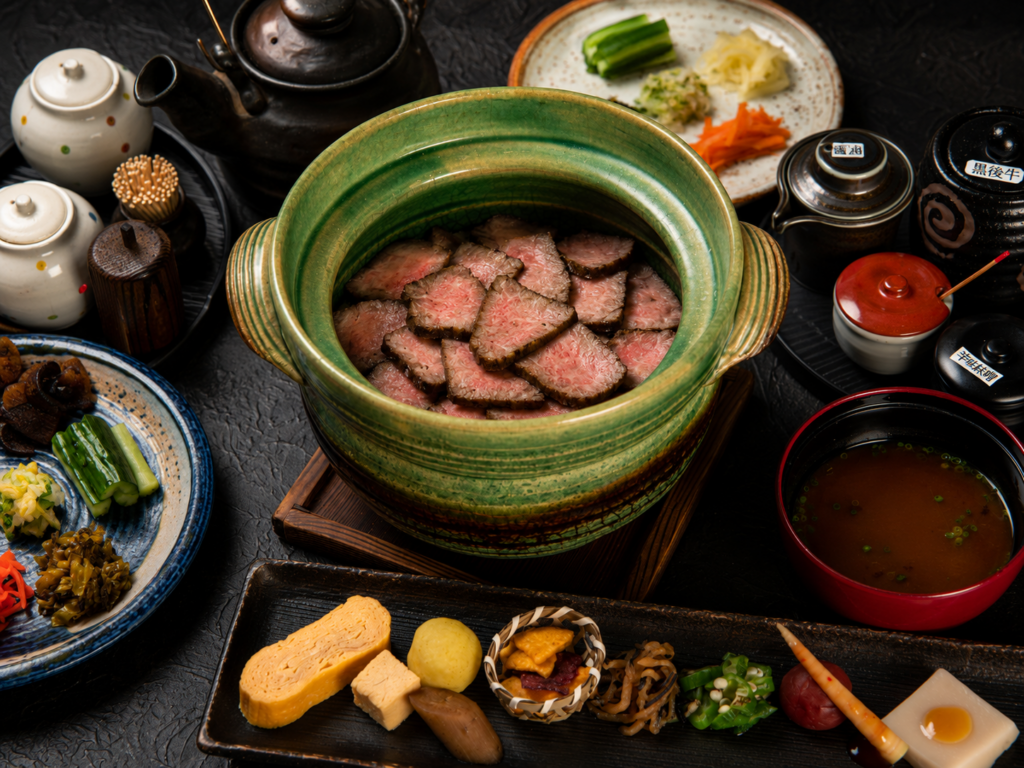
Not everything in Yufuin is eaten standing up. For travellers who want to sit down, rest their legs, and eat a proper meal, the signature is Yufu Mabushi — a Bungo beef rice bowl inspired by Nagoya-style hitsumabushi but made with local ingredients.
The dish is served in a wooden tub: sliced Bungo beef (a regional wagyu variety) grilled over charcoal and layered over rice. You eat it in stages — first as-is, then with condiments (wasabi, spring onion, pickles), and finally as a tea-rice broth (ochazuke) using the dashi poured tableside. The progression turns a single bowl into three distinct experiences.
Yufumabushi Shin is the restaurant that popularised this dish in Yufuin. It has two locations:
| Ekimae (Station) Branch | Kinrinko (Lake) Main Branch | |
|---|---|---|
| Address | 3-minute walk from Yufuin Station | Near Lake Kinrin, end of Yunotsubo Kaido |
| Hours | 11:00 until ingredients run out (often ~14:30) | 10:30–18:30 (L.O. 17:30) |
| Price range | ¥2,000–4,500 | ¥2,000–4,500 |
| Best for | Lunch before walking the street | Late lunch or early dinner |
| Queue | Notable — arrive before 11:15 or go after 13:30 | Shorter, but builds up around noon |
The station branch is convenient if you arrive early — grab a numbered ticket, eat first, then walk the food street with a full stomach and a lighter food agenda. The lake branch works better if you want to eat at the end of your walk with a view of the lake across the street.
What catches some travellers out is the closing time. The station branch closes when the beef runs out, not at a fixed hour. On busy days, that can be as early as 13:30. If you’re aiming for this branch, arrive before 11:00 for the best chance of getting in without a 40-minute wait.
Sweet Finishes and Extra Bites
After the croquettes, cheesecake, and beef, there’s always room for one more snack — especially something cold or sweet to balance the savoury run. These are the reliable options that don’t sell out and don’t require strategy:
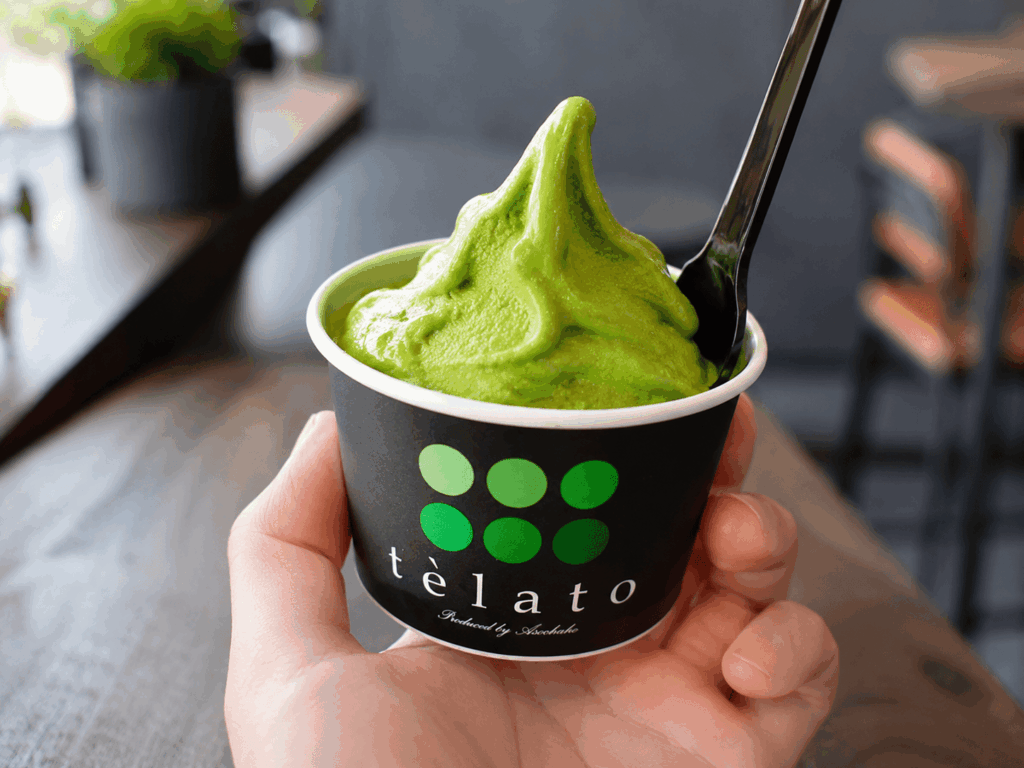
Telato — Matcha Gelato with a Twist
Telato is a small gelato shop specialising in matcha (green tea). The standout feature is the intensity scale: you choose from six levels of matcha strength, from mild creamy sweetness (Level 1) to a bold, almost bitter concentration that tastes like a shot of ceremonial-grade tea (Level 5). Other flavours include hojicha (roasted tea) and black tea. Prices start at around ¥600 per cup. It’s located mid-street on Yunotsubo Kaido, easy to spot by the green awning.
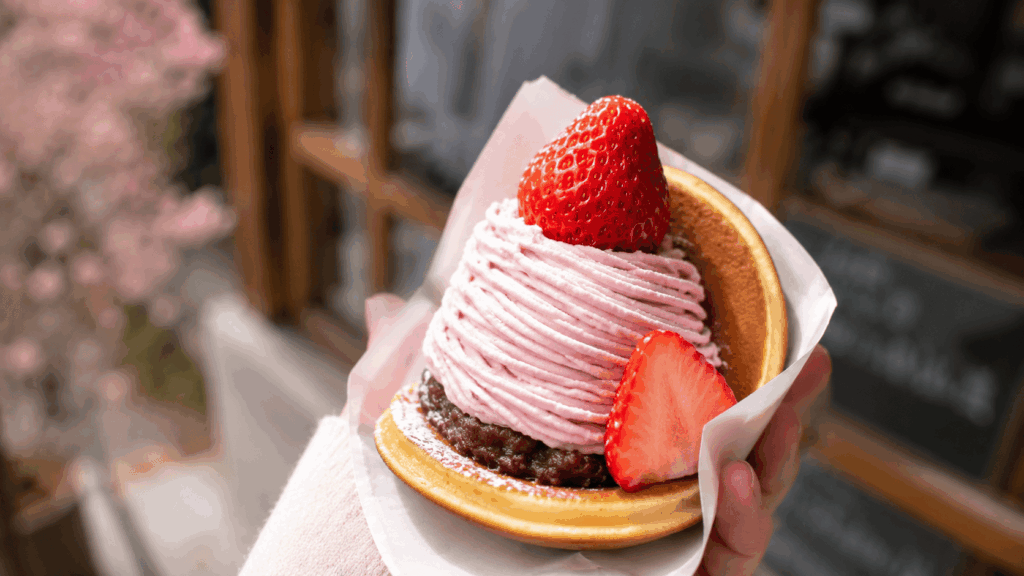
Hanakoji Kikuya — Purindora (Pudding Dorayaki)
Hanakoji Kikuya (花小路 きくや) sells a clever hybrid: a soft dorayaki pancake sandwich filled with caramel custard pudding. Called Purindora, it costs around ¥173 and is best eaten fresh — the pancake stays soft, the pudding is firm but creamy, and the sweetness level is noticeably lower than standard dorayaki. The shop is on a side lane branching off Yunotsubo Kaido, not directly on the main strip, so many walkers miss it.
Other Quick Bites You’ll Pass
- Grilled crab leg (¥500–600) — a popular skewer sold at several stands. Good for seafood lovers, but portion-to-price ratio is poor compared to the croquette
- Sweet potato chips — thin fried chips dusted with sugar or salt. Available at multiple stalls. Inoffensive but not special
- Yufuin Pudding — a classic custard pudding in a glass jar. Creamy and satisfying, sold at several souvenir-style shops
The Smart Eating Strategy: What Order to Walk and Buy
Here’s where most first-time visitors lose time. They wander, join the nearest queue, eat, walk further, discover a different stall with a longer queue, and run out of appetite (or daylight) before reaching the best items. The solution is a fixed order that accounts for sell-out times and queue lengths.
The optimal sequence:
- B-speak first (10:00 → station side) — Walk from the station toward Yunotsubo Kaido. B-speak is on this approach. Buy your P-Roll slice before it sells out. It keeps well for 2–3 hours if you don’t open the packaging.
- Kinsho Croquette second (mid-street) — Walk into Yunotsubo Kaido. If the main shop has a line, check the second shop (2-gouten). Eat the croquette warm — this is the snack that loses its magic when cold.
- Milch third (further down the street) — Continue walking. The queue at Milch moves steadily, and you’re now in the middle of the street with other items nearby. Buy one hot and one cold cheesecake.
- Telato or Kikuya anytime (flexible) — These are your fillers. If you need a break from savoury food, grab a gelato or purindora. No queue strategy needed.
- Yufu Mabushi for seated lunch (end or start) — Either eat at the station branch before you start walking, or at the Kinrinko branch after you reach the lake. Don’t try to do both a full street food crawl and a heavy rice bowl — you’ll be too full to enjoy either.
Kai’s tip: The order above isn’t random — it’s designed around the three kinds of risk. B-speak sells out (time risk). Kinsho and Milch have queues (patience risk). Everything else is always available (no risk). If you reverse the order and start with the no-risk items, you’ll hit the lunch-time crowds at the popular shops without having secured the roll cake first. One friend I walked through this route missed B-speak by 25 minutes and was visibly disappointed — don’t let that be you. Hit the limited-quantity item before you do anything else.
If the route above sounds useful but you would rather not manage every stop, queue, and side lane yourself, this short guided walk is the booking that fits this article best: it starts at JR Yufuin Station, covers Yunotsubo Street, continues to Lake Kinrin, and uses quieter lanes on the way back.
Why I’d book this one
- It keeps the food street in context — not just snacks, but Mount Yufu, Lake Kinrin, and how the town fits together.
- The small-group format should feel more like a guided walk than a large bus-tour stop.
- Food costs are separate, which works well here: you can still choose the croquette, Milch, B-speak, or skip items based on your appetite.
See live availability, start times, and what is included for the Yufuin highlights walk before finalising your food crawl.
Street Food Etiquette in Yufuin: What Travelers Often Get Wrong
Japan’s relationship with “tabe-aruki” (eating while walking) is more nuanced than blanket rules suggest. In Yufuin, the unspoken etiquette is simple: don’t eat while actively walking. Stand still near the shop where you bought the food, finish your bite, then move on. Most shops have a small area or a bench nearby for this purpose.
Kai’s tip: The mistake I see travellers make most often is taking their food and immediately walking away, eating as they go. In a busy shopping street, this creates a safety issue — people bump into you, food falls, and shopkeepers have to clean up. The convention here is to stand for a minute, eat quickly, dispose of your packaging in the shop’s bin (or a nearby public bin), and then continue. Nobody will scold you — but standing still while eating is the observant traveller’s choice, and it makes the whole street flow more comfortably for everyone.
Other practical points:
- No public trash bins are abundant. Many shops provide a small bin near their entrance for their own packaging. Use it. Don’t expect to find municipal bins on every corner — Yufuin has very few.
- Liquid drinks are fine while walking — bottled tea and coffee don’t raise the same eyebrows as food on a stick.
- Queuing culture — lines form in single file, and cutting in is rare. Even if the queue looks casual (a few people standing around the counter), ask “Is this the line?” before joining.
- Photography of food is welcome — shop owners are used to travellers taking photos before eating. Just don’t hold up the line doing it.
What to Skip: An Honest Verdict on What’s Overrated
Not everything on Yunotsubo Kaido deserves space in your stomach. Here’s my honest read on what you can skip without FOMO:
- Grilled crab leg (¥500–600 for a single skewer): The crab is pre-cooked and reheated on a grill. The meat-to-price ratio is poor — you get a lot of shell for your money, and the crab itself is ordinary. If you’re from a coastal region with good seafood, you will be disappointed. Easy skip unless you really want a photo of a crab claw in your hand.
- Sweet potato chips from random stalls: Not badly made, but they’re the same product sold at every sightseeing street in Japan. No shop on Yunotsubo Kaido does a version worth a detour. If you want them, grab a bag — don’t queue for them.
- Overpriced fruit on a stick (candied strawberries / grapes): These show up at several stalls. They look photogenic but cost ¥400–600 for what amounts to a few pieces of fruit dipped in sugar syrup. Save the sugar budget for Telato’s matcha gelato.
What I would not skip, even if you feel full? The croquette and Milch are genuinely worth eating. They are the two items that make Yufuin’s street food scene stand out from other onsen-town shopping streets in Kyushu. If you can only eat three things on the street, make them the croquette, Milch cheesecake, and B-speak P-Roll — in that strategic order.
Frequently Asked Questions About Yufuin Street Food
Is Yufuin street food expensive?
For a sightseeing town, the prices are reasonable. A croquette costs around ¥200–300, a Milch cheesecake about ¥200, and a B-speak roll cake slice around ¥540. The most expensive single item you’ll encounter is the Yufu Mabushi rice bowl at ¥2,000–4,500. Compared to Tokyo or Kyoto, you’ll spend less here per snack. The grilled crab leg and candied fruit skewers are the only items that feel overpriced for what you get.
Can you eat while walking in Yufuin?
The convention is to stand still near the shop where you bought the food rather than eating while walking. Most stalls have a small standing area or a bench nearby. Eating while actively walking is generally discouraged — not strictly forbidden, but observant travellers choose to stand or sit while eating. Drinks are fine to carry while walking.
What time should I start the food street?
The ideal start time is between 10:00 and 10:30. Most shops open by 10:00, the crowds haven’t arrived yet, and B-speak’s roll cake is still fully stocked. If you start after noon, you risk B-speak selling out and longer queues at Milch and the croquette shop. If you’re arriving by the Yufuin no Mori train from Hakata (which arrives around midday), go straight to B-speak before anything else.
Is there vegetarian or halal food on Yunotsubo Kaido?
Vegetarian options are limited but exist. Milch’s cheesecake is made with dairy but no meat. Telato’s matcha gelato is typically vegetarian. The croquettes and Yufu Mabushi contain beef. Halal-certified options are very rare in Yufuin. If you have strict dietary requirements, the seated restaurants are more likely to accommodate modifications than the street stalls. Plan to eat at a restaurant with a full menu rather than relying on the street food.
Do the food stalls take credit cards?
Most street food stalls on Yunotsubo Kaido are cash-only. B-speak and Yufumabushi Shin accept cards, but small stalls like Kinsho Croquette, Milch, and Telato are cash-only. Bring enough yen — there is an ATM at Yufuin Station, but you’ll want cash in hand before you start walking.
How long does it take to eat your way through Yunotsubo Kaido?
If you’re eating the five recommended items without rushing, budget 2 to 3 hours. This includes queue times at the popular shops, standing to eat, and strolling at a relaxed pace. If you eat a full Yufu Mabushi rice bowl as well, add another 40 minutes for queuing and seated eating. A quick version (grab the top three snacks) can be done in about 90 minutes.
Is B-speak really worth the hype?
Yes — but only if you’re comparing it against convenience-store roll cakes. B-speak’s cream is noticeably lighter and less sweet, and the sponge cake has a fine, even texture. It’s a genuinely well-made version of a simple product. That said, it’s still a rolled sponge cake with cream — don’t expect a life-changing pastry. The hype is deserved within its category, but the croquette and Milch cheesecake are more distinctive to Yufuin.
What’s the best rainy-day alternative for food?
The shops on Yunotsubo Kaido have awnings, so light rain doesn’t stop the food stalls from operating. In heavy rain, the covered areas near Yufuin Station have a few food options, but the street food experience is diminished. On a rainy day, prioritise Yufumabushi Shin (seated, dry, warm) and grab takeaway snacks from shops with covered fronts rather than trying to eat standing in the rain.
Final Verdict: Is Yufuin Street Food Worth It?
Yes — with clear expectations. Yufuin’s street food is not a mind-blowing culinary destination like Osaka’s Dotonbori or Fukuoka’s yatai stalls. It’s a quiet, well-executed collection of snack foods in a scenic onsen town, and that’s exactly what it should be. The value comes from the combination: fresh air, a relaxed walking street, and genuinely good snacks that don’t feel like mass-produced tourist fodder.
Choose Yufuin street food if:
- You want a low-pressure, walkable food crawl that fits into a half-day itinerary
- You enjoy simple, well-made snacks (croquettes, cheesecake, roll cake) rather than complex or adventurous dishes
- You’re looking for a scenic, family-friendly food experience between Fukuoka and Beppu
- You appreciate knowing the strategy — which items to queue for, which to skip, and what order to eat them in
Skip Yufuin street food (or downgrade expectations) if:
- You’re expecting street food variety comparable to Osaka, Taipei, or Bangkok — Yufuin has about 5–6 stand-out items and then a lot of filler
- You have strict dietary restrictions with no flexibility — vegetarian options are thin, and halal-certified food is nearly absent
- Your schedule is tight and you’re not interested in queues — the best items require waiting, and there’s no way around it
- You prefer savoury over sweet — the balance in Yufuin leans sweet (Milch, B-speak, Telato, purindora) with only two major savoury items (croquette, mabushi)
For first-time visitors: Do the full route in the recommended order. The croquette and Milch are non-negotiable. B-speak is worth the morning timing. Skip the crab leg and fruit skewers — they’re the items locals would tell you are for the photos, not the taste.
For day-trippers from Fukuoka: Arrive by 10:00 if possible. The Yufuin no Mori limited express arrives around midday, which works but forces you into a tighter window. Eat B-speak first, then the croquette, then Milch, and finish with mabushi at the lake branch or a sweet bite at Telato. You can cover the street in 2.5 hours including eating time, leaving the rest of your afternoon for other things to do around Lake Kinrin and the onsen.
For families with children: The street is stroller-friendly on weekdays but can feel crowded on weekends. The croquette and Milch are crowd-pleasers across ages. B-speak sells out too early for a relaxed family pace — consider buying it at opening while someone watches the kids, or letting it go and focusing on the no-risk items. The seated mabushi restaurant is a good mid-walk rest point.
For repeat visitors: You already know the drill. Skip the queue at the croquette main shop and go straight to the second shop. Try the Level 5 matcha gelato at Telato if you haven’t — it’s a different experience from the standard sweetness. And consider visiting in the late afternoon (after 15:00) when the day-trip crowds have thinned and the street feels like a local town again.
Yufuin’s food street won’t change your life — but if you eat in the right order and know what to skip, it will give you one of the most pleasant, unhurried food walks in Kyushu. And honestly, for a traveller spending a day in a hot-spring town, that’s exactly the right kind of meal.

Hi, I’m Kai. I’m a Tokyo-based travel writer, tourism industry insider, and the author of a published guidebook for international visitors to Japan. With over 10 years of professional experience at a leading Japanese tourism company, my mission is to help you skip the tourist traps and navigate Japan’s best destinations like a local. I believe the perfect day trip is like a traditional kaiseki meal: a beautiful balance of precise planning and unforgettable seasonal discovery. When I’m not out conducting field research, you’ll usually find me drafting new itineraries with one of my favorite fountain pens!